YAKUTAT, Alaska: Forget the open-air sleigh overloaded with gifts and powered by flying reindeer.
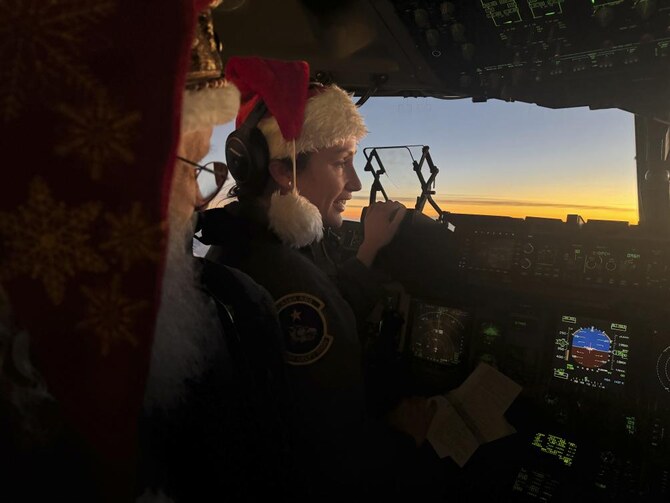
Santa and Mrs. Claus this week took supersized rides to southeast Alaska in a C-17 military cargo plane and a camouflaged Humvee, as they delivered toys to the Tlingit village of Yakutat, northwest of Juneau.
The visit was part of this year’s Operation Santa Claus, an outreach program of the Alaska National Guard to largely Indigenous communities in the nation’s largest state. Each year, the Guard picks a village that has suffered recent hardship — in Yakutat’s case, a massive snowfall that threatened to buckle buildings in 2022.
“This is one of the funnest things we get to do, and this is a proud moment for the National Guard,” Maj. Gen. Torrence Saxe, adjutant general of the Alaska National Guard, said Wednesday.
Saxe wore a Guard uniform and a Santa hat that stretched his unit’s dress regulations.
The Humvee caused a stir when it entered the school parking lot, and a buzz of “It’s Santa! It’s Santa!” pierced the cold air as dozens of elementary school children gathered outside.
In the school, Mrs. Claus read a Christmas story about the reindeer Dasher. The couple in red then sat for photos with nearly all of the 75 or so students and handed out new backpacks filled with gifts, books, snacks and school supplies donated by the Salvation Army. The school provided lunch, and a local restaurant provided the ice cream and toppings for a sundae bar.
Student Thomas Henry, 10, said while the contents of the backpack were “pretty good,” his favorite item was a plastic dinosaur.
Another, 9-year-old Mackenzie Ross, held her new plush seal toy as she walked around the school gym.
“I think it’s special that I have this opportunity to be here today because I’ve never experienced this before,” she said.
Yakutat, a Tlingit village of about 600 residents, is in the lowlands of the Gulf of Alaska, at the top of Alaska’s panhandle. Nearby is the Hubbard Glacier, a frequent stop for cruise ships.
Some of the National Guard members who visited Yakutat on Wednesday were also there in January 2022, when storms dumped about 6 feet (1.8 meters) of snow in a matter of days, damaging buildings.
Operation Santa started in 1956 when flooding severely curtailed subsistence hunting for residents of St. Mary’s, in western Alaska. Having to spend their money on food, they had little left for Christmas presents, so the military stepped in.
This year, visits were planned to two other communities hit by flooding. Santa’s visit to Circle, in northeastern Alaska, went off without a hitch. Severe weather prevented a visit to Crooked Creek, in the southwestern part of the state, but Christmas was saved when the gifts were delivered there Nov. 16.
“We tend to visit rural communities where it is very isolated,” said Jenni Ragland, service extension director with the Salvation Army Alaska Division. “A lot of kids haven’t traveled to big cities where we typically have Santa and big stores with Christmas gifts and Christmas trees, so we kind of bring the Christmas program on the road.”
After the C-17 Globemaster III landed in Yakutat, it quickly returned to Joint Base Elmendorf-Richardson in Anchorage, an hour away, because there was nowhere to park it at the village’s tiny airport. Later it returned to pick up the Christmas crew.
Santa and Mrs. Claus, along with their tuckered elves, were seen nodding off on the flight back.

Santa and Mrs. Claus use military transports to bring Christmas to an Alaska Native village
https://arab.news/m4bej
Santa and Mrs. Claus use military transports to bring Christmas to an Alaska Native village
- Operation Santa started in 1956 when flooding severely curtailed subsistence hunting for residents of St. Mary’s, in western Alaska
Egypt reveals restored colossal statues of pharaoh in Luxor
- Amenhotep III, one of the most prominent pharaohs, ruled during the 500 years of the New Kingdom, which was the most prosperous time for ancient Egypt
LUXOR: Egypt on Sunday revealed the revamp of two colossal statues of a prominent pharaoh in the southern city of Luxor, the latest in the government’s archeological events that aim at drawing more tourists to the country.
The giant alabaster statues, known as the Colossi of Memnon, were reassembled in a renovation project that lasted about two decades. They represent Amenhotep III, who ruled ancient Egypt about 3,400 years ago.
“Today we are celebrating, actually, the finishing and the erecting of these two colossal statues,” Mohamed Ismail, secretary-general of the Supreme Council of Antiquities, said ahead of the ceremony.
Ismail said the colossi are of great significance to Luxor, a city known for its ancient temples and other antiquities. They’re also an attempt to “revive how this funerary temple of King Amenhotep III looked like a long time ago,” Ismail said.
Amenhotep III, one of the most prominent pharaohs, ruled during the 500 years of the New Kingdom, which was the most prosperous time for ancient Egypt. The pharaoh, whose mummy is showcased at a Cairo museum, ruled between 1390–1353 BC, a peaceful period known for its prosperity and great construction, including his mortuary temple, where the Colossi of Memnon are located, and another temple, Soleb, in Nubia.
The colossi were toppled by a strong earthquake in about 1200 BC that also destroyed Amenhotep III’s funerary temple, said Ismail.
They were fragmented and partly quarried away, with their pedestals dispersed. Some of their blocks were reused in the Karnak temple, but archeologists brought them back to rebuild the colossi, according to the Antiquities Ministry.
In late 1990s, an Egyptian German mission, chaired by German Egyptologist Hourig Sourouzian, began working in the temple area, including the assembly and renovation of the colossi.
“This project has in mind … to save the last remains of a once-prestigious temple,” she said.
The statues show Amenhotep III seated with hands resting on his thighs, with their faces looking eastward toward the Nile and the rising sun. They wear the nemes headdress surmounted by the double crowns and the pleated royal kilt, which symbolizes the pharaoh’s rule.
Two other small statues on the pharaoh’s feet depict his wife, Tiye.
The colossi — 14.5 meters and 13.6 meters respectively — preside over the entrance of the king’s temple on the western bank of the Nile. The 35-hectare complex is believed to be the largest and richest temple in Egypt and is usually compared to the temple of Karnak, also in Luxor.
The colossi were hewn in Egyptian alabaster from the quarries of Hatnub, in Middle Egypt. They were fixed on large pedestals with inscriptions showing the name of the temple, as well as the quarry.
Unlike other monumental sculptures of ancient Egypt, the colossi were partly compiled with pieces sculpted separately, which were fixed into each statue’s main monolithic alabaster core, the ministry said.
Sunday’s unveiling in Luxor came just six weeks after the inauguration of the long-delayed Grand Egyptian Museum, the centerpiece of the government’s bid to boost the country’s tourism industry. The mega project is located near the famed Giza Pyramids and the Sphinx.
In recent years, the sector has started to recover after the coronavirus pandemic and amid Russia’s war on Ukraine — both countries are major sources of tourists visiting Egypt.
“This site is going to be a point of interest for years to come,” said Tourism and Antiquities Minister Sherif Fathy, who attended the unveiling ceremony. “There are always new things happening in Luxor.”
A record number of about 15.7 million tourists visited Egypt in 2024, contributing about 8 percent of the country’s GDP, according to official figures.
Fathy, the minister, has said about 18 million tourists are expected to visit the country this year, with authorities hoping for 30 million visitors annually by 2032.