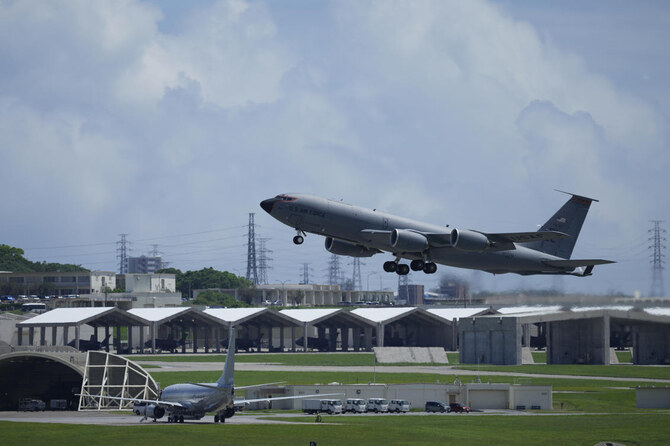
TOKYO: The partial transfer of US Marines from Okinawa to Guam began on Saturday, 12 years after Japan and the United States agreed on their realignment to reduce the heavy burden of American troop presence on the southern Japanese island, officials said.
The relocation started with 100 members of III Marine Expeditionary Force stationed on Okinawa moving to the Pacific island for the initial logistical work, the US Marine Corps and Japan’s Defense Ministry said in a joint statement.
Under the plan agreed between Tokyo and Washington in April 2012, about 9,000 of the 19,000 Marines currently stationed on Okinawa are to be moved out of Okinawa, including about 4,000 of them to be moved to Guam in phases. Details, including the size and timing of the next transfer, were not immediately released.
The Marine Corps is committed to the defense of Japan and meeting operational requirements to maintain a free and open Indo-Pacific, and it will maintain presence in the region “through a combination of stationing and rotating Marines in Japan, Guam and Hawaii,” the joint statement said.
Japan has paid up to $2.8 billion for the building of infrastructure at the US bases on Guam, and the US government will fund the remaining costs. The two governments will continue to cooperate on the development of Camp Blaz, which will serve as the main installation for Marines stationed in Guam.
The Marines and Japan Self Defense Forces will conduct joint training in Guam, the statement said.
Okinawa, which was under US postwar occupation until 1972, is still home to a majority of the more than 50,000 American troops based in Japan under a bilateral security pact, while 70 percent of US military facilities are on Okinawa, which accounts for only 0.6 percent of Japanese land.
Many Okinawans have long complained about the heavy US military presence on the island, and say Okinawa faces noise, pollution, aircraft accidents and crime related to American troops.
The relocation is likely to be welcomed by local residents, but how much improvement they will feel is uncertain because of the rapid Japanese military buildup on Okinawan islands as a deterrence to threats from China.
The start of the Marines relocation comes at a time of growing anti-US military sentiment following a series of sexual assault cases involving American servicemembers.
On Thursday, a senior Air Force servicemember belonging to the Kadena Air Base was convicted of the kidnapping and sexual assault of a teenage girl last year, a case that triggered outrage on the island. The Naha District Court sentenced him to five years in prison.

US Marines start partial transfer from Okinawa in Japan to Guam under plan agreed 12 years ago
Short Url
https://arab.news/m3zhw
US Marines start partial transfer from Okinawa in Japan to Guam under plan agreed 12 years ago
- Relocation started with 100 members of III Marine Expeditionary Force moving to the Pacific island
- Many Okinawans have long complained about the heavy US military presence on the island
Tourists empty out of Cuba as US fuel blockade bites
- Several nations have advised against travel to Cuba since the US tightened a decades-old embargo
- The island of 9.6 million inhabitants has faced hard times since the US trade embargo took hold in 1962
HAVANA: With rolling power cuts, hotel closures, and flight routes suspended for lack of fuel, tourists are gradually emptying out of Cuba, deepening a severe crisis on the cash-strapped island.
Several nations have advised against travel to Cuba since the US tightened a decades-old embargo by choking vital oil imports.
“I found only one taxi,” said French tourist Frederic Monnet, who cut short a trip to a picturesque valley in western Cuba to head back to Havana.
“There might be no taxis afterward,” he said.
A petroleum shortage has led to regular hours-long power cuts, long queues at petrol stations, and has forced many airlines to announce that they will cancel regular services.
About 30 hotels and resorts across the island are being temporarily closed due to low occupancy and fuel rationing, according to an internal Tourism Ministry document obtained by AFP.
Since January, a flotilla of US warships have stopped Venezuelan tankers from delivering oil to Cuban ports.
Washington has also threatened Mexico and other exporter with punitive tariffs if they continue deliveries.
Several Canadian and Russian airlines are sending empty flights to Cuba to retrieve thousands of otherwise stranded passengers, and others are introducing refueling stops in the route home.
American tourist Liam Burnell contacted his airline to make sure he could get a flight back.
“There was a danger that I might not be able to return, because the airport says it doesn’t have enough fuel for the planes,” he said.
‘Critical, critical’
An absence of tourists is more than an inconvenience for the Cuban government.
Tourism is traditionally Cuba’s second major source of foreign currency, behind revenue from doctors sent abroad.
The revenue is vital to pay for food, fuel, and other imports.
And the 300,000 Cubans who make a living off the tourist industry are already feeling the pinch.
A hop-on, hop-off bus touring Havana’s sites on Thursday was virtually empty.
Horses idled in the shade of colonial buildings, waiting for carriages to fill with visitors.
“The situation is critical, critical, critical,” said 34-year-old Juan Arteaga, who drives one of the island’s many classic 1950s cars so beloved by tourists.
“There are few cars (on the street) because there is little fuel left. Whoever had a reserve is keeping it,” he said.
“When my gasoline runs out, I go home. What else can I do?” he said.
The island of 9.6 million inhabitants has faced hard times since the US trade embargo took hold in 1962, and in recent years the severe economic crisis has also been marked by shortages of food and medicine.
On Thursday, two Mexican navy ships arrived in Cuba with more than 800 tons of much-needed humanitarian aid — fresh and powdered milk, meat, cookies, beans, rice and personal hygiene items, according to the Mexican foreign ministry.
Musician Victor Estevez said because tourism has been “a lifeline for all Cubans...if that is affected, then we are really going to be in trouble.”
“The well-being of my family depends on me.”
The tourism sector had already been severely hit by the Covid-19 pandemic, experiencing a 70 percent decline in revenue between 2019 and 2025.
Tourism expert Jose Luis Perello said the island now faces the prospect of “a disastrous year.”
Several nations have advised against travel to Cuba since the US tightened a decades-old embargo by choking vital oil imports.
“I found only one taxi,” said French tourist Frederic Monnet, who cut short a trip to a picturesque valley in western Cuba to head back to Havana.
“There might be no taxis afterward,” he said.
A petroleum shortage has led to regular hours-long power cuts, long queues at petrol stations, and has forced many airlines to announce that they will cancel regular services.
About 30 hotels and resorts across the island are being temporarily closed due to low occupancy and fuel rationing, according to an internal Tourism Ministry document obtained by AFP.
Since January, a flotilla of US warships have stopped Venezuelan tankers from delivering oil to Cuban ports.
Washington has also threatened Mexico and other exporter with punitive tariffs if they continue deliveries.
Several Canadian and Russian airlines are sending empty flights to Cuba to retrieve thousands of otherwise stranded passengers, and others are introducing refueling stops in the route home.
American tourist Liam Burnell contacted his airline to make sure he could get a flight back.
“There was a danger that I might not be able to return, because the airport says it doesn’t have enough fuel for the planes,” he said.
‘Critical, critical’
An absence of tourists is more than an inconvenience for the Cuban government.
Tourism is traditionally Cuba’s second major source of foreign currency, behind revenue from doctors sent abroad.
The revenue is vital to pay for food, fuel, and other imports.
And the 300,000 Cubans who make a living off the tourist industry are already feeling the pinch.
A hop-on, hop-off bus touring Havana’s sites on Thursday was virtually empty.
Horses idled in the shade of colonial buildings, waiting for carriages to fill with visitors.
“The situation is critical, critical, critical,” said 34-year-old Juan Arteaga, who drives one of the island’s many classic 1950s cars so beloved by tourists.
“There are few cars (on the street) because there is little fuel left. Whoever had a reserve is keeping it,” he said.
“When my gasoline runs out, I go home. What else can I do?” he said.
The island of 9.6 million inhabitants has faced hard times since the US trade embargo took hold in 1962, and in recent years the severe economic crisis has also been marked by shortages of food and medicine.
On Thursday, two Mexican navy ships arrived in Cuba with more than 800 tons of much-needed humanitarian aid — fresh and powdered milk, meat, cookies, beans, rice and personal hygiene items, according to the Mexican foreign ministry.
Musician Victor Estevez said because tourism has been “a lifeline for all Cubans...if that is affected, then we are really going to be in trouble.”
“The well-being of my family depends on me.”
The tourism sector had already been severely hit by the Covid-19 pandemic, experiencing a 70 percent decline in revenue between 2019 and 2025.
Tourism expert Jose Luis Perello said the island now faces the prospect of “a disastrous year.”
© 2026 SAUDI RESEARCH & PUBLISHING COMPANY, All Rights Reserved And subject to Terms of Use Agreement.