

Syria must not repeat ‘horrific scenarios’ of Libya, Iraq, Afghanistan: EU’s Kallas

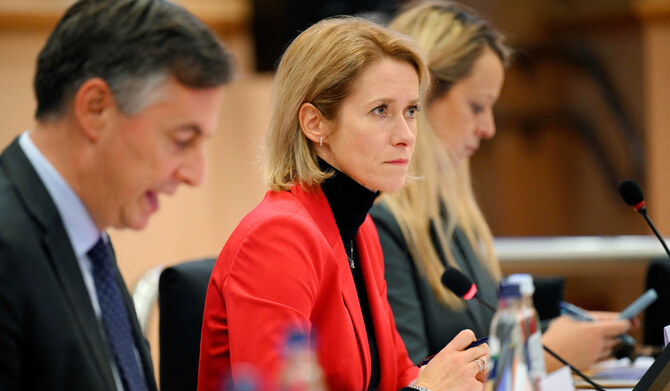
Kaja Kallas (C), High Representative of the European Union for Foreign Affairs and Security Policy, looks on during an extraordinary committee of foreign affairs on the situation in Syria following the fall of Syrian president, at the European Parliament in Brussels on December 10, 2024. (AFP)
Short Url
Updated 11 December 2024
Follow

Syria must not repeat ‘horrific scenarios’ of Libya, Iraq, Afghanistan: EU’s Kallas

  • Kallas threw her weight behind United Nations efforts to help steward an “orderly, peaceful and inclusive transition”

BRUSSELS, Belgium: EU foreign policy chief Kaja Kallas warned Tuesday of the risks of sectarian violence and an extremist resurgence in Syria, as she urged international powers to help a peaceful transition after Bashar Assad’s fall.
“We must avoid a repeat of the horrific scenarios in Iraq, Libya and Afghanistan,” Kallas told a hearing of EU lawmakers.
“It is our role as international partners to accompany the Syrian people in piecing together a shattered society.”
Kallas said there were questions over whether Islamist group Hayat Tahrir Al-Sham (HTS), which spearheaded the ouster of Syrian president Bashar Assad and once had root in Al-Qaeda, “had changed.”
The EU’s top diplomat said Assad’s ouster was a “huge blow” for his Russian and Iranian allies.
“They are weakened, distracted and overstretched in other theaters in the broader Middle East and in Ukraine,” she said.
Kallas threw her weight behind United Nations efforts to help steward an “orderly, peaceful and inclusive transition.”
She said that Western nations needed to work with regional players including the Gulf states, Turkiye, Lebanon, Iraq and Israel “to address shared challenges.”
Kallas said Syria needed an “inclusive rebuilding process” that involved minorities as well as women and girls.
The EU was monitoring humanitarian conditions to see if more aid was needed and would help efforts to hold Assad’s government responsible for its crimes, she said.


Somalia’s capital votes in first step toward restoring universal suffrage

Updated 1 sec ago
Follow

Somalia’s capital votes in first step toward restoring universal suffrage

MOGADISHU: Residents of Somalia’s capital Mogadishu will vote on Thursday ​in municipal elections meant to pave the way for the East African country’s first direct national polls in more than half a century.
With the exception of votes in the semi-autonomous region of Puntland and the breakaway region of Somaliland, Somalia last held direct elections in 1969, months before military general, Mohamed Siad Barre, took power in a coup.
After years of civil ‌war that ‌followed Barre’s fall in 1991, indirect elections ‌were ⁠introduced ​in ‌2004. The idea was to promote consensus among rival clans in the face of an Islamist insurgency, although some Somalis say politicians prefer indirect elections because they create opportunities for corruption.
Under the system, clan representatives elect lawmakers, who then choose the president. The president, in turn, has been responsible for appointing Mogadishu’s mayor.
The vote in Mogadishu, a ⁠city of some 3 million people where security conditions have improved in recent years ‌despite continuing attacks by Al-Qaeda-linked al ‍Shabab militants, is seen as ‍a test run for direct elections at the national level.
Around ‍1,605 candidates are running on Thursday for 390 posts in Mogadishu’s district councils, said Abdishakur Abib Hayir, a member of the National Electoral Commission. Council members will then choose a mayor.
“It shows Somalia is standing ​on its feet and moving forward,” Hayir told Reuters. “After the local election, elections can and will take place in ⁠the entire country.”
A 2024 law restored universal suffrage ahead of federal elections expected next year. However, President Hassan Sheikh Mohamud reached a deal in August with some opposition leaders stipulating that while lawmakers would be directly elected in 2026, the president would still be chosen by parliament.
Opposition parties have argued the rapid introduction of a new electoral system would benefit Mohamud’s re-election prospects.
They also question whether the country is safe enough for mass voting given Al-Shabab’s control over vast areas of the countryside and regular strikes ‌on major population centers.
