Germany arrests suspected Islamists over attack plot

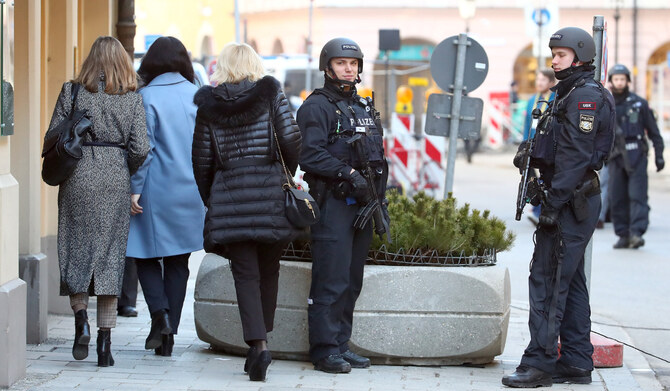
Police stand guard in Munich, Germany. (REUTERS file photo)
Short Url
Updated 11 December 2024
Follow

Germany arrests suspected Islamists over attack plot

  • The fall of President Bashar Assad has stoked fears that Daesh could be revived in Syria

BERLIN: Three suspected Islamist extremists have been arrested in Germany on suspicion of preparing a “serious act of violence,” with an assault rifle and knives also seized, authorities said Tuesday.
Police swooped Sunday on the homes of two German-Lebanese brothers aged 15 and 20 in the city of Mannheim, and a 22-year-old German-Turkish man from the Hochtaunus district of Hessen state.
German media reports said they were planning to attack Christmas markets in either Frankfurt or Mannheim.
Local prosecutors and police said in a statement that the act they were planning could have “endangered the state,” without disclosing further details.
Germany has faced a string of attacks and plots by suspected Islamists in recent years and has been on high alert since Hamas’s October 7, 2023, attack on Israel sparked the war in the Gaza Strip.
The brothers detained in Mannheim, who had a “strong religious ideology and profound sympathy” for the Daesh group, had made concrete preparations for an attack, authorities said.
The assault rifle, along with ammunition, was found during a search of the 22-year-old German-Turkish man’s home, they said. Several knives, a balaclava as well as mobile phones were also turned up during searches.
But officials stressed that “at no point was there any concrete danger to the public.” The suspects are in pre-trial detention.
Roman Poseck, Hessen state interior minister, praised law enforcement officials for making the arrests in “good time, before any acts could be carried out.”
“At the same time, it is once again clear that the security situation is tense,” Poseck added.
Germany has in recent times seen a series of allegedly Islamist-motivated knife attacks.
Three people were killed and eight wounded in a stabbing spree at a street festival in the western city of Solingen in August.
Police arrested a Syrian suspect over the attack that was claimed by IS.
In June, a policeman was killed in a knife attack in Mannheim, with an Afghan national held as the main suspect.
The fall of President Bashar Assad has stoked fears that IS could be revived in Syria.
But the international community has so far reacted cautiously to the prospect of the Islamist Hayat Tahrir Al-Sham (HTS), which led the rebel groups that ousted Assad, taking control in the country.


8 in 10 British Muslims face ‘financial faith penalty’ when seeking home finance, survey finds

Updated 5 sec ago
Follow

8 in 10 British Muslims face ‘financial faith penalty’ when seeking home finance, survey finds

  • Restricted choices plague potential buyers

LONDON: Eight in 10 British Muslims say their home finance choices are restricted because of their faith, according to a new national survey that highlighted what researchers describe as a growing “financial faith penalty” in the UK housing market.

The report, published by Islamic home finance fintech firm Offa, found that 80 percent of Muslim respondents believe their religious beliefs limit their access to suitable home finance, while those who do use Islamic products often face slower decisions, heavier paperwork and poorer customer experiences than in the conventional mortgage market.

Based on surveys of 1,000 British Muslims conducted by Muslim Census, and 2,000 non-Muslims carried out by OnePoll, the research calls on providers, brokers and policymakers to modernize Islamic home finance and improve access to Sharia-compliant products.

Among the 24.3 percent of British Muslims who have used Islamic home finance, just 5 percent said they had received a same-day decision.

Some 62 percent waited up to two weeks, while 33 percent waited more than 15 days, including 16 percent who waited over a month.

Long decision times were cited as the biggest challenge by 28 percent of respondents, followed by excessive paperwork (22.6 percent) and poor customer service (18.9 percent).

Islamic home finance differs from conventional mortgages by avoiding interest and steering investment away from sectors considered harmful to society, including gambling, alcohol, tobacco, arms trading and animal testing.

Sagheer Malik, chief commercial officer and managing director of home finance at Offa, said the findings showed British Muslims were being underserved by outdated systems.

Malik said: “Property is the asset class of choice for many of the UK’s 3.87 million Muslims, both as a route to generational wealth and as a long-term financial foundation, yet our insightful research report reveals that British Muslims are being underserved and deterred by slow, outdated and opaque Islamic home finance provision.

“This is not a niche concern. It goes to the heart of financial fairness and inclusion in modern Britain.”

He added that Muslims deserved Sharia-compliant products that matched mainstream standards on “price, speed and simplicity.”

Despite strong demand, uptake remains low.

Only 12.8 percent of British Muslims surveyed said they currently use Islamic home finance, with a further 11.5 percent having done so in the past. More than three quarters (75.7 percent) have never used it.

Faith plays a central role in financial decisions, with 94.2 percent saying it is important that their financial products align with their ethical or religious beliefs. Yet more than half of those using conventional mortgages said they felt unhappy or uneasy about doing so because of their faith.

The study also found that British Muslims share similar home ownership aspirations to the wider population, with 79.1 percent citing the desire to provide a stable home for their family, while 18.6 percent said building generational wealth was their main motivation. Only 2.2 percent said they did not want to own a home.

The report suggests Islamic finance could appeal beyond Muslim communities. While 64 percent of non-Muslim respondents had never heard of Islamic home finance, 63 percent said they favored its ethical principles once explained.

Younger generations were the most receptive, with 43 percent of Generation Z and 37 percent of millennials saying they would consider using Islamic home finance, compared with just 7 percent of baby boomers. More than three quarters of Gen Z and 72 percent of millennials also said it was important that their finance provider avoided investing in ethically harmful sectors.

Offa said the findings pointed to an opportunity to expand ethical finance in the UK, provided the industry can deliver faster, simpler and more transparent services.