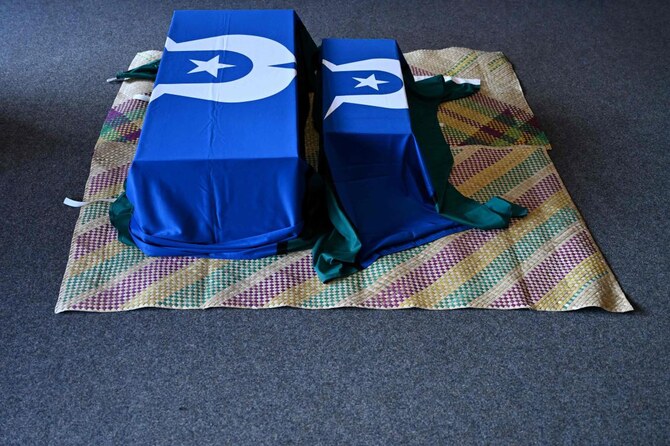
BERLIN: Five sets of ancestral remains from Australia that had been in German museum collections since the 19th century were handed back at a ceremony Thursday that a community representative described as a sad but “very joyful” moment.
The restitution is part of ongoing efforts by German museums and authorities to return human remains and cultural artifacts that were taken during colonial times.
In this case, three sets of remains that had been in Berlin since 1880 were handed over along with two other sets of remains held in the northwestern German city of Oldenburg. They were received by four representatives of the Ugar Island community, part of the Torres Strait Islands off the northeastern tip of Australia.
“These ancestral remains were never meant to be here,” said Hermann Parzinger, the head of the Prussian Cultural Heritage Foundation, which oversees Berlin’s state museums.
“They’re here because, during the colonial era and beyond, Europeans presumed to make other peoples and cultures the subject, or more often object, of their research — appropriating artifacts from cultures outside Europe on a scale that is almost unimaginable today and even desecrating the burial places of those communities in the process,” he said.
Around the turn of the 20th century, he added, Berlin museums set up a network of scientists, travelers, traders and others who sent back cultural items from around the world, and “in racing to compete with the other major European museums, they all too often disregarded the humanity and dignity of the peoples they encountered.”
The restitution of the remains from Berlin’s Ethnological Museum and the State Museum for Nature and Man in Oldenburg means that 162 sets of ancestral remains have now been returned to Australia from Germany, and about 1,700 from around the world, said Natasha Smith, Australia’s ambassador to Germany. She said the returns are “an extremely high priority” for Aboriginal and Torres Strait Islander communities and the government.
“It’s sad, but it’s a very joyful moment,” Ugar Island representative Rocky Stephen said at the ceremony honoring the ancestors. “This is a process of healing that’s going to happen when they return back to us.”
“No matter (if) it was nearly a 40-hour journey to travel here, because it’s been 144 years they have been missed back at their home,” he said.
Berlin’s museums now aim to do “everything we can to make the repatriation possible” of remains whose countries and communities of origin can be identified and want to bring them home, Parzinger said.
More broadly, governments and museums in Europe and North America have increasingly sought to resolve ownership disputes over objects looted during colonial times.
In 2022, for example, Germany and Nigeria signed an agreement paving the way for the return of hundreds of artifacts known as the Benin Bronzes taken from Africa by a British colonial expedition more than 120 years ago.


![]()

Germany hands over Australian ancestral remains held by museums for over 100 years
Short Url
https://arab.news/yh2ja
Germany hands over Australian ancestral remains held by museums for over 100 years
- The restitution is part of ongoing efforts by German museums and authorities to return human remains and cultural artifacts that were taken during colonial times
- In this case, three sets of remains that had been in Berlin since 1880 were handed over along with two other sets of remains held in the northwestern German city of Oldenburg


Latest updates


© 2026 SAUDI RESEARCH & PUBLISHING COMPANY, All Rights Reserved And subject to Terms of Use Agreement.