

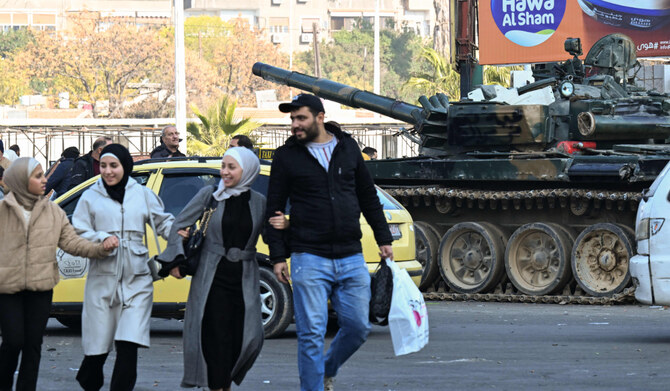
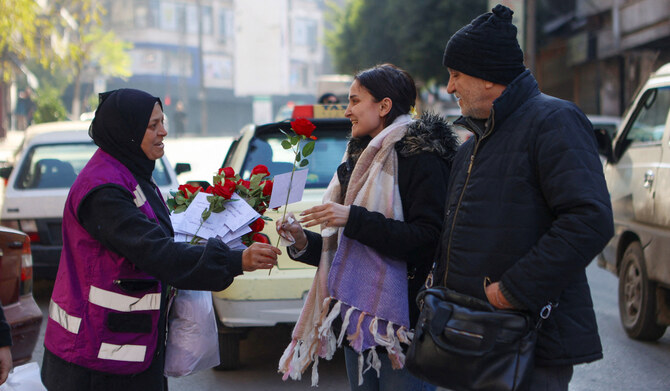

DAMASCUS: In Damascus, life is cautiously returning to normal as residents step out of their homes into a Syria transformed by the ousting of long-time president Bashar Assad.
“We were a little worried, but since Sunday, we are no longer afraid,” said Lina Al-Ostaz, referring to when the Syrian capital fell to a coalition of Islamist-led rebels.
The 11-day lightning offensive by Hayat Tahrir Al-Sham (HTS) and allies ended over half a century of unchecked rule by the Assad dynasty.
Ostaz said she left her house for the first time since the offensive began to go shopping in central Damascus on Tuesday. She strolled through the market with her husband, smiling at patrons and passersby.

People eat outdoors in Damascus on December 9, 2024, a day after the ousting of Syrian president Bashar al-Assad by Islamist-led anti-government fighters, who took the capital, forcing him to flee, and ending five decades of Baath rule in Syria. (AFP)
“We Syrians, we love life, and life goes on,” said the 57-year-old, who hesitated before mentioning she was arrested by government forces in 2015.
“I hope that the future will be better for young people,” she said.
After more than half a century of repression, Syrians seem to be speaking more freely.
In Qassaa, a predominantly Christian neighborhood, cafes are bustling with patrons smoking shisha and playing cards.
“We were very afraid... but we encouraged each other to go out and resume our normal lives,” said Rania Diab, a 64-year-old doctor who left home for the first time to meet up with friends at a cafe.
“But we remain cautious, we go home early, the situation is not yet clear,” she added.
She said her only hope was “that we can live normally in our country, that our freedoms are preserved... and that we can live in security and with freedom of opinion.”
The curfew imposed on the capital’s residents since Sunday has been relaxed, now starting at 9:00 p.m. (1800 GMT) instead of 5:00 p.m. and lasting until morning.
In the streets, portraits of Bashar Assad have been torn down. The green, white, and black flag of the revolution now flies, replacing the red, white, and black of the Syrian flag adopted during Assad’s father Hafez’s reign.
Spent bullet casings litter the vast central Umayyad Square, where revellers play out revolutionary songs.
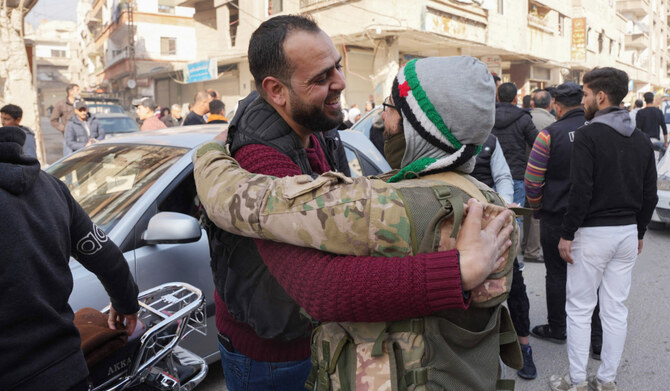
Armed men from various rebel groups, clad in fatigues and often wearing balaclavas, patrol the streets of the capital. Regime soldiers and police officers deserted their posts in large numbers on Sunday.
At the police headquarters in Damascus, there are officers from the self-proclaimed rebel government of Idlib, led by Mohammad Al-Bashir, who was appointed as the head of Syria’s transitional government on Tuesday.
A man who introduced himself as the new head of the police and declined to give his name told AFP that they would take up their duties in the coming days.
“We will ensure the security of all government buildings and maintain security in the capital,” he said.
In the upscale Malki neighborhood, people sat in outdoor cafes, while young people staged an impromptu demonstration, dancing to the familiar tunes of the 2011 uprising.
The peaceful demonstrations were brutally repressed by Assad’s forces, sparking a civil war that fragmented Syria and killed more than half a million people.
In the historic heart of the capital, the bars of the Christian neighborhood of Bab Touma, which serve alcohol, are still closed.
In the restaurants and cafes that are open, alcohol is not served, out of caution as residents await the new order under Damascus’s new rulers.


