Baghdad traders protest new customs tariffs

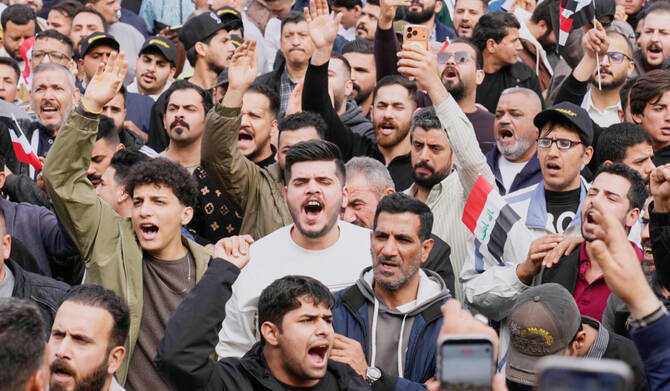
Iraqi traders protest against the imposition of customs duties on imported goods in Baghdad, Iraq, Sunday, Feb. 8, 2026. (AP)
Short Url
Updated 08 February 2026
Follow

Baghdad traders protest new customs tariffs

  • The demonstrators gathered outside the General Customs Directorate on Sunday, chanting slogans against corruption and rejecting the new fees

BAGHDAD: Hundreds of traders and owners of customs clearance companies protested in central Baghdad on Sunday, demanding that Iraq’s government reverse recently imposed customs tariffs they say have sharply increased their costs and disrupted trade.
The new tariffs that took effect on Jan. 1 were imposed to reduce the country’s debt and reliance on oil revenues, as oil prices have fallen.
Iraq faces a debt of more than 90 trillion Iraqi dinars ($69 billion) — and a state budget that remains reliant on oil for about 90 percent of revenues, despite attempts to diversify.

We used to pay about 3 million dinars per container, but now in some cases they ask for up to 14 million.

Haider Al-Safi, Company owne

But traders say the new tariffs — in some cases as high as 30 percent — have placed an unfair burden on them. Opponents have filed a lawsuit aiming to reduce the decision, which Iraq’s Federal Supreme Court is set to rule on Wednesday.
The demonstrators gathered outside the General Customs Directorate on Sunday, chanting slogans against corruption and rejecting the new fees.
“We used to pay about 3 million dinars per container, but now in some cases they ask for up to 14 million,” said Haider Al-Safi, a transport and customs clearance company owner. 
“Even infant milk fees rose from about 495,000 dinars to nearly 3 million.”
He said that the new tariffs have caused a backlog of goods at the Umm Qasr port in southern Iraq and added that electric vehicles, previously exempt from customs duties, are now subject to a 15 percent fee.
“The main victim is the citizen with limited income, and government employee whose salary barely covers his daily living, those who have to pay rent, and have children with school expenses — they all will be affected by the market,” said Mohammed Samir, a wholesale trader from Baghdad.
Protesters also accused influential groups of facilitating the release of goods in exchange for lower unofficial payments, calling it widespread corruption. 
Many traders, they said, are now considering routing their imports through the Kurdistan region, where fees are lower.
The protests coincided with a nationwide strike by shop owners, who closed markets and stores in several parts of Baghdad to oppose the tariff increase. 
In major commercial districts, shops remained shut and hung up banners reading “Customs fees are killing citizens.”


The UN says Al-Hol camp population has dropped sharply as Syria moves to relocate remaining families

Updated 15 February 2026
Follow

The UN says Al-Hol camp population has dropped sharply as Syria moves to relocate remaining families

  • Forces of Syria’s central government captured the Al-Hol camp on Jan. 21 during a weekslong offensive against the SDF, which had been running the camp near the border with Iraq for a decade

DAMASCUS: The UN refugee agency said Sunday that a large number of residents of a camp housing family members of suspected Daesh group militants have left and the Syrian government plans to relocate those who remain.
Gonzalo Vargas Llosa, UNHCR’s representative in Syria, said in a statement that the agency “has observed a significant decrease in the number of residents in Al-Hol camp in recent weeks.”
“Syrian authorities have informed UNHCR of their plan to relocate the remaining families to Akhtarin camp in Aleppo Governorate (province) and have requested UNHCR’s support to assist the population in the new camp, which we stand ready to provide,” he said.
He added that UNHCR “will continue to support the return and reintegration of Syrians who have departed Al-Hol, as well as those who remain.”
The statement did not say how residents had left the camp or how many remain. Many families are believed to have escaped either during the chaos when government forces captured the camp from the Kurdish-led Syrian Democratic Forces last month or afterward.
There was no immediate statement from the Syrian government and a government spokesperson did not respond to a request for comment.
At its peak after the defeat of IS in Syria in 2019, around 73,000 people were living at Al-Hol. Since then, the number has declined with some countries repatriating their citizens. The camp’s residents are mostly children and women, including many wives or widows of IS members.
The camp’s residents are not technically prisoners and most have not been accused of crimes, but they have been held in de facto detention at the heavily guarded facility.
Forces of Syria’s central government captured the Al-Hol camp on Jan. 21 during a weekslong offensive against the SDF, which had been running the camp near the border with Iraq for a decade. A ceasefire deal has since ended the fighting.
Separately, thousands of accused IS militants who were held in detention centers in northeastern Syria have been transferred to Iraq to stand trial under an agreement with the US
The US military said Friday that it had completed the transfer of more than 5,700 adult male IS suspects from detention facilities in Syria to Iraqi custody.
Iraq’s National Center for International Judicial Cooperation said a total of 5,704 suspects from 61 countries who were affiliated with IS — most of them Syrian and Iraqi — were transferred from prisons in Syria. They are now being interrogated in Iraq.