

Morocco flood evacuees still shaken, waiting to return home

1 / 2
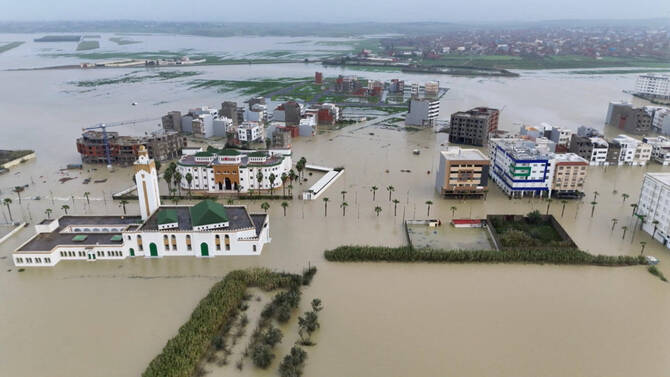
Heavy rainfall raised water levels in Ksar El-Kebir, Morocco. (Via Reuters)
2 / 2
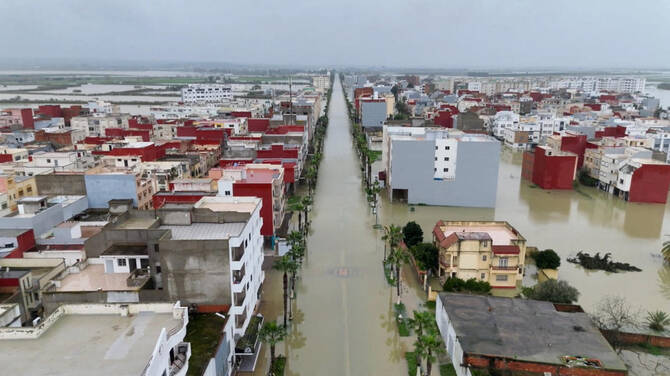
Heavy rainfall raised water levels in Ksar El-Kebir, Morocco. (Via Reuters)
Short Url
Updated 08 February 2026
Follow

Morocco flood evacuees still shaken, waiting to return home

  • More than 150,000 people have been evacuated over the past week as heavy rainfall battered provinces in Morocco’s north
  • Authorities have set up a vast camp of small blue tents sheltering nearly 40,000 people 50km north of Rabat

KENITRA, Morocco: It was through a call from her local mosque’s loudspeakers that Kasia El Selami learnt it was time to flee as floodwaters rose in her Moroccan village of Ouled Ameur.
Selami is among more than 150,000 people to have been evacuated over the past week as heavy rainfall battered provinces in Morocco’s north.
“We felt immense fear... especially for our children,” said the 67-year-old while hanging a blanket by the tent in which she now lives.
Some residents, including children and elderly people, were seen stranded on rooftops before being rescued, at times with small boats.
Others were rescued by helicopter as floodwaters inundated roads and farmland in several areas.
Near Kenitra, some 50 kilometers north of Rabat, authorities have set up a vast camp of small blue tents sheltering nearly 40,000 people, including Selami and her children.
At the camp, evacuees make do with little while waiting to be able to return home.
One woman scrubbed laundry in a small basin just a few meters away from an enclosure where evacuated cows, horses, chickens and sheep were penned.
Nearby, sick or lightly injured men and women queued outside a mobile clinic.

‘Terrified’

Despite the relative quiet, Ali Al Aouni said these were “very difficult days.”
The 60-year-old complained about the cold and anxiety, adding that his children were still “terrified” after what had happened.
“The water level got about a meter and a half high” in his village, he recalled. “We’re afraid to go home if the flood comes back.”
Aouni said his eldest son stayed behind to watch over their property, updating him over the phone that the water kept rising.
Not far away, the civil defense was handing out mattresses, warm clothing and food to the rescued families.
These came “in addition to health care and veterinary check-ups for livestock,” Adil Al-Khatabi, an official, told AFP.
Selami is already thinking about going home.
“We’re waiting for this ordeal to end as soon as possible, so we can return to our homes,” she said.
Last December 37 people were killed in sudden floods in Safi, in Morocco’s deadliest weather-related disaster in the past decade.
In recent weeks, severe weather and flooding in neighboring Algeria killed two people, including a child.
In Tunisia, at least five people died, while others were still missing after the country experienced its heaviest rainfall in over 70 years last month.
And further north, Portugal and Spain have also endured storms and torrential rains in recent days.

Iran Guards say will block oil exports as long as war continues

Updated 4 sec ago
Follow

Iran Guards say will block oil exports as long as war continues

  • Shipping traffic through the strategic Strait of Hormuz, through which nearly 20 percent of the world’s crude oil usually transits, has been severely disrupted
TEHRAN: Iranian forces will not allow the export of oil from the region to allies of the United States and Israel as long as the war continues, a Revolutionary Guards spokesman said Tuesday.
“The Iranian armed forces... will not allow the export of a single liter of oil from the region to the hostile side and its partners until further notice,” said Ali Mohammad Naini, according to a report from Iran’s Tasnim news agency.
He said any change would take place based on the conditions of the conflict.
On February 28, the US and Israel launched strikes against Iran that killed its supreme leader Ayatollah Ali Khamenei and triggered a war that has spread across the Middle East.
Iran has responded with drone and missile strikes targeting Israel and US interests across the region.
Shipping traffic through the strategic Strait of Hormuz, through which nearly 20 percent of the world’s crude oil usually transits, has been severely disrupted.
Iranian forces have repeatedly targeted oil tankers passing through the strategic waterway since the war began.
Oil prices have since risen dramatically to over $100 per barrel — the highest since Russia’s invasion of Ukraine in 2022 — before reversing course Monday after US President Donald Trump said military operations would be ending soon.
“Their efforts to reduce and control the price of oil and gas will be temporary and fruitless,” IRGC spokesman Naini said. “Trade in war conditions is hinged on security.”
The Revolutionary Guards late on Monday urged countries to expel their US and Israeli ambassadors to gain passage through the Strait of Hormuz.
“Any Arab or European country that expels the Israeli and American ambassadors from its territory will have complete freedom and authority to pass through the Strait of Hormuz starting tomorrow,” the Guards said, as quoted by Iranian state TV.