


MOSCOW: The collapse of Moscow ally Bashar Assad’s Syrian government has dealt a major blow to Russia’s image of global strength and laid bare the limits of its military reach as its Ukraine offensive drags on.
Moscow helped keep Assad in power when it intervened in the Syrian civil war in 2015, but with its troops and firepower now concentrated on Ukraine, its ability to protect the iron-fisted ruler this time was limited.
Rebels swept into the capital Damascus after a lightning offensive that took less than two weeks to topple the regime and send Assad fleeing, with Russian news agencies reporting he had been granted asylum in Moscow.
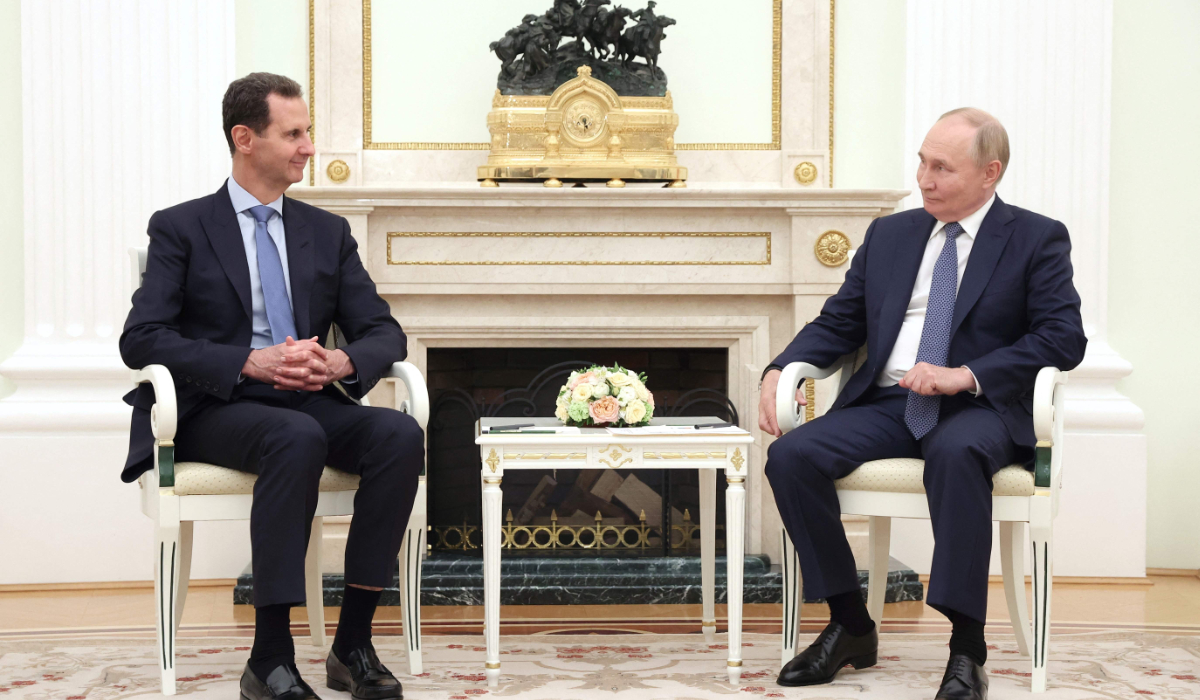
In this file pool photograph distributed by the Russian state agency Sputnik, Russia's President Vladimir Putin (R) meets with Syria's President Bashar al-Assad at the Kremlin in Moscow on July 24, 2024. (AFP)
It is now unclear if Russia can maintain control of its Mediterranean naval base in the Syrian port of Tartus or its air base in Hmeimim, threatening to dislodge Moscow’s strategic military presence in the region.
“Moscow does not have sufficient military forces, resources, influence and authority to intervene effectively by force outside the former Soviet Union,” analyst Ruslan Pukhov said in an opinion piece for the Russian daily Kommersant.
This became even more evident after 2022, with the outbreak of Moscow’s “protracted” offensive in Ukraine depleting Russia’s military capabilities, he said.
Days after rebel groups launched their offensive against Assad in late November, Russia announced it was responding with air strikes, helping the Syrian army in three northern provinces.
But it was clear that the intervention was limited.
“Attempts to maintain (Assad) would have ended in failure anyway. Russia has other priorities now, and resources are not infinite,” political analyst Fyodor Lukyanov told AFP.
The Kremlin said it was “surprised” by the sheer speed of the rebel attack.
Russia had invested huge financial resources in the country after helping Assad ward off rebel forces with deadly air strikes and devastating bombing campaigns in the latter half of the war.
It is now having to conduct “negotiations” with the same rebel groups it was targeting to secure the safety of its citizens and embassy staff, according to Russian spy chief Sergei Naryshkin.
“This is now the main goal — to ensure the safety of our people,” he told reporters on Monday.
Further aggravating matters, Russia faces the “most likely” prospect of having to withdraw from its military bases in the country, Lukyanov said.
The Russian naval base at Tartus allows it to sail warships directly into the Mediterranean Sea, while its air base at Hmeimim gives it quick access to skies above swathes of the Middle East.
These bases in Syria “play a role in Russia’s efforts to project power not only inside Syria but in the broader region, including in Libya, Sudan, and other parts of Africa,” the New York-based Soufan Center global security analysts said in a note.
If Russia loses this warm-water naval base and air base, it loses its military capabilities in the region and potentially further afield, analysts said.
“The damage to Moscow’s ability to manouevre in Africa and the Mediterranean may have a strategic impact on Russian influence across the world,” said R. Clarke Cooper, research fellow at the Atlantic Council tink tank.
After Assad was ousted, military bloggers in Moscow reacted with shock and dismay.
“I will not grieve for Syria any more than I would grieve for Izyum, Kherson or Kyiv,” Russian war correspondent Alexander Kots wrote on Telegram, referring to Ukrainian cities that Moscow retreated from during its nearly three-year offensive.
“The image of our country will depend entirely on the results of the Special Military Operation, (which is) more important than anything else at the moment,” he said, using the Kremlin’s term for the offensive.
But the fall of Assad, one of Russian President Vladimir Putin’s closest allies, could weaken Moscow’s hand in any future negotiations on the Ukraine conflict, according to the Soufan Center.
Moscow’s inability to keep Assad in power suggests it is consumed with the Ukraine conflict, it said, “taxing Russia’s resources and capabilities, raising questions about the sustainability of its ongoing offensive in Ukraine.”


