

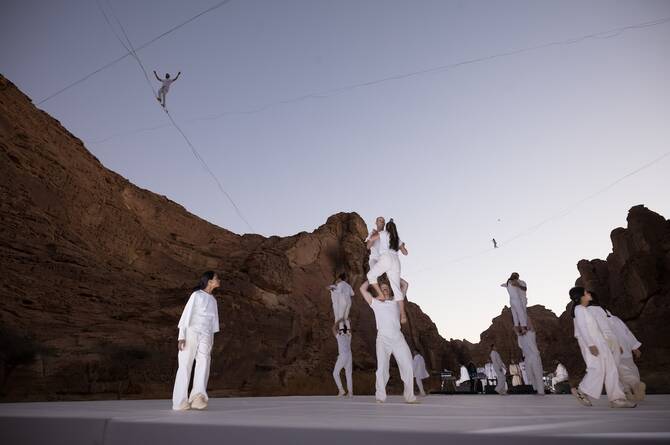

ALULA: The fifth AlUla Arts festival began last weekend. Until Feb. 14, the ancient oasis has become a living backdrop for bold land art, workshops, dance and musical performances inspired by the area’s majestic desert canyons and lush palm groves.
Sumantro Ghose, the arts and creative industries programming director, said: “We started in 2022 with 19,000 visitors. In 2025 (we had more than) 70,000. So we’re a growing festival. And what makes us unique is that we’re very rooted in the local community, but we’re also global.”
“We believe that AlUla, as a destination, was built by artists for artists,” Hamad Alhomiedan, director of arts and creative industries at the Royal Commission for AlUla, told Arab News. “That’s why we have this amazing program this year, which will be our largest art festival yet, and it’s basically focused on three cultural assets that we’re developing,” he continued. Those three assets are: AlJadidah Arts District, Wadi AlFann, and the upcoming Contemporary Art Museum of AlUla.

Aseel Alamoudi, AlUla Design Residency Artwork 2025, displayed at AlUla Design Space. (Courtesy of the RCU and Lorenzo Arrigoni)
One of the highlights of the festival, once again, is Desert X AlUla, which runs until Feb. 28. The international site-specific contemporary art exhibition returns to AlUla for the fourth time, showcasing 11 installations by local, regional, and international artists — from Sara Abdu’s layering of poetry and geological strata to Héctor Zamora’s “Tar HyPar,” which transforms the valley into a musical instrument.
The exhibition, curated by Zoé Whitley and Wejdan Reda under the vision of artistic directors Neville Wakefield and Raneem Farsi, is inspired by the poetry of the late US-Lebanese writer and philosopher Kahlil Gibran, under the theme “Space Without Measure.”
“In the spirit of Gibran’s words, this edition of Desert X 2026 unfolds as an invitation to dream, to wander, and to connect with the landscape — not as something observed from a distance, but as something deeply felt. Here, space opens beyond measure, and it is from this shared invitation, the artists begin to speak, each in their own register, material and rhythm, offering personal yet deeply atoned responses to the landscape,” Reda said during the exhibit’s opening ceremony.

Ayman Zedani's 'The Holy Wadi' is on display in the exhibition 'Arduna.' (Supplied)
Elsewhere, the exhibition “Arduna” (‘our land’) ushers in the pre-opening of AlUla’s Contemporary Art Museum. Running from Feb. 1 to Apr. 15, the exhibit is a collaboration with Centre Pompidou and the French Agency for AlUla development and features contemporary art from the RCU’s collection alongside pieces from France’s Musée National d’Art Moderne, including works by Kandinsky and Picasso.
Alhomiedan said: “The community sits at the center of the development (of the Contemporary Art Museum). We did more than 30 focus groups, asking ‘What do you want the museum to look like? Do you know what a museum is?’ And ‘How do you imagine the museum can step out of the boundary of the wall and also reach to the houses and go inside these houses?’ Because we don’t believe a museum (to be) this physical space.”
The AlJadidah Arts District plays a major role in the festival, staging a number of initiatives, including newly commissioned artworks, workshops, exhibitions, film screenings, and musical performances. Saudi-French cultural institution Villa Hegra is hosting the photography exhibition “Not Deserted: AlUla’s Archives in Movement,” which features early 20th-century photographs by Tony André alongside an exhibition of cinematic images of desert landscapes by Saudi filmmaker and Villa Hegra resident Saad Tahaitah, while the AlUla Music Hub presents a number of concerts, ranging from Arabic, to jazz, to fusion. Cinema AlJadidah presents a curated series of art documentaries, feature films, and shorts, set in the open-air, and at ATHR Gallery, visitors can find works by Saudi-born artist Sara Abdu exploring architecture as memory.

Works on display in the photography exhibition 'Not Deserted.' (Supplied)
Just across from ATHR Galley at Design Space AlUla is “Material Witness: Celebrating Design From Within,” an exhibition curated by Dominique Petit-Frère and Majedah Alduligan and artistically led by Ali Alghazzawi and Arnaud Murand, that highlights the connection between design and place and includes works by five participants in the AlUla Artist Residency’s 2025 design edition.
Alhomiedan said: “Every single one of these initiatives is inspired by the place and by memory and materials. Because if we don’t focus on that, then you can do this work anywhere else in the world.
“Focusing on where you are right now — like, the shadows of the palm groves or the palm trees, the different local plants that you can extract pigments from, local stones, different local fabrics, the local flora and fauna — this is how artists explore creativity through the place, memory, and community of AlUla.”
The festival positions art as a connective pillar between nature and heritage, aiming not only to revive the artistic practices exemplified in the ancient architectural marvels of the tombs in Hegra or the carefully carved statues uncovered in Dadan, but also to utilize their powerful history as proof of the region’s inherent gravitation towards art.


