

Saudi Arabia positioned to lead global hydrogen production, say experts

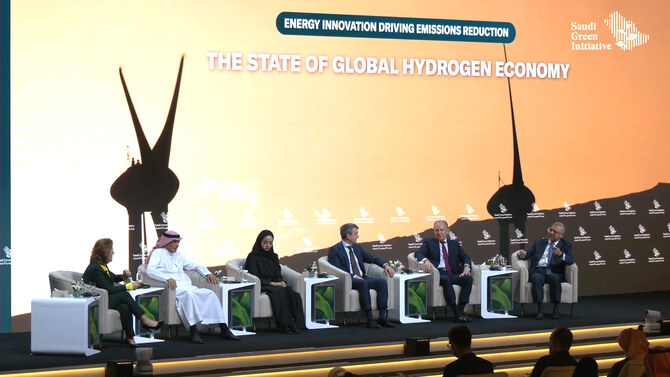
Speakers express their views on global hydrogen production at a panel at the Saudi Green Initiative Forum in Riyadh.
Short Url
Updated 04 December 2024
Follow

Saudi Arabia positioned to lead global hydrogen production, say experts

  • SABIC, in collaboration with its parent company Aramco, plans to produce low-carbon ammonia
  • COP16 panelists cautioned hydrogen alone will not solve global decarbonization challenges

RIYADH: Saudi Arabia is poised to become one of the world’s leading producers of hydrogen, capitalizing on its abundant renewable energy resources and robust infrastructure, experts say.

At the Saudi Green Initiative Forum in Riyadh, Abdulrahman Al-Fageeh, CEO and executive board member of SABIC, outlined the Kingdom’s unique advantages in the hydrogen sector.

“Saudi Arabia, by the way, as a country, is going to be the best competitive in terms of the economics of producing hydrogen from any source by having the solar, by having the wind and also by having the gray hydrogen that we have in our systems,” he said. 

Al-Fageeh underscored that the Kingdom’s hydrogen ambitions would depend on close collaboration across the entire value chain, as well as strong regulatory support.

“Collaboration across the value chain is key, and regulators will play a crucial role,” he emphasized, highlighting the importance of coordinated efforts to scale production and integrate hydrogen into fuel systems and broader decarbonization strategies.

As part of its hydrogen strategy, SABIC, in collaboration with its parent company Aramco, plans to produce low-carbon ammonia.

“We have committed to advancing our decarbonization efforts using hydrogen and will collaborate with Aramco to produce low-carbon ammonia, which will play an important role in the fuel systems of the future,” Al-Fageeh added.

Sanjiv Lamba, CEO of Linde, also spoke positively about Saudi Arabia’s potential, describing hydrogen as a vital link in the global energy transition.

“Low-carbon hydrogen offers a cost-effective, scalable solution with mature technologies today, ensuring safe and reliable hydrogen production,” he said, adding that Saudi Arabia is particularly well-positioned to produce green hydrogen at globally competitive prices.

Kholoud Al-Otaibi, a clean hydrogen analyst at the Saudi Ministry of Energy, highlighted the Kingdom’s ongoing progress in building the necessary infrastructure for hydrogen production and export.

“The Kingdom is already taking deliberate steps to develop the protection and capacity, as well as the export infrastructure needed for hydrogen,” she said, underscoring the potential of hydrogen to support a sustainable energy future.

Despite the optimism, panelists cautioned that hydrogen alone will not solve global decarbonization challenges.

“It is one of many solutions. To address this pragmatically, we need to answer three key questions: where, what, and how,” said Al-Fageeh.

Francois Jackow, CEO of Air Liquide, noted that the energy transition is at a critical “scale-up phase,” requiring substantial investment and industrial innovation to unlock its full potential.

The forum also tackled broader challenges in climate finance, with experts stressing the urgent need to bridge the funding gap for climate adaptation, particularly in low- and middle-income countries.

Mohammed Ayoub, lead climate finance negotiator at the Saudi Ministry of Energy, warned that macroeconomic factors, such as unsustainable debt levels and foreign exchange risks, are restricting access to capital for developing nations.

“This is driving up the cost of capital due to lower sovereign ratings,” Ayoub said, explaining that it limits critical investments in climate adaptation measures that save lives and improve quality of life in vulnerable regions.

Florent Baarsch, founder and CEO of finres, highlighted the scale of the shortfall, pointing out that current overseas development assistance stands at $220 billion annually, far below the $300 billion to $500 billion needed each year for climate adaptation.

“Even if we allocated the entire ODA to adaptation, it would still fall short,” Baarsch said.

Rachel Kyte, the UK special representative on climate, said that adaptation finance must prioritize the most vulnerable populations and combine public and private funding to meet the scale of the challenge.


Saudi-built AI takes on financial crime

Updated 30 January 2026
Follow

Saudi-built AI takes on financial crime

  • Mozn’s FOCAL reflects the Kingdom’s growing fintech ambitions

RIYADH: As financial institutions face increasingly complex threats from fraud and money laundering, technology companies are racing to build systems that can keep pace with evolving risks. 

One such effort is FOCAL, an AI-powered compliance and fraud prevention platform developed by Riyadh-based enterprise artificial intelligence company Mozn.

Founded in 2017, Mozn was established with a focus on building AI technology tailored to regional market needs and regulatory environments. Over time, the company has expanded its reach beyond Saudi Arabia, developing advanced AI solutions used by financial institutions in multiple markets. It has also gained international recognition, including being listed among the World’s Top 250 Fintech Companies for the second consecutive year.

In January 2026, Mozn’s flagship product, FOCAL, was named a Category Leader in Chartis Research’s RiskTech Quadrant 2025 for both AML Transaction Monitoring and KYC (Know Your Customer) Data and Solutions, placing it among 10 companies globally to receive this designation.

Malik Alyousef, co-founder of Mozn and chief technology officer of FOCAL, told Arab News that the platform initially focused on core anti-money laundering functions when development began in 2018. These included customer screening, watchlists, and transaction monitoring to support counter-terrorism financing efforts and the detection of suspicious activity.

As financial crime tactics evolved, the platform expanded into fraud prevention. According to Alyousef, this shift introduced a more proactive model, beginning with device risk analysis and later incorporating tools such as device fingerprinting, behavioral biometrics, and transaction fraud detection.

More recently, FOCAL has moved toward platform convergence through its Financial Crime Intelligence layer, a vendor-neutral framework designed to bring together multiple systems into a single interface for investigation and reporting. The approach allows institutions to gain a consolidated view without replacing their existing technology infrastructure.

“Our architecture eliminates blind spots in financial crime detection. It gives institutions a complete view of the user journey, combining transactional and non-transactional behavioral data,” Alyousef said.

DID YOU KNOW?

• Some electronic money institutions using the platform have reported fraud reductions of up to 90 percent.

• The platform combines anti-money laundering and fraud prevention into a single financial crime intelligence system.

• FOCAL integrates with existing banking systems without requiring institutions to replace their technology stack.

Beyond its underlying architecture, Alyousef pointed to several areas where FOCAL aims to differentiate itself in a competitive market. One is its emphasis on proactive fraud prevention, which assesses risk throughout the customer lifecycle — from onboarding and login behavior to ongoing account activity — with the goal of stopping fraud before losses occur.

He described the platform as an “expert-led model,” highlighting the availability of on-the-ground support for system design, tuning, assessments, and continuous optimization throughout its use.

“FOCAL is designed to be extended,” Alyousef added, noting its adaptability and the ability for clients to customize schemas, rules, and data fields to match their business models and risk tolerance. This flexibility, he said, allows institutions to respond more quickly to emerging fraud patterns.

Alyousef also emphasized the importance of local context in the platform’s development.

“The platform incorporates regional regulatory requirements and language considerations. Global tools often struggle with local context, naming conventions and compliance nuances — we are designed specifically with these realities in mind,” he said.

FOCAL is currently used by a range of organizations, including traditional banks, digital banks, fintech firms, electronic money institutions, payment companies, and other financial service providers. Alyousef said results from live deployments have been significant, with some large EMI clients reporting fraud reductions of up to 90 percent.

“Clients benefit not only from reduced fraud losses but also from an improved customer experience, as the system minimizes unnecessary friction and false rejections,” he said. “Beyond financial services, we also work with organizations in e-commerce and telecommunications.”

Looking ahead, Alyousef said the company sees agentic AI as a key direction for the future of financial crime prevention, both in the region and globally. Mozn, he added, is investing heavily in this area to enhance investigative workflows and operational efficiency, building on the capabilities of its Financial Crime Intelligence layer.

“We are pioneers in introducing agentic AI for financial crime investigation and rule-building. Our roadmap increasingly emphasizes automation, advanced machine learning and AI-assisted workflows to improve investigator productivity and reduce false positives.”

As AI tools become more widely available, Alyousef warned that the risk of misuse by criminals is also increasing, raising the bar for defensive technologies.

“Our goal is to stay ahead of that curve and to contribute meaningfully to positioning Saudi Arabia and the region as globally competitive leaders in AI,” he said.