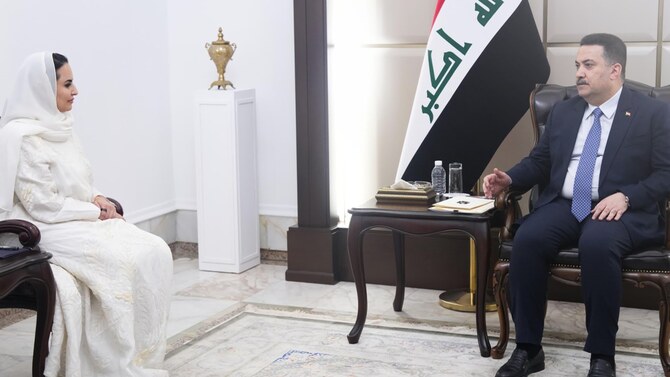
Secretary-General of DCO meets Iraqi PM to discuss digital cooperation

Deemah AlYahya, the secretary-general of the Digital Cooperation Organization (DCO), met with Iraqi PM Mohammed Shia’ Al-Sudani (Courtesy: @dcorg)
Short Url
Updated 28 November 2024
Follow

Secretary-General of DCO meets Iraqi PM to discuss digital cooperation

  • Deemah Al-Yahya, head of the multilateral Digital Cooperation Organization, commended Iraq’s investment in human capital as driver for growth and expansion of digital economy
  • Iraq has been working in recent years to develop a strategy for digital transformation to help support the private and public sectors and grow the economy

RIYADH: Saudi senior tech diplomat Deemah AlYahya, the secretary-general of the multilateral Digital Cooperation Organization, held talks on Monday with Iraq’s prime minister, Mohammed Shia Al-Sudani, about support for Baghdad’s plans to develop its digital business and artificial intelligence sectors.

They discussed Iraq’s strategy for digital transformation, and the need to create and develop a workforce with the tech skills required to help grow the Iraqi economy effectively, the Saudi Press Agency reported.

Though Iraq is not a member of the DCO, an international body that focuses on the digital economy, Al-Sudani said his country is keen to work with the organization to meet the nation’s needs for a skilled workforce in the business sector.

AlYahya commended Iraq for the progress it has already made in terms of investment in the human capital needed to develop the digital skills that are essential to drive growth in a digitized economy.

Iraq has been working in recent years to develop a strategy for digital transformation to help support the private and public sectors and grow the economy. Authorities this month organized the first Digital Space Iraq Forum, which focused on the use of advanced technologies, including AI, to help build a comprehensive digital economy.

The DCO says that since it was founded in November 2020, it has been at the forefront of efforts to curate policies and initiatives to support the digital economy in several countries. Currently, 16 nations are members, including Saudi Arabia, Jordan, Pakistan, Bahrain, Bangladesh and Oman. It also has 39 observer partner organizations.

DCO member states have a collective gross domestic product of $3.5 trillion and serve a combined market of nearly 800 million people, more than 70 percent of whom are under the age of 35.


Foreign ministers chair Saudi-Omani coordination council meeting in Muscat

Updated 23 December 2025
Follow

Foreign ministers chair Saudi-Omani coordination council meeting in Muscat

MUSCAT: Saudi Foreign Minister Prince Faisal bin Farhan met with Oman’s Foreign Minister Sayyid Badr bin Hamad Al-Busaidi on Monday.

They reviewed bilateral relations between their nations and ways to enhance and develop them across various fields. Additionally, they discussed regional and international developments.

The ministers co-chaired the third meeting of the Saudi-Omani Coordination Council in the Omani capital, Muscat, with the participation of the heads of the Council’s subsidiary committees and the two heads of the Council’s General Secretariat teams.

The meeting comes as an affirmation of the keenness of Saudi and Omani leaders to strengthen ties and advance them toward greater prosperity for both nations.

In his remarks during the meeting, Prince Faisal affirmed that gathering builds on the previous council meeting, held last year in AlUla, and on its positive and fruitful outcomes within the framework of the approved recommendations and initiatives. 

He stressed the importance of continuing the work of the council’s subsidiary committees to complete the necessary procedures to implement the remaining initiatives, and of the General Secretariat’s role in follow-up and in addressing any challenges that may hinder implementation.

He also underscored the importance of developing and enhancing trade relations, stimulating investment, and strengthening cooperation between the public and private sectors.

He also praised the ongoing work to establish and launch the Coordination Council’s electronic platform, which aims to connect all committee work and initiatives to facilitate follow-up on the Council’s progress. 

Al-Busaidi affirmed in his remarks the qualitative progress in relations between the two countries and the notable development witnessed across numerous sectors toward achieving economic integration and enhancing intra-trade and joint investments. 

The Omani foreign minister also highlighted deeper cooperation in the security and judicial fields, as well as the cultural and tourism sectors, noting the advanced and continuous political cooperation, consultation, and coordination on regional and international issues.