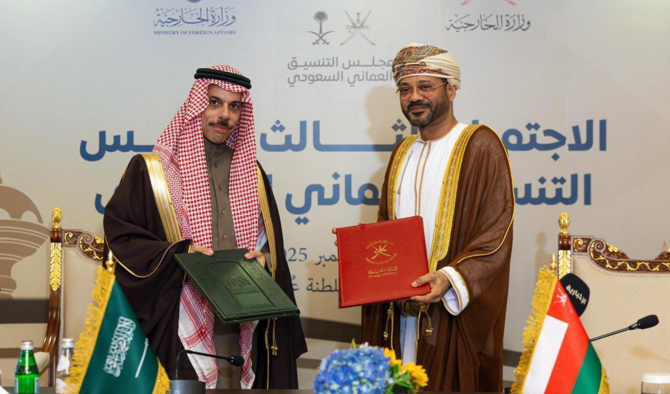
Foreign ministers chair Saudi-Omani coordination council meeting in Muscat

Saudi Foreign Minister Prince Faisal bin Farhan and Oamni Foreign Minister Sayyid Badr bin Hamad Al-Busaidi. (SPASayyid Badr bin Hamad Al-Busaidi)
Short Url
Updated 23 December 2025
Follow

Foreign ministers chair Saudi-Omani coordination council meeting in Muscat

MUSCAT: Saudi Foreign Minister Prince Faisal bin Farhan met with Oman’s Foreign Minister Sayyid Badr bin Hamad Al-Busaidi on Monday.

They reviewed bilateral relations between their nations and ways to enhance and develop them across various fields. Additionally, they discussed regional and international developments.

The ministers co-chaired the third meeting of the Saudi-Omani Coordination Council in the Omani capital, Muscat, with the participation of the heads of the Council’s subsidiary committees and the two heads of the Council’s General Secretariat teams.

The meeting comes as an affirmation of the keenness of Saudi and Omani leaders to strengthen ties and advance them toward greater prosperity for both nations.

In his remarks during the meeting, Prince Faisal affirmed that gathering builds on the previous council meeting, held last year in AlUla, and on its positive and fruitful outcomes within the framework of the approved recommendations and initiatives. 

He stressed the importance of continuing the work of the council’s subsidiary committees to complete the necessary procedures to implement the remaining initiatives, and of the General Secretariat’s role in follow-up and in addressing any challenges that may hinder implementation.

He also underscored the importance of developing and enhancing trade relations, stimulating investment, and strengthening cooperation between the public and private sectors.

He also praised the ongoing work to establish and launch the Coordination Council’s electronic platform, which aims to connect all committee work and initiatives to facilitate follow-up on the Council’s progress. 

Al-Busaidi affirmed in his remarks the qualitative progress in relations between the two countries and the notable development witnessed across numerous sectors toward achieving economic integration and enhancing intra-trade and joint investments. 

The Omani foreign minister also highlighted deeper cooperation in the security and judicial fields, as well as the cultural and tourism sectors, noting the advanced and continuous political cooperation, consultation, and coordination on regional and international issues.


Saudi Arabia designates 2026 the Year of Artificial Intelligence

Updated 9 sec ago
Follow

Saudi Arabia designates 2026 the Year of Artificial Intelligence

  • SDAIA unveils official logo after it was approved by the Cabinet

RIYADH: Saudi Arabia has designated 2026 as the Year of Artificial Intelligence, underscoring the Kingdom’s growing leadership in global AI adoption, and reaffirming AI as a top priority by supporting the nation’s AI ambitions in line with Saudi Vision 2030.

With the Kingdom emerging as a global hub for data and AI, driven by the support of Crown Prince Mohammed bin Salman, the move was underscored by the Saudi Cabinet’s approval on Tuesday.

The Saudi Data and Artificial Intelligence Authority, meanwhile, launched the official logo for the Year of Artificial Intelligence, Saudi Press Agency reported Wednesday.

The logo integrates symbolism in its elements: a palm tree signifies the national emblem and the Kingdom’s cultural heritage, while the letters “AI” highlight the technological and innovative aspects central to promoting digital inclusion as part of Vision 2030.

The palm tree’s green color symbolizes the Saudi flag and the Kingdom’s national identity, while the accompanying blue color represents digital technology and progression toward advanced technological development.

The logo is accompanied by the official hashtag for the Year of Artificial Intelligence: #SaudiAIYear.

Muhammad Khurram Khan, a professor of cybersecurity at King Saud University, told Arab News: “Saudi Arabia’s decision to designate 2026 as the Year of Artificial Intelligence represents a strategic milestone in the Kingdom’s digital transformation under Vision 2030.

“Over the past several years, SDAIA has successfully moved the national AI agenda from planning to large-scale implementation. The progress is visible in the Kingdom’s rapid rise in global AI rankings, its significant investment in emerging technologies, and the development of advanced infrastructure such as national data platforms and large-scale data centers,” he said.

The Kingdom ranked 14th in the 2025 Global AI Index and holds a leading position in the Arab world for AI model development.

Investment in the sector has grown significantly, with government spending on emerging technologies rising by more than 56 percent in 2024 and AI companies securing $9.1 billion in funding.

“The newly unveiled logo effectively reflects this vision. The logo thoughtfully blends Saudi Arabia’s heritage with its technological ambitions, reflecting the Kingdom’s forward-looking vision for a technology-driven future,” said the professor.

“What distinguishes Saudi Arabia’s approach is its holistic strategy. Rather than focusing solely on technology deployment, the Kingdom has invested heavily in talent development, regulatory frameworks, and ecosystem building. Training thousands of specialists and engaging more than a million participants through national AI initiatives demonstrates a long-term commitment to building a sustainable knowledge economy. Equally important is the Kingdom’s emphasis on responsible AI governance, reflected in its participation in international AI partnerships focused on ethics,” he added.

Welcoming the Cabinet’s decision to designate 2026 as the Year of Artificial Intelligence, Abdullah bin Sharaf Al-Ghamdi, SDAIA president, said on Tuesday the decision reflects the crown prince’s vision to strengthen the Kingdom’s global standing in advanced technologies.

He described it as an important step toward creating national momentum around innovation and the role of artificial intelligence in shaping a smarter and more sustainable future.

Since its establishment in 2019, SDAIA has led the National Strategy for Data and Artificial Intelligence, which focuses on six pillars: ambition, competencies, policies, investment, innovation, and ecosystem.

These efforts have moved the Kingdom from strategic planning to implementation, including regulating AI sectors and developing advanced digital infrastructure.

Infrastructure has expanded with the launch of the Shaheen III supercomputer and the Hexagon data center, the world’s largest government data facility with a capacity of 480 megawatts.

The Kingdom has also established a National Data Lake integrating more than 430 government systems.

Human capital development remains a priority. More than 11,000 specialists have been trained, and the SAMAI program has reached over one million participants.

Internationally, Saudi Arabia has strengthened its presence in the AI sector. It became the first Arab nation to join the Global Partnership on AI and hosts the UNESCO-sponsored International Center for Artificial Intelligence Research and Ethics in Riyadh.

These initiatives reflect the Kingdom’s commitment to the responsible and ethical use of artificial intelligence to support economic diversification and serve humanity globally.