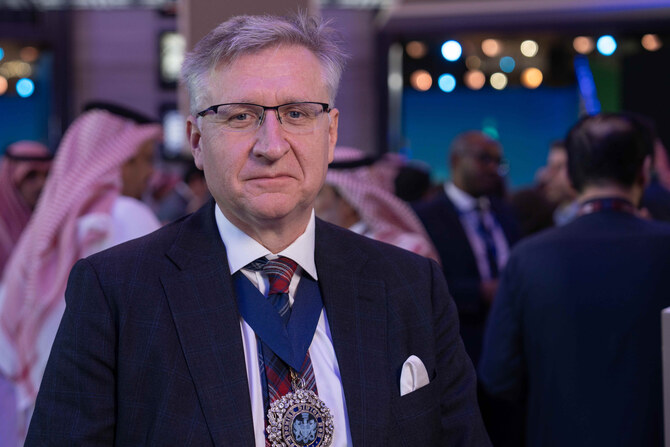

RIYADH: UK-based fintech firms have an opportunity to address rising demand for fintech services in Saudi Arabia, according to the Lord Mayor of London.
Speaking on the sidelines of the 28th World Investment Conference in Riyadh, Alderman Alastair King highlighted the UK capital’s extensive expertise in fintech, particularly as the city works on digitizing national debt instruments.
He noted that such initiatives could provide opportunities for collaboration between the UK and Saudi Arabia’s growing fintech sector.
“We have incredible expertise in London in relation to fintech and financial technologies in general. I know there’s a great demand for that sector here in Saudi, so those are some of the areas we are concentrating on,” said the Lord Mayor.
“In the United Kingdom, we’ve just started to digitize our national gilts, what they call the debt instruments. Now, there’s a road ahead to digitize them, which is a wonderful opportunity to work on those types of things,” he said.
A gilt is a UK government bond issued in sterling, and London’s efforts to digitize these instruments could pave the way for similar initiatives in Saudi Arabia, added.
King went to say that the payments sector could also be explored, noting that the entire sector is being transformed by fintech and that there are enormous opportunities for collaboration.
Other sectors that could be devoloped include infrastructure, insurance, and legal services, as well as asset management, and banking.
“London is the number one global center for professional services in the world. Saudi Arabia is the fastest growing economy in the G20. There’s going to be a fantastic symbiosis between us, and we can do all sorts of things together,” the Lord Mayor said during the interview.
King also discussed the broader opportunities arising from Saudi Arabia’s energy transition and economic diversification, particularly in industries such as asset management, banking, and insurance. He emphasized the role of both large companies and small and medium-sized enterprises in fostering innovation.
“In London, as an extraordinary financial and professional services ecosystem, there is a symbiosis between small and medium-sized companies and the large ones. Part of my job is to go around to the British companies, whether small, medium, or large, and encourage them to take advantage of the international markets that are going to be available to us,” the Lord Mayor said.
“So, although the early adopters are the large companies, I think you often see real innovation coming out of the small and medium-sized companies,” he added.
The Lord Mayor added that he would consider it a success if more British firms expanded into Saudi Arabia and other Gulf Cooperation Council markets, particularly in professional services.
“I’d also view success as greater investment flows into financial and professional services in the UK,” he concluded.
Investment trends
During a panel discussion at the World Investment Conference, Nan Li Collins, senior director of investment and enterprise at the UN Conference on Trade and Development, discussed global investment trends, emphasizing the importance of effective regional policies and multilateral efforts to counteract fragmentation and protectionism.
“I think these are the efforts we need to promote globally for more multilateral reasons, for more regional integration, to lower trade and investment barriers, and then work with countries’ investment promotion agencies to look at how to strengthen investment facilitation,” she added.
During the discussion, Collins highlighted three key trends shaping the market.
“The first is the long-term trend of trade and investment,” she said, adding that while GDP and trade have grown steadily since the 2008 financial crisis, FDI has stagnated.
She identified global fracturing as the second trend, noting that investment is increasing in geopolitically aligned countries but declining in more distant ones.
The third trend is digitization, Collins said, adding that over the last decade, investment in digital services has risen from 60 percent to 80 percent, now accounting for the majority of new global FDI.