

Investment strategies must align with SDGs to drive sustainable global growth, WIC hears

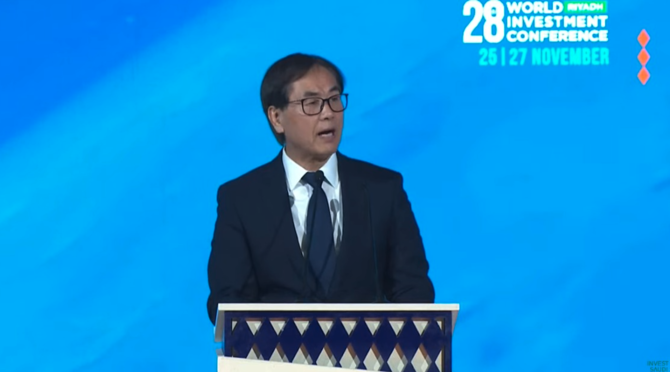
James Zhan, chair of the WIC executive board, speaking at the conference. Screenshot
Short Url
Updated 25 November 2024
Follow

Investment strategies must align with SDGs to drive sustainable global growth, WIC hears

RIYADH: Investment strategies must be compatible with sustainable development goals to ensure economically viable and environmentally responsible global growth, a top official said at the World Investment Conference.

Speaking on the first day of the Riyad-based event, James Zhan, chair of the WIC executive board, said reforming the global financial system should be a priority alongside helping to deliver social and environmental reform.

The 28th WIC is being held from Nov. 25 to 27,  and will see global stakeholders gather to explore investment trends and how best to foster sustainable development. 

During a panel discussion titled “Impact Maximization: Leveraging Trade and Investment for Growth and Development,” Zhan said: “We need to embed investment strategies into the SDG implementation plans. We need to transform these international investment regimes into a kind of SDG promotion instrument.”

The SDGs are a set of 17 global objectives established by the UN to address pressing social, economic, and environmental challenges, aiming to achieve a sustainable and equitable future by 2030.

Zhan also called for transforming international investment: “We need to be practicing incentives for investment on the ground.”

Ibrahim Al-Mubarak, assistant minister of investment and CEO of the Saudi Investment Promotion Authority, outlined the Kingdom’s focused approach to investment. 

“Our investment strategy focuses on quality, FDI. That’s a very big word. So, what I like to call it is smart capital,” he said. 

Al-Mubarak also emphasized Saudi Arabia’s reform journey under Vision 2030, saying: “Since the launch of Vision 2030, we have set a very ambitious reform agenda. That reform agenda comes in various ways, be it in the reform of existing laws, launching new laws, removing subsidies.”

These reforms aim to bolster the Kingdom’s investment environment, which has already been recognized as the 16th most competitive economy globally, according to the IMD’s World Competitiveness Index.

Al-Mubarak highlighted the significance of comprehensive and consistent regulatory reforms in enhancing investment appeal. 

One measure of this is the success of Saudi Arabia’s Regional Headquarters Program, which came into effect in January and encouraged multinational companies to set up regional offices in Riyadh.

“We already have exceeded our target by having 550 regional headquarters companies here. Our location, our infrastructure, our youth are enabling us to achieve those (goals), but they have to be clubbed with positive, unified, consistent regulatory reform agenda,” Al-Mubarak said. 

The assistant minister highlighted that attracting investments requires groundwork, adding: “The promotion piece of investment is one thing, but the attraction is a much tougher one because it requires a lot more reforms and work on the ground, on the infrastructure, on the policies, on the procedures.”

Chairman of the Berlin Global Dialogue and Professor of Economics at the European School of Management and Technology Lars-Hendrik Roller called for a broader perspective on global investments. 

“The world is changing, and now I think we need to look eye level (at) Africa and other continents as well,” he said. 

He also cautioned about the interplay of foreign policy and national security with economic agendas, adding: “What is now overarching more and more (is) foreign policy and economic policy, national security issues. And I think we have to be very careful with that.” 

Roller pointed out the distorting effects of subsidies on global markets and stressed the urgency of private investments in the green economy, saying: “We’re not going to solve the climate crisis unless we generate a lot more private investment in the green economy.”


First EU–Saudi roundtable on critical raw materials reflects shared policy commitment

Updated 57 min 54 sec ago
Follow

First EU–Saudi roundtable on critical raw materials reflects shared policy commitment

RIYADH: The EU–Saudi Arabia Business and Investment Dialogue on Advancing Critical Raw Materials Value Chains, held in Riyadh as part of the Future Minerals Forum, brought together senior policymakers, industry leaders, and investors to advance strategic cooperation across critical raw materials value chains.

Organized under a Team Europe approach by the EU–GCC Cooperation on Green Transition Project, in coordination with the EU Delegation to Saudi Arabia, the European Chamber of Commerce in the Kingdom and in close cooperation with FMF, the dialogue provided a high-level platform to explore European actions under the EU Critical Raw Materials Act and ResourceEU alongside the Kingdom’s aspirations for minerals, industrial, and investment priorities.

This is in line with Saudi Vision 2030 and broader regional ambitions across the GCC, MENA, and Africa.

ResourceEU is the EU’s new strategic action plan, launched in late 2025, to secure a reliable supply of critical raw materials like lithium, rare earths, and cobalt, reducing dependency on single suppliers, such as China, by boosting domestic extraction, processing, recycling, stockpiling, and strategic partnerships with resource-rich nations.

The first ever EU–Saudi roundtable on critical raw materials was opened by the bloc’s Ambassador to the Kingdom, Christophe Farnaud, together with Saudi Deputy Minister for Mining Development Turki Al-Babtain, turning policy alignment into concrete cooperation.

Farnaud underlined the central role of international cooperation in the implementation of the EU’s critical raw materials policy framework.

“As the European Union advances the implementation of its Critical Raw Materials policy, international cooperation is indispensable to building secure, diversified, and sustainable value chains. Saudi Arabia is a key partner in this effort. This dialogue reflects our shared commitment to translate policy alignment into concrete business and investment cooperation that supports the green and digital transitions,” said the ambassador.

Discussions focused on strengthening resilient, diversified, and responsible CRM supply chains that are essential to the green and digital transitions.

Participants explored concrete opportunities for EU–Saudi cooperation across the full value chain, including exploration, mining, and processing and refining, as well as recycling, downstream manufacturing, and the mobilization of private investment and sustainable finance, underpinned by high environmental, social, and governance standards.

From the Saudi side, the dialogue was framed as a key contribution to the Kingdom’s industrial transformation and long-term economic diversification agenda under Vision 2030, with a strong focus on responsible resource development and global market integration.

“Developing globally competitive mineral hubs and sustainable value chains is a central pillar of Saudi Vision 2030 and the Kingdom’s industrial transformation. Our engagement with the European Union through this dialogue to strengthen upstream and downstream integration, attract high-quality investment, and advance responsible mining and processing. Enhanced cooperation with the EU, capitalizing on the demand dynamics of the EU Critical Raw Materials Act, will be key to delivering long-term value for both sides,” said Al-Babtain.

Valere Moutarlier, deputy director-general for European industry decarbonization, and directorate-general for the internal market, industry, entrepreneurship and SMEs at European Commission, said the EU Critical Raw Materials Act and ResourceEU provided a clear framework to strengthen Europe’s resilience while deepening its cooperation with international partners.

“Cooperation with Saudi Arabia is essential to advancing secure, sustainable, and diversified critical raw materials value chains. Dialogues such as this play a key role in translating policy ambitions into concrete industrial and investment cooperation,” she added.