Pakistani PM thanks King Salman, Gates foundations for global anti-polio efforts

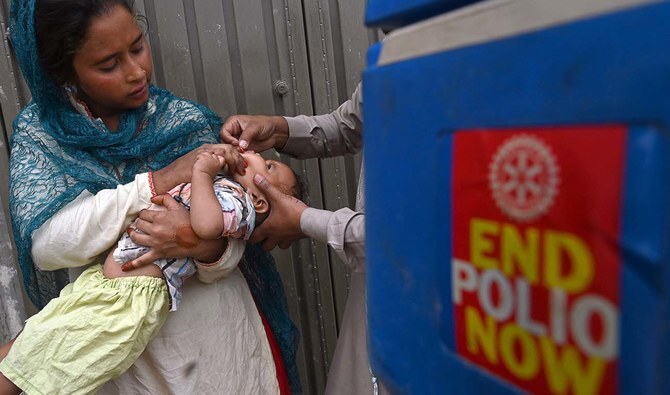
A health worker administers polio vaccine drops to a child during a door-to-door polio vaccination campaign at a slum area in Lahore on May 23, 2022. (AFP/File)
Short Url
Updated 21 November 2024
Follow

Pakistani PM thanks King Salman, Gates foundations for global anti-polio efforts

  • Pakistan, along with neighboring Afghanistan, remains last polio-endemic country in the world
  • This year, 50 cases have been reported in Pakistan so far, a majority in Balochistan province 

ISLAMABAD: Pakistani Prime Minister Shehbaz Sharif on Wednesday met a delegation of the Polio Oversight Board in Islamabad and thanked the King Salman and Bill & Melinda Gates foundations, among others, in their global efforts for polio eradication.

Pakistan, along with neighboring Afghanistan, remains the last polio-endemic country in the world. The nation’s polio eradication campaign has hit serious problems with a spike in reported cases this year that has prompted officials to review their approach to stopping the crippling disease.

Poliovirus, which can cause crippling paralysis particularly in young children, is incurable and remains a threat to human health as long as it has not been eradicated. Immunization campaigns have succeeded in most countries and have come close in Pakistan, but persistent problems remain.

“The Prime Minister thanked the King Salman Foundation, Bill & Melinda Gates Foundation, Rotary Foundation, UNICEF and CDC, which are partners with the Government of Pakistan in the polio eradication campaign,” Sharif’s office said in a statement after the meeting. 

“The role of all these organizations reflects the global efforts in the polio eradication campaign.”

This year, 50 cases have been reported in Pakistan: 24 from Balochistan province, 13 from Sindh, 10 from KP and one each from Punjab and Islamabad. 

In the early 1990s, Pakistan reported around 20,000 cases annually but in 2018 the number dropped to eight cases. Six cases were reported in 2023 and only one in 2021. 

Pakistan’s polio eradication program began in 1994, and the number of cases has declined dramatically since then. But efforts to eradicate the virus have for years been undermined by vaccine misinformation and opposition from some religious hard-liners, who say immunization is a foreign ploy to sterilize Muslim children or a cover for Western spies. Militant groups also frequently attack and kill members of polio vaccine teams. 

In July 2019, a vaccination drive in Khyber Pakhtunkhwa was thwarted after mass panic was created by rumors that children were fainting or vomiting after being immunized.

Public health studies in Pakistan have shown that maternal illiteracy and low parental knowledge about vaccines, together with poverty and rural residency, are also factors that commonly influence whether parents vaccinate their children against polio.

Pakistan’s chief health officer this month said an estimated 500,000 children had missed polio vaccinations during a recent countrywide inoculation drive due to vaccine refusals. 


Pakistan offloads wheat stocks, boosts provincial supply to stabilize prices

Updated 28 January 2026
Follow

Pakistan offloads wheat stocks, boosts provincial supply to stabilize prices

  • ECC approves sale of 500,000 tons of wheat, allocates 300,000 tons to Punjab
  • Cabinet body also clears utility arrears and approves vaccine and fertilizer funding

KARACHI: Pakistan’s top economic decision-making body on Wednesday approved the disposal of surplus government wheat stocks and a major inter-provincial allocation to stabilize domestic flour prices, as Islamabad seeks to manage food security risks while containing fiscal pressures.

The decisions come as Pakistan grapples with food inflation sensitivity, climate-related supply disruptions and the fiscal burden of carrying large public stocks. Wheat, the country’s staple food, is politically and economically critical because flour prices directly affect household inflation and living costs, and past volatility has triggered public unrest and costly emergency imports.

On Wednesday, the Economic Coordination Committee (ECC) of the Cabinet authorized the sale of 500,000 metric tons of wheat held by the Pakistan Agricultural Storage and Services Corporation (PASSCO), the federal grain procurement agency, through competitive bidding. It also approved the release of 300,000 metric tons to the Punjab government to ensure uninterrupted supplies to flour mills, according to an official statement issued by the Finance Division.

“The disposal of 500,000 metric tons of PASSCO wheat stock through competitive bidding aims at managing surplus stocks, reducing carrying and storage costs, and ensuring price stability in the domestic wheat market while safeguarding food security considerations,” the Finance Division said in a statement following the ECC meeting.

In a related move, the committee approved the provision of PASSCO wheat to Punjab, the country’s most populous province and a key driver of national wheat consumption, to help maintain adequate supplies for flour mills and prevent supply chain disruptions, the statement said.

Beyond food security, the ECC approved a technical supplementary grant - an off-budget allocation used to meet urgent funding needs - of Rs 10.98 billion ($39 million) to clear long-standing liabilities owed by the Pakistan Post Office Department to utility companies, part of broader efforts to address inter-government arrears that have strained public sector finances.

In the health sector, the committee authorized Rs 29.66 billion ($106 million) for the Federal Directorate of Immunization to ensure uninterrupted procurement of vaccines and syringes under the Expanded Program on Immunization, a move aimed at sustaining routine immunization coverage and preventing outbreaks of vaccine-preventable diseases.

The ECC also approved a Rs 23.42 billion ($84 million) subsidy package for imported urea, to be shared equally between the federal and provincial governments, as authorities seek to cushion farmers from rising fertilizer costs and limit spillover effects on food prices.