

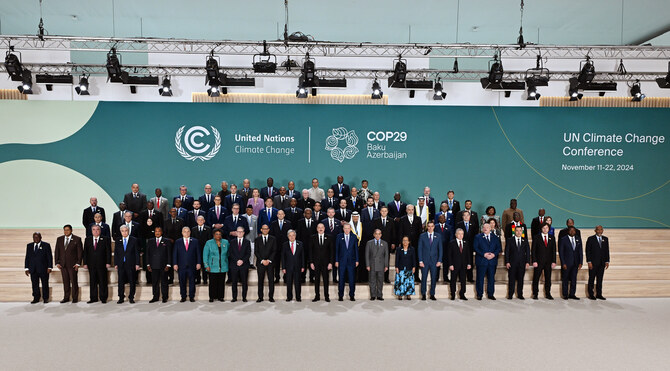
COP29 Day 2: World leaders gather in Baku for UN climate conference

World leaders gather for COP29. Supplied
Short Url
Updated 13 November 2024
Follow

COP29 Day 2: World leaders gather in Baku for UN climate conference

  • Top priority at COP29 is landing a hard-fought deal to boost funding for climate action in developing countries
  • African leaders shared national-level initiatives aimed at bolstering climate stability and economic prosperity

RIYADH: Dozens of world leaders convened in Azerbaijan on Tuesday for COP29 as the UN Secretary-General warned of the clock ticking for action to limit global temperature rises.

Speaking at the gathering in Baku, Antonio Guterres said the world is in the “final countdown” to limit global temperature rise to 1.5 degrees Celsius.

He added that 2024 is “almost certain” to be the hottest year on record.

His comments came as leading figures from governments around the world arrived for the summit, although many top politicians are not attending this year’s summit.

US President Joe Biden, China’s Xi Jinping, India’s Narendra Modi and French leader Emmanuel Macron are among G20 leaders missing the event.

The top priority at COP29 is landing a hard-fought deal to boost funding for climate action in developing countries.

Here are some of the key points from day 2 of COP29

African leaders warn of economic toll


Ethiopian President Taye Atske Selassie. Screenshot

During COP29, African leaders shared national-level initiatives aimed at bolstering climate stability and economic prosperity. 

Ethiopian President Taye Atske Selassie emphasized his nation's commitment to environmental restoration, saying: “We were able to plant 40 million trees, expanding our forest coverage to 23.6 percent with the potential to sink 10 billion tonnes of carbon.”  

He noted that Ethiopia has allocated 1 percent of its national budget towards a green legacy and land restoration fund, urging international support for these ongoing efforts. 

Tanzania’s Vice-President, Philip Mpango, highlighted the severe economic toll climate change has on developing nations, noting its current impact on his country.  

He added that Tanzania is losing 2 to 3 percent of its GDP annually due to climate-related damages, estimating the need for $19.2 billion by 2030 to meet its climate adaptation goals. 

Tiemoko Meyliet Kone, vice president of Cote d’Ivoire, outlined the economic risks his nation faces if climate action is not prioritized.  

“Without our bold initiatives, we could see a 13 percent drop in GDP by 2050, with nearly 2 million people falling into poverty,” Koné stated.  


Financial need is trillions, not billions, says President of Maldives


Screenshot

The lack of finance remains one of the main barriers for many countries, especially underdeveloped, to meet their climate goals, the President of Maldives told COP29.

Mohamed Muizzu explained that small island developing states need financing in trillions rather than billions.

“It is the lack of finance that inhibits our ambitions, which is why this COP, the finance COP we need to deliver the new climate finance goal, must reflect the true scale of the climate crisis. The need is in trillions, not billions,” Muizzu said.

Leaders call for an end to half-measures


Kazakhstan’s President Kassym-Jomart Tokayev. Screenshot

At COP 29, leaders stressed the need for urgent, cooperative action on climate change. Kazakhstan’s President Kassym-Jomart Tokayev pledged his country’s resources for the energy transition, emphasizing that demand must be socially responsible.  

Serbian President Aleksandar Vucic warned that while addressing environmental crises is essential, global peace is a prerequisite. He also called for financial solutions to aid smaller, poorer nations unfairly burdened by climate impacts caused by wealthier countries. 

Zimbabwe’s President Emmerson Mnangagwa urged an end to “half-measures,” while Turkiye’s President Recep Tayyip Erdogan highlighted his country’s vulnerability to climate change and its plans to expand nuclear energy capacity by 2050.  

Iraqi President Abdul Latif Rashid emphasized climate justice as a human rights issue, pressing for immediate action to protect current and future generations from the harsh realities of climate change. 

Leaders called for equity in green technology access and stronger global solidarity. Congo’s President Felix Tshisekedi reaffirmed his country’s commitment to biodiversity, and Belarusian President Aleksandr Lukashenko advocated for fair access to green technologies, ensuring developing nations retain autonomy over their resources. 


Fossil fuels ‘a gift of the God,’ Azerbaijan President tells COP29


Azerbaijan President Ilham Aliyev. Supplied

Defending fossil fuels and the right of countries to exploit them, Azerbaijan President Ilham Aliyev said: “Quote me that I said that this is a gift of the God, and I want to repeat it today here at this audience.”

He told delegates: “Oil, gas, wind, sun, gold, silver, copper, all ... are natural resources and countries should not be blamed for having them and should not be blamed for bringing these resources to the market, because the market needs them. People need them.”

UK Prime Minister Keir Starmer committed to a more ambitious climate goal for the country, saying greenhouse gas emissions would be cut by 81 percent versus 1990 levels by 2035 at the UN COP29 climate summit.

Last month Britain’s climate advisers, the Committee on Climate Change, made that recommendation to the government.

The emissions cut target recommended by the advisers compared to the current target of a 78 percent reduction by 2035 compared with 1990 levels and excludes international aviation and shipping emissions.

Saudi Arabia present at COP29


‘Without collaboration and cooperation ... we cannot hope to survive into the next century’ – Mayor of Kuala Lumpur


Supplied

The Mayor of Kuala Lumpur, Maimunah Sharif, used her address at the summit to highlight the critical issue of plastic pollution and its far-reaching effects.

She warned that by 2040, an estimated 1.3 billion tons of plastic will contaminate the air, water, and food we consume.

“In fact, each of us now has microplastics in our bloodstream, vital organs, and, as of this year, even in babies, in pregnant women,” Sharif said.


‘Developing countries must not leave Baku empty-handed’ — UN Secretary-General Antonio Guterres


UN Secretary-General Antonio Guterres​​​​​. Supplied

Guterres used a speech at COP29 to say the forum “must tear down the walls to climate finance.” 

He set out five elements he believes are critical to success: 

  • A significant increase in concessional public finance.
  • A clear indication of how public finance will mobilize the trillions of dollars developing countries need.
  • Tapping innovative sources, particularly levies on shipping, aviation, and fossil fuel extraction. Polluters must pay.
  • A framework for greater accessibility, transparency, and accountability – giving developing countries confidence that the money will materialize
  • Boosting lending capacity for bigger and bolder Multilateral Development Banks. 

Voluntary Carbon Markets

An announcement away from the speeches as Saudi Arabia’s Regional Voluntary Carbon Market Co. today launched its voluntary carbon market exchange platform, bringing 22 domestic and international companies on board on its first day of trading.

The launch of the platform is a major milestone in Saudi Arabia’s ambition to become one of the largest voluntary carbon markets in the world by 2030. It aims to scale up the supply and demand of high-quality carbon credits across the Global South and beyond, driving funding to climate projects that require finance, supporting the transition to global net zero emissions.

Speaking in Baku, Riham El-Gizy, RVCMC’s CEO said: “The message coming into COP is clear: To accelerate global decarbonization we must unlock financial flows to critical climate projects on an enormous scale. High integrity voluntary carbon markets can play an important role in bridging the climate finance gap this decade. But institutional grade infrastructure must be put in place to help buyers and sellers scale up private sector participation and achieve the market’s potential.”

RVCMC was established by the Public Investment Fund and Saudi Tadawul Group Holding Co. in October 2022. PIF holds an 80 percent stake and Tadawul Group holds a 20 percent stake in the company. 


Mapping Saudi soils to grow better crops

Updated 19 December 2025
Follow

Mapping Saudi soils to grow better crops

  • Palm trees, root crops, and coastal plants reveal the land’s story

RIYADH: Saudi Arabia’s land tells stories written beneath the feet. From fertile plains and rugged highlands to vast deserts, the Kingdom’s diverse landscapes shape what can grow, where it grows, and how agriculture can thrive.

Alongside geography and climate, soil conditions play a decisive role in agricultural success. Understanding soil types across the Kingdom helps determine which crops can flourish and what interventions may be needed to sustain them.

In an interview with Arab News, Turki Almutairi, a senior environmental specialist at the National Afforestation Center under the National Center for Vegetation Cover Development and Combating Desertification, outlined the main soil types found across Saudi Arabia.

High amount of salt makes the soil unfit for the production of most crops, even if the soil is fertile. (Supplied)

“The dominant soil in the Kingdom are sandy desert soils, alongside calcareous soils in the central region. Rocky and stony soils are present along mountainous and hilly landscapes,” he said.

“Alluvial soils are common in wadies (valleys), while saline and sodic soils are located in depressions (Sabkhas) and along coastlines. Pockets of clayed soils can be also found around few sites along the Kingdom.”

The Kingdom’s vast territory gives rise to unique soil characteristics in each region, enabling different crops to grow depending on local conditions.

“Soil is the growing medium for plants. The role of soil includes structural stabilization, providing nutrients and a communication medium for plants,” Basil Nasir, soil lead at engineering consultancy William Sale Partnership, told Arab News.

Basil Nasir, soil lead at the engineering consultant company, William Sale Partnership (WSP). (Supplied)

According to Nasir, assessing soil use is essential before determining whether it is fertile or infertile, as different soils support different plant types.

“The soil used for trees differs from the soil used for ornamental plants and from the soil used for aquatic plants. It varies according to the specific needs of each plant, and based on this, we determine what the soil requires and assess its fertility,” he said.

Nasir explained that soil characteristics are shaped by both physical and chemical components. In addition to water and air, mineral particles such as sand, silt and clay are key indicators of soil health. Organic matter, derived from plant and animal remains, forms the fourth major component.

The balance between these elements determines soil behavior. One important physical trait is water-holding capacity, which influences what types of plants a soil can support.


Opinion

This section contains relevant reference points, placed in (Opinion field)

“If the soil is like dunes, adding water will cause it to run off, but if the soil is clay, its ability to retain water will be very high. If you add water and return the next day, you will find that the water is still there,” said Nasir.

Chemical properties, such as whether soil is alkaline or acidic, are equally important. Understanding both physical and chemical traits allows for proper assessment and treatment when needed.

“What determines whether a plant is suitable for a particular environment is primarily the plant's nature. For example, some plants have fibrous roots and therefore do not require well-draining soil,” Nasir added.

“A palm tree, for example, does not care whether it was planted in one soil or the other because its roots are fibrous. Therefore, palm trees are strong plants and are suitable to grow in both dry and wetlands, while preferring sandy areas.”

Soil Salinity can be treated through Soil leaching which means washing the soil with certain amount of water to reduce the salt in it. (Supplied)

Crops such as potatoes, onions, carrots and beetroots — where the edible part grows underground — typically thrive in sandy soils. As a result, plantations of these crops are commonly found in northern regions such as Hail and in Wadi Ad-Dawasir.

In the eastern region, including Al-Ahsa, wetlands are more common due to climatic conditions. Growing plants in such environments often requires human intervention.

“Plants that are coastal or could be found in lagoons or lakes must have some sort of soil around them, like lotus flowers and mangrove trees.”

“An important parameter to keep in mind is that there is no air in its soil, and they are adapted to this condition. However, the lack of air, along with the presence of organic matter, will create a situation where anaerobic bacteria react with the soil, potentially causing diseases we can easily avoid,” said Nasir.

He emphasized that removing organic matter from such soils is essential to ensure plant survival in aquatic environments.

Mountainous and rocky regions in Saudi Arabia are generally volcanic, resulting in low water-holding capacity and challenging growing conditions. However, volcanic ash contributes to high fertility, allowing certain crops to flourish.

As a result, western regions support tree crops such as coffee, mangoes, some banana varieties and pomegranates.

There are various types of soils such as clay, sandy, silty and loamy. Each type provides excellent conditions for specific plants. (Supplied)

As development accelerates across the Kingdom, soil improvement efforts are expanding under the National Greening Program.

“Soil is considered fundamental for the National Greening Program’s objectives. Understanding the soil variability along the Kingdom is a precondition for fostering sustainable soil management,” Almutairi told Arab News.

Adding, “In this line, the NGP is working towards the establishment of the Saudi Soil Information System (TURBA-KSA), which consists of mapping soils and its functional properties in the Kingdom using state-of-the-art technology.”

He also noted the creation of the “Land Rehabilitation Watch” to report, verify and monitor land rehabilitation nationwide.

“This milestone allows the Kingdom to understand how soil and land health are progressing against national and international targets of land degradation neutrality. Documenting good soil and land management practices is also important, so that those successful practices could be scaled up along the Kingdom, which is a priority task for NGP,” he said.

Raising public awareness is another key pillar of the program.

“Assessing different emerging technologies and soil amendments is a daily activity of NGP, as it then provides technical support to partners on the selection and application of these technologies.”

DID YOU KNOW?

• Saudi Arabia cultivates around 1 million hectares, mainly in Riyadh, Qassim, Hail, and Jouf.

• Farming follows the seasons: winter brings onions, garlic, and carrots, while summer yields watermelon, tomatoes, and cucumbers.

• The Kingdom is a top date producer, with over 31 million palm trees generating nearly 1.54 million tons, especially in Riyadh and Qassim.

Almutairi stressed that soil is often overlooked because it lies unseen beneath the surface, despite its critical role.

Yet soil produces 95 percent of food, stores water, holds more carbon than vegetation and the atmosphere, suppresses contaminants, regulates water, carbon and nutrient cycles, and hosts microorganisms linked to the human microbiome.

He emphasized the need to engage the general public, particularly urban communities disconnected from nature. Education helps people understand where food comes from and how contact with soil — such as walking barefoot — can support well-being. Healthy soils also contribute to cleaner water and air, he added.

Almutairi also called for stronger advocacy among decision-makers, noting that investment in healthy soils supports climate action, food security and sustainable development.

He concluded that key strategies include officially observing UN World Soil Day on Dec. 5, integrating soil education into curricula, launching annual social media campaigns, using art to raise awareness, and organizing public events that connect soils to everyday life.