

Nearly 25 million votes already cast as Harris, Trump hit battleground states

1 / 4
Students at The University of Wisconsin-Madison fill out ballots during the first day of Wisconsin's in-person absentee voting on the campus in Madison, Wisconsin, on Oct. 22, 2024. (Wisconsin State Journal/AP)
2 / 4
Students at The University of Wisconsin-Madison wait in line to cast their ballots in the 2024 election during the first day of Wisconsin's in-person absentee voting on the campus in Madison, Wisconsin on Oct. 22, 2024. (Wisconsin State Journal/AP)
3 / 4
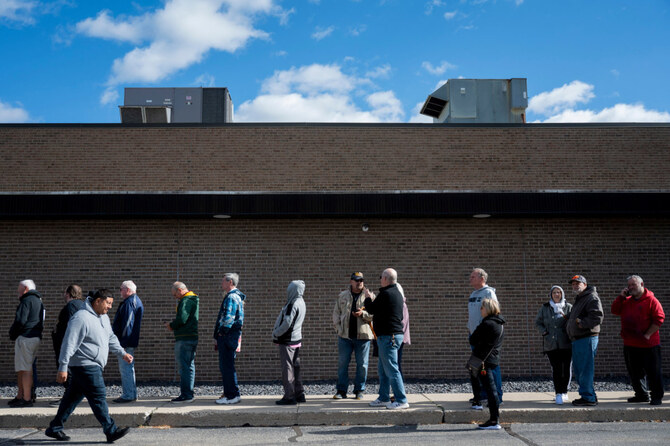
People wait in line to vote on the second day of early voting in Wisconsin at the American Serb Hall Banquet in Milwaukee, Wisconsin, on October 23, 2024. (REUTERS)
4 / 4
A woman puts her ballot in a ballot box on the second day of early voting in Wisconsin at the Milwaukee Area Technical College on October 23, 2024. (REUTERS)
Short Url
Updated 24 October 2024
Follow

Nearly 25 million votes already cast as Harris, Trump hit battleground states

  • Harris seeks support from undecided voters in Pennsylvania
  • Trump campaigns in Georgia with Tucker Carlson and Robert F. Kennedy Jr

PHILADELPHIA/ZEBULON, Georgia: With millions of US voters already heading to the polls, Democratic presidential candidate Kamala Harris on Wednesday will seek support from undecided voters at a televised town hall in battleground Pennsylvania, while Republican Donald Trump swept through Georgia.
Nearly 25 million voters have cast ballots, either through in-person early voting or mail-in ballots, according to tracking data from the Election Lab at the University of Florida.
Several states, including the battlegrounds of North Carolina and Georgia, set records on their respective first day of early voting last week.
“The votes in Georgia are at record levels,” Trump told a religious-themed “ballots and believers” event in Zebulon, Georgia. “The votes in every state, frankly, are at record levels. We’re doing really well and hopefully we can fix our country.”


Voters wait in line on the second day of early voting in Wisconsin at the American Serb Hall Banquet in Milwaukee, Wisconsin, on October 23, 2024. (REUTERS)

The robust early turnout comes as Vice President Harris and former President Trump remain neck and neck in the seven most competitive states with less than two weeks to go until the Nov. 5 election.
Trump in recent days has sought to rally turnout from Christian evangelicals, hoping they will set aside any concerns about his frequent off-color commentary like his tale about Arnold Palmer’s anatomy.
Trump, who made campaign rallies a staple of his political career starting back in 2015, said in Zebulon that “in many ways it’s sad” that his time as a political candidate is coming to a close. If he wins on Nov. 5, he would serve his second and final term.
“We’ve been doing this for nine years, and it’s down to 12 days,” he said.
After Zebulon, Trump was headed to Duluth, Georgia, for a rally with former Fox News star Tucker Carlson and former independent presidential candidate Robert F. Kennedy Jr.
Harris was to participate in a CNN town hall in Chester Township, Pennsylvania, an attempt to persuade the dwindling number of undecided voters to support her and help turn the tide in a closely divided race where even a small percentage of votes could be critical.
Harris on Wednesday seized on comments by Trump’s former White House chief of staff John Kelly, who told the New York Times that the former president met the “general definition of fascist” and admired dictators.
Harris, who has argued that Trump is a threat to US democracy, called Trump’s remarks as quoted by Kelly “deeply troubling and incredibly dangerous.” Trump’s campaign has denied Kelly’s account, calling them “debunked stories.”
Harris tried and failed to push Trump to agree to a second presidential debate on CNN after she was considered to have won the first and only presidential debate between the two candidates, which took place in September on ABC News.
Pennsylvania and Georgia are among the seven battleground states that will decide who wins the presidency, and both candidates are likely to spend much of the rest of their campaigns visiting them. Harris held a marginal 46 percent to 43 percent lead nationally over the former president in the latest Reuters/Ipsos poll.


EU leaders to reassess US ties despite Trump U-turn on Greenland

Updated 55 min 3 sec ago
Follow

EU leaders to reassess US ties despite Trump U-turn on Greenland

  • Diplomats stressed that, although Thursday’s emergency EU talks in Brussels would now lose some of their urgency, the longer-term issue of how to handle the relationship with the US remained

BRUSSELS: EU leaders will rethink their ties with the US at an emergency summit on Thursday after Donald Trump’s threat of tariffs and even military action to ​acquire Greenland badly shook confidence in the transatlantic relationship, diplomats said.
Trump abruptly stepped back on Wednesday from his threat of tariffs on eight European nations, ruled out using force to take Greenland, a semi-autonomous territory of NATO ally Denmark, and suggested a deal was in sight to end the dispute.
German Chancellor Friedrich Merz, welcoming Trump’s U-turn on Greenland, urged Europeans not to be too quick to write off the transatlantic partnership.
But EU governments remain wary of another change of mind by a mercurial president who is increasingly seen as a bully that Europe will have to stand up to, and they are focused on coming up with a longer-term plan on how to deal with the ‌United States under this ‌administration and possibly its successors too.
“Trump crossed the Rubicon. He might do ‌it ⁠again. ​There is no ‌going back to what it was. And leaders will discuss it,” one EU diplomat said, adding that the bloc needed to move away from its heavy reliance on the US in many areas.
“We need to try to keep him (Trump) close while working on becoming more independent from the US It is a process, probably a long one,” the diplomat said.
EU RELIANCE ON US
After decades of relying on the United States for defense within the NATO alliance, the EU lacks the needed intelligence, transport, missile defense and production capabilities to defend itself against a possible Russian attack. This gives the US substantial leverage.
The US ⁠is also Europe’s biggest trading partner, making the EU vulnerable to Trump’s policies of imposing tariffs to reduce Washington’s trade deficit in goods, and, as in ‌the case of Greenland, to achieve other goals.
“We need to discuss where ‍the red lines are, how we deal with this bully ‍across the Atlantic, where our strengths are,” a second EU diplomat said.
“Trump says no tariffs today, but does ‍that mean also no tariffs tomorrow, or will he again quickly change his mind? We need to discuss what to do then,” the second diplomat said.
The EU had been considering a package of retaliatory tariffs on 93 billion euros ($108.74 billion) on US imports or anti-coercive measures if Trump had gone ahead with his own tariffs, while knowing such a step would harm Europe’s economy as well ​as the United States.
WHAT’S THE GREENLAND DEAL?
Several diplomats noted there were still few details of the new plan for Greenland, agreed between Trump and NATO Secretary General Mark Rutte late on ⁠Wednesday on the sidelines of the World Economic Forum in Davos, Switzerland.
“Nothing much changed. We still need to see details of the Greenland deal. We are a bit fed up with all the bullying. And we need to act on a few things: more resiliency, unity, get our things together on internal market, competitiveness. And no more accepting tariff bullying,” a third diplomat said.
Rutte told Reuters in an interview in Davos on Thursday that under the framework deal he reached with Trump the Western allies would have to step up their presence in the Arctic.
He also said talks would continue between Denmark, Greenland and the US on specific issues.
Diplomats stressed that, although Thursday’s emergency EU talks in Brussels would now lose some of their urgency, the longer-term issue of how to handle the relationship with the US remained.
“The approach of a united front in solidarity with Denmark and Greenland while focusing on de-escalation and finding an off-ramp has worked,” a fourth EU diplomat said.
“At the ‌same time it would be good to reflect on the state of the relationship and how we want to shape this going forward, given the experiences of the past week (and year),” he said.