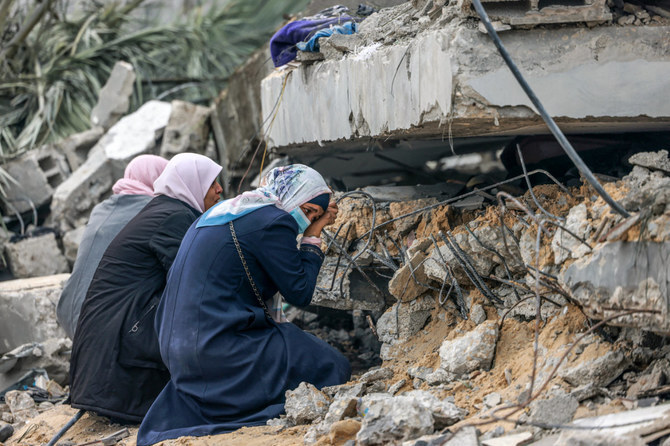
UNITED NATIONS: The proportion of women killed in conflict in 2023 doubled compared to the previous year, according to a UN report that denounced “oppressive patriarchal” structures and called out an increase in sexual violence in war zones.
In the annual “Women and Peace and Security” report published on Tuesday evening, UN Secretary-General Antonio Guterres painted a stark picture showing “progress made over decades is vanishing before our eyes.”
According to the UN’s data, of at least 33,443 civilian deaths recorded in conflicts around the world in 2023 — 72 percent more than in 2022 — four out of 10 were women, a 100 percent increase, and three out of 10 were children.
“Amid record levels of armed conflict and violence... generational gains in women’s rights hang in the balance around the world, undercutting the transformative potential of women’s leadership and inclusion in the pursuit of peace,” the report said.
UN Women Executive Director Sima Bahous said the trends were part “of a larger war on women.”
“Women continue to pay the price of the wars of men,” she said.
“The deliberate targeting of women’s rights is not unique to conflict-affected countries but is even more lethal in those settings.”
In 2023, more than 170 armed conflicts were recorded, with around 612 million women and girls living within 50 kilometers (30 miles) of these conflicts — 150 percent more than a decade ago, the report said.
The number of cases of sexual violence against women in those conflict zones increased by 50 percent, the UN’s data showed, with the number of girls affected by “grave violations” in active conflict areas increasing by 35 percent.
“Perpetrators of sexual violence still largely enjoy impunity,” the report said. “In the Democratic Republic of the Congo, more than 123,000 cases of gender-based violence were reported in 2023, a 300 percent increase in only three years.”
Women also made up a tiny fraction of those involved in peace negotiations, the UN’s data showed.
Preliminary data from 50 peace processes showed that in 2023, on average, women made up only 9.6 percent of negotiators, 13.7 percent of mediators and 26.6 percent of signatories to peace agreements and ceasefire agreements.
The proportion of women signatories dropped to 1.5 percent if agreements in Colombia were excluded.
“Power and decision-making on peace and security matters remain overwhelmingly dominated by men, and progress has been disturbingly slow in terms of ending impunity for those who perpetrate atrocities against women and girls,” the report said.


Proportion of women killed in conflict doubled in 2023: UN
https://arab.news/6xg5b
Proportion of women killed in conflict doubled in 2023: UN

- UN Secretary-General Antonio Guterres painted a stark picture showing “progress made over decades is vanishing before our eyes“
- “Amid record levels of armed conflict and violence... generational gains in women’s rights hang in the balance around the world,” the report said


Bolivia and Israel to restore ties severed over the war in Gaza
- Paz's government eased visa restrictions on American and Israeli travelers last month
- The Bolivian foreign ministry said its top diplomat would meet his Israeli counterpart in Washington later Tuesday to discuss the revival of bilateral ties
LA PAZ, Bolivia: Bolivia's new right-wing government said Tuesday that it would restore diplomatic relations with Israel, the latest sign of the dramatic geopolitical realignment underway in the South American country that was once among the most vocal critics of Israeli policies toward Palestinians.
The Bolivian foreign ministry said its top diplomat would meet his Israeli counterpart in Washington later Tuesday to discuss the revival of bilateral ties, which Bolivia's previous left-wing government severed two years ago over Israel's devastating campaign against Hamas in Gaza.
Bolivia said the effort came as part of a new foreign policy strategy under conservative President Rodrigo Paz aimed at “rebuilding Bolivia's international prestige, opening new economic opportunities and strengthening alliances that directly benefit the country and our citizens abroad."
Bolivian Foreign Minister Fernando Aramayo is in the midst of a whirlwind trip to Washington for meetings with American officials as his government works to warm long-chilly relations with the United States and unravel nearly two decades of hard-line, anti-Western policies under the Movement Toward Socialism, or MAS, party that left Bolivia economically isolated and diplomatically allied with China, Russia and Venezuela.
Paz's government eased visa restrictions on American and Israeli travelers last month.
In announcing his expected meeting with Aramayo on Monday, Israeli Foreign Minister Gideon Saar thanked Bolivia for scrapping Israeli visa controls and said he spoke to Paz after the center-right senator's Oct. 19 election victory to express “Israel’s desire to open a new chapter” in relations with Bolivia.
Paz entered office last month, ending the dominance of the MAS party founded by Evo Morales, the charismatic former coca-growing union leader who became Bolivia's first Indigenous president in 2006. Not long after taking power, Morales sent Israel's ambassador packing and cozied up to Iran over their shared enmity toward the U.S. and Israel.
When protests over Morales' disputed 2019 reelection prompted him to resign under pressure from the military, a right-wing interim government took over and restored full diplomatic relations with the U.S. and Israel as it sought to undo many of Morales’ popular policies.
But 2020 elections brought the MAS party back to power with the presidency of Luis Arce, who in 2023 once again cut ties with Israel in protest over its military actions in Gaza.
Other left-wing Latin American countries, like Chile and Colombia, soon made similar moves, recalling their ambassadors and joining South Africa’s genocide case against Israel before the United Nations’ highest judicial body.


