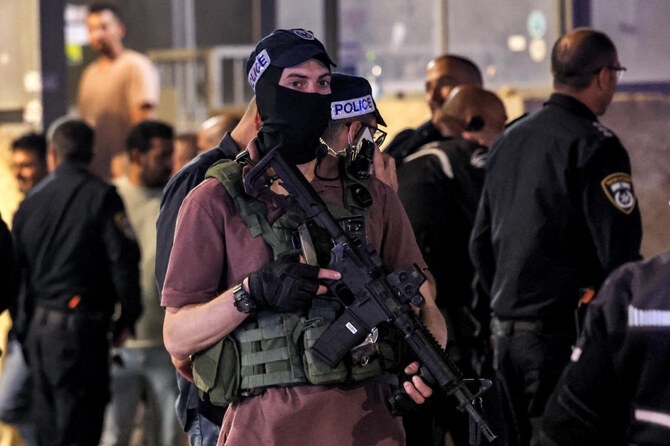
JERUSALEM: Israeli police on Monday said they had arrested a spy network of seven Israeli citizens who were gathering information on Israel’s military bases and energy infrastructure for Iranian intelligence.
The internal security agency and police “successfully dismantled a spy network involving seven Israeli citizens who were operating on behalf of Iranian intelligence,” the police said in a statement, adding that all seven had been arrested.
The seven Israelis were from the city of Haifa and northern areas of the country.
“This network was engaged in gathering sensitive information on IDF (military) bases and energy infrastructure,” it said.
Israeli investigations had revealed that the group carried out several missions under the direction of two Iranian agents known as “Alkhan and Orkhan” over a period of two years, the police said.
“The network members were aware that the intelligence they provided compromised national security and could potentially aid enemy missile attacks,” the police said.
“The network conducted extensive reconnaissance missions on IDF bases nationwide, focusing on air force and navy installations, ports, Iron Dome system locations, and energy infrastructure such as the Hadera power plant,” the police said.
It added that the group received hundreds of thousands of dollars for the work, often through crypto-currency payments.
The work often involved photographing and documenting strategic sites, with the collected data being handed over to Iranian agents, the police said.
“The investigation led to seizure of substantial materials compiled by the network members for Iranian agents,” an official from Israel’s internal security agency was quoted as saying in the police statement.
“These included photographs and videos of numerous IDF bases across Israel, ports, and energy infrastructure.
“It is assessed that these activities have inflicted security damage on the state.”
Members of the group were also tasked with collecting intelligence on several Israeli citizens at the behest of the Iranian agents, it said.
Israel is currently engaged in a multi-front conflict with Iran-backed groups such as Hezbollah in Lebanon, Hamas in Gaza and the Houthis in Yemen.
Israel has also vowed to retaliate over an missile attack by Tehran on October 1.


![]()

Israel police say seven Israelis arrested for spying for Iran
Short Url
https://arab.news/z4css
Israel police say seven Israelis arrested for spying for Iran
- The seven Israelis were from the city of Haifa and northern areas of the country
- “This network was engaged in gathering sensitive information on IDF (military) bases and energy infrastructure,” police said


Latest updates




© 2026 SAUDI RESEARCH & PUBLISHING COMPANY, All Rights Reserved And subject to Terms of Use Agreement.