India-Canada relations reach historic lows as top diplomats expelled

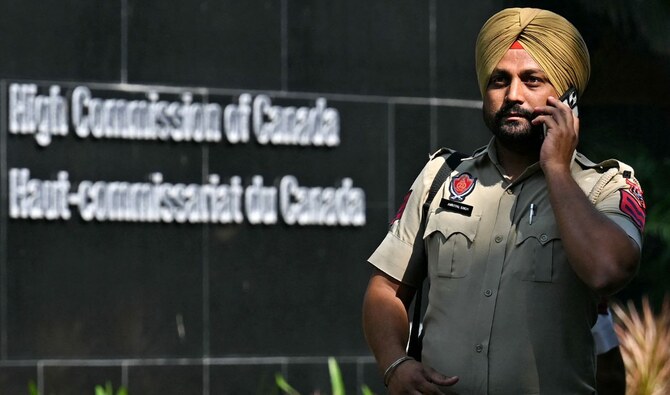
An Indian policeman stands guard outside the entrance of the Canadian High Commission, in New Delhi on October 15, 2024. (AFP)
Short Url
Updated 15 October 2024
Follow

India-Canada relations reach historic lows as top diplomats expelled

  • Relations fraught since the murder of a Sikh separatist leader in British Columbia last year
  • Canadian PM says Indian officials identified as ‘persons of interest’ in the assassination plot

NEW DELHI: Relations between India and Canada have reached a historic low as the countries expelled each other’s diplomats in an ongoing row over the killing of a Sikh separatist activist on Canadian soil.

Canadian Prime Minister Justin Trudeau accused India’s government on Monday of “supporting criminal activity against Canadians here on Canadian soil,” and the country’s Foreign Ministry announced the expulsion of six Indian diplomats, including the high commissioner.

The ministry said Canadian police had gathered evidence, which identified them as “persons of interest” in last year’s killing of Hardeep Singh Nijjar, who was gunned down in Surrey, British Columbia.

India immediately rejected the accusations as absurd, and its Ministry of External Affairs said it was expelling Canada’s acting high commissioner, his deputy, and the embassy’s four first secretaries.

Before the announcement, it also summoned the Canadian charge d’affaires and said it was withdrawing its high commissioner and “other targeted diplomats,” contradicting Canada’s statement of expulsion.

“Prime Minister Trudeau has been making these public statements repeatedly, but the evidence that he claims to possess is not available to us so we cannot make any kind of a judgment,” Dr. Ajai Sahni, executive director of the Institute for Conflict Management in New Delhi, told Arab News.

“This is the first time the relationship is so low … It has created a lot of problems and it has done damage to relationships between the two countries for the time being.”

This is not the first time India-Canada relations have been strained. In 1974, after India conducted its first nuclear weapon test, it drew outrage from Canada, which accused it of extracting plutonium from a Canadian reactor, a gift intended for peaceful use.

Ottawa subsequently suspended its support for New Delhi’s nuclear energy program.

“The relationship was also low in the 1980s with the hijacking of an Indian Airlines plane and the bombing of the plane, in which many people died,” said Prof. Ronki Ram, political science lecturer at the Punjab University.

The explosion from a bomb planted by Canada-based militants killed 329 people — the worst terrorist attack in Canadian history. India had warned the Canadian government about the possibility of attacks and accused the Canadian Security Intelligence Service of not acting on it.

But the current strain in relations is the first in which diplomats have been withdrawn.

“This is the first time that the relationship has gone down so low,” Ram said.

“Allegations and counter-allegations will have serious implications both internationally and domestically. The Indian government should look into the allegations and try to address them.”

Nijjar, a Sikh Canadian citizen, was gunned down in June 2023 outside a Sikh temple in Surrey, which has a significant number of Sikh residents. He was an outspoken supporter of the Khalistan movement, which calls for a separate Sikh homeland in parts of India’s Punjab state.

The movement is outlawed in India, considered a national security threat by the government, and Nijjar’s name appears on the Indian Home Ministry’s list of terrorists.

Canada has the largest population of Sikhs outside their native state of Punjab — about 770,000 or 2 percent of its entire population.

“Many Panjabi diaspora are in Canada, and a mini-Punjab has been established there,” Ram said.

“The government is taking an electoral interest in the landscape of Canada also. Those things are becoming very critical.”


Pakistan’s Lahore marks Basant festival after government lifts decades-old ban on kite flying

Updated 5 sec ago
Follow

Pakistan’s Lahore marks Basant festival after government lifts decades-old ban on kite flying

  • Pakistan’s Punjab province outlawed Basant in 2000s after authorities linked metal-coated kite strings and celebratory gunfire to multiple deaths and injuries
  • The three-day festivities began after midnight on Thursday as residents gathered on brightly lit rooftops to fly colorful kites to welcome the cultural festival

ISLAMABAD: The eastern Pakistani city of Lahore on Friday welcomed the return of Basant spring festival after the government this year lifted a more than two-decade-old ban on kite flying for a period three days, with Punjab Chief Minister Maryam Nawaz urging masses to follow precautions.

Provincial officials, including Punjab Information Minister Azma Bokhari, were seen flying kites in videos widely shared online. Meanwhile, the prices of air tickets from various Pakistani cities to Lahore have skyrocketed during the three days of the festival as more and more people try to join the celebrations after over a 20-year-hiatus.

Basant, once a vibrant tradition signaling the arrival of spring with colorful kites and rooftop festivities, was outlawed in Pakistan’s Punjab province in the 2000s after authorities linked metal-coated kite strings and celebratory gunfire to multiple deaths and injuries.

The government of CM Nawaz this year allowed Basant festivities in the provincial capital of Lahore, Pakistan’s cultural heart, on Feb. 6-8, but issued an extensive safety plan regarding kite materials and motorcyclists and pedestrians to avoid any untoward incident.

Commuters ride past a large model of a kite celebrating the Basant festival in Lahore on February 3, 2026. (AFP)

The three-day festivities began after midnight on Thursday as residents of Lahore gathered on their brightly lit rooftops along with family, friends and guests visiting from other cities and abroad to fly colorful kites to welcome the return of Basant.

“Kites return to the skies of Lahore as Basant comes alive again after 25 years,” CM Nawaz said on X. “A celebration of culture, color, and community! Let’s enjoy the festivities together responsibly, follow all safety SOPs (standard operating procedures), and make this Basant safe for everyone.”

The Pakistan Meteorological Department (PMD) this week forecast favorable weather conditions for kite flying in Lahore on Feb. 6-8, marked by light westerly winds blowing at speeds of 10–15 kilometers an hour.

Authorities have distributed 1 million safety rods among motorcyclists through designated safety points across Lahore, with spending on the initiative crossing Rs110 million ($392,000), according to local media reports. To enforce regulations and manage traffic flow, around 100 road safety camps have been set up in the city, staffed by teams from the district administration, traffic police and rescue services.

In addition, the Punjab government has launched a free shuttle service to reduce traffic congestion and promote safer travel via 695 buses deployed across Lahore.