

Pakistan’s Lahore marks Basant festival after government lifts decades-old ban on kite flying

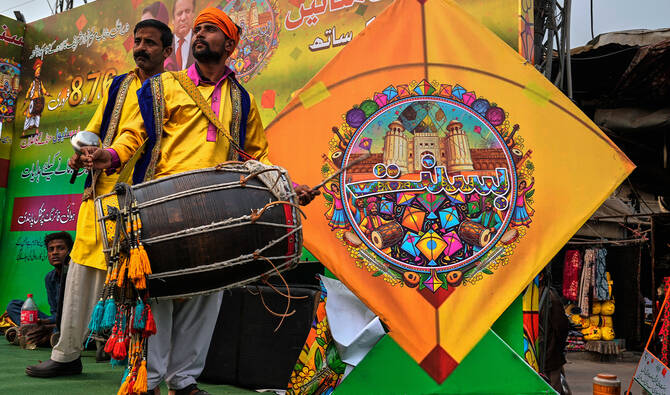
Traditional drummers perform on a truck decorated with colourful kites ahead of the three-day kite flying Basant festival celebrations, in Lahore, Pakistan, on Feb. 3, 2026. (AP)
Short Url
Updated 06 February 2026
Follow

Pakistan’s Lahore marks Basant festival after government lifts decades-old ban on kite flying

  • Pakistan’s Punjab province outlawed Basant in 2000s after authorities linked metal-coated kite strings and celebratory gunfire to multiple deaths and injuries
  • The three-day festivities began after midnight on Thursday as residents gathered on brightly lit rooftops to fly colorful kites to welcome the cultural festival

ISLAMABAD: The eastern Pakistani city of Lahore on Friday welcomed the return of Basant spring festival after the government this year lifted a more than two-decade-old ban on kite flying for a period three days, with Punjab Chief Minister Maryam Nawaz urging masses to follow precautions.

Basant, once a vibrant tradition signaling the arrival of spring with colorful kites and rooftop festivities, was outlawed in Pakistan’s Punjab province in the 2000s after authorities linked metal-coated kite strings and celebratory gunfire to multiple deaths and injuries.

The government of CM Nawaz this year allowed Basant festivities in the provincial capital of Lahore, Pakistan’s cultural heart, on Feb. 6-8, but issued an extensive safety plan regarding kite materials and motorcyclists and pedestrians to avoid any untoward incident.
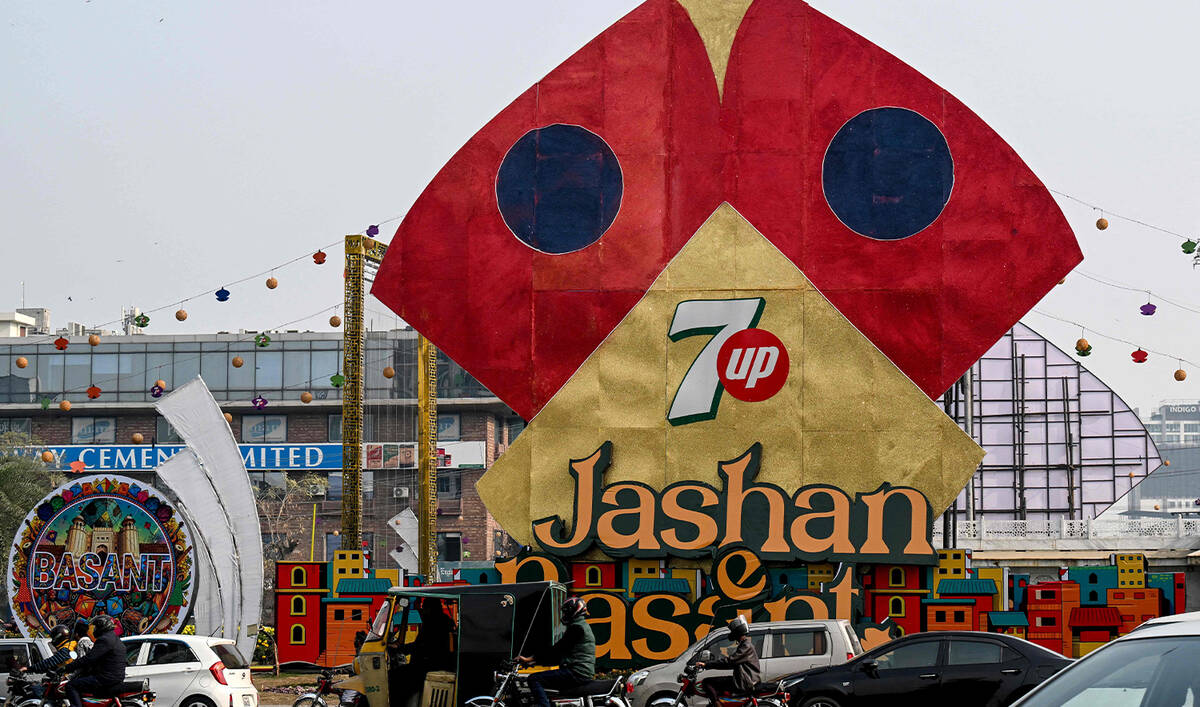


Commuters ride past a large model of a kite celebrating the Basant festival in Lahore on February 3, 2026. (AFP)

The three-day festivities began after midnight on Thursday as residents of Lahore gathered on their brightly lit rooftops along with family, friends and guests visiting from other cities and abroad to fly colorful kites to welcome the return of Basant.

“Kites return to the skies of Lahore as Basant comes alive again after 25 years,” CM Nawaz said on X. “A celebration of culture, color, and community! Let’s enjoy the festivities together responsibly, follow all safety SOPs (standard operating procedures), and make this Basant safe for everyone.”

Provincial officials, including Punjab Information Minister Azma Bokhari, were seen flying kites in videos widely shared online. Meanwhile, the prices of air tickets from various Pakistani cities to Lahore have skyrocketed during the three days of the festival as more and more people try to join the celebrations after over a 20-year-hiatus.

The Pakistan Meteorological Department (PMD) this week forecast favorable weather conditions for kite flying in Lahore on Feb. 6-8, marked by light westerly winds blowing at speeds of 10–15 kilometers an hour.

Authorities have distributed 1 million safety rods among motorcyclists through designated safety points across Lahore, with spending on the initiative crossing Rs110 million ($392,000), according to local media reports. To enforce regulations and manage traffic flow, around 100 road safety camps have been set up in the city, staffed by teams from the district administration, traffic police and rescue services.

In addition, the Punjab government has launched a free shuttle service to reduce traffic congestion and promote safer travel via 695 buses deployed across Lahore.


Babar Azam dropped for scoring too slowly, says Pakistan coach Hesson

Updated 7 sec ago
Follow

Babar Azam dropped for scoring too slowly, says Pakistan coach Hesson

  • Shaheen Shah Afridi was left out after conceding 101 runs in three matches
  • Pakistan will now face New Zealand in the opening match of the second phase

COLOMBO: Batting great Babar Azam was dropped for Pakistan’s final T20 World Cup group game against Namibia for scoring too slowly, said head coach Mike Hesson on Friday.

Azam, who is the highest run-scorer in T20 international history with 4,571 runs, was left out for the must-win game against Namibia as Pakistan racked up 199-3 and secured a place in the Super Eights by 102 runs.

The 2009 champions face New Zealand in Colombo on Saturday in the opening match of the second phase.

“I think Babar is well aware that his strike rate in the power play in the World Cup is less than 100 and that’s clearly not the role we think we need,” Hesson told reporters after Pakistan’s final practice session on Friday was washed out by rain.

Pakistan left out Azam for the same reason at last year’s Asia Cup and even after dismal showing in the Big Bash League, he was still selected for the T20 World Cup.

“We brought Babar back in for a specific role post the Asia Cup,” said Hesson.

“We’ve got plenty of other options who can come in and perform that role toward the end.

“Babar is actually the first to acknowledge that.

“He knows that he’s got a certain set of skills that the team requires and there are certain times where other players can perform that role more efficiently.”

Hesson also defended dropping pace spearhead Shaheen Shah Afridi after he conceded 101 runs in three matches, including 31 in two overs against India.

“We made a call that Salman Mirza was coming in for Shaheen, and he bowled incredibly well,” said Hesson.

“To be fair, he was probably really unlucky to not be playing the second and third games.”

Hesson was wary of Pakistan’s opponents on Saturday.

“New Zealand have played a huge amount in the subcontinent in recent times so we have to play at our best.”
