Funeral service held in Iraq for Iranian general killed with Hezbollah chief

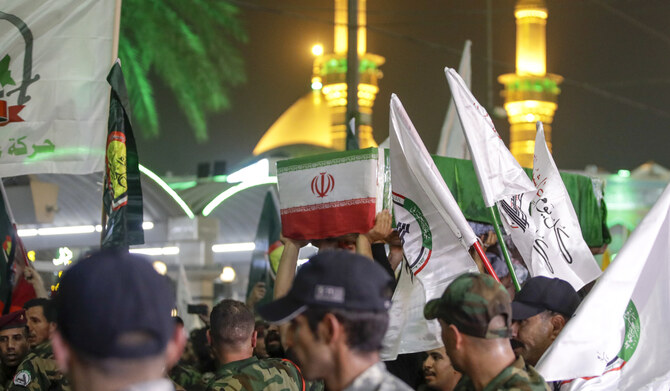
Mourners carry the coffin of Iranian Revolutionary Guards' deputy commander Brigadier Gen. Abbas Nilforushan who died alongside Hezbollah leader Hassan Nasrallah in an Israeli airstrike in Beirut last month during his funeral in Karbala, Iraq, Monday, Oct. 14, 2024. (AP)
Short Url
Updated 15 October 2024
Follow

Funeral service held in Iraq for Iranian general killed with Hezbollah chief

  • Israel said it carried out the Beirut strike but did not comment on Haniyeh’s death in Tehran, where he had attended the inauguration of the Islamic republic’s new president

KARBALA, Iraq: The funeral procession for Iranian Revolutionary Guard General Abbas Nilforoushan, who was killed in an Israeli air strike alongside Hezbollah chief Hassan Nasrallah, began in Iraq on Monday, an AFP photographer saw.
Nilforoushan, a top commander in the Islamic Revolutionary Guard Corps Quds Force foreign operations arm, was killed on September 27 alongside Nasrallah in the strike on south Beirut.
The Guard Corps said on Friday that Nilforoushan’s body had been recovered from the site of the strike on the Lebanese capital’s southern suburbs, a Hezbollah stronghold.
His body was taken from Beirut to the central Iraqi city of Karbala, considered holy by Shia Muslims.
There it was taken to the shrine of Imam Husayn where a representative of Iraq’s top Shia cleric, Ayatollah Ali Al-Sistani, led funeral prayers before a massive crowd.
Mourners chanted “death to Israel” and brandished the flags of Iran, Hezbollah and the Iraqi Shia Kataib Hezbollah armed group.
The funeral cortege then moved on to the nearby Al-Abbas shrine before leaving for another Shia holy city, Najaf.
Nilforoushan’s body is due to be sent to the Iranian holy city of Mashhad, according to Sepah news agency, which is affiliated to the Revolutionary Guard Corps.
Another funeral ceremony is due to take place in Tehran’s Imam Hossein Square on Tuesday, while Nilforoushan then will be buried in his home town of Isfahan in central Iran, Sepah said.
On October 1, Iran fired some 200 missiles at Israel in retaliation for the killings of Nasrallah, Nilforoushan and Hamas political chief Ismail Haniyeh in late July.
Israel said it carried out the Beirut strike but did not comment on Haniyeh’s death in Tehran, where he had attended the inauguration of the Islamic republic’s new president.
Israel has vowed to retaliate for the Iranian missile attack, with Defense Minister Yoav Gallant saying the response would be “deadly, precise, and surprising.”


Syria’s Sharaa grants Kurdish Syrians citizenship, language rights for first time, SANA says

Updated 17 January 2026
Follow

Syria’s Sharaa grants Kurdish Syrians citizenship, language rights for first time, SANA says

  • The decree for ⁠the first time grants Kurdish Syrians rights, including recognition of Kurdish identity as part of Syria’s national fabric
  • It designates Kurdish as a national language alongside Arabic and allows schools to teach it

DAMASCUS: Syria’s President Ahmed Al-Sharaa issued a decree affirming the rights of the Kurdish Syrians, formally recognizing their language and restoring citizenship to all Kurdish Syrians, state news agency SANA reported on Friday.
Sharaa’s decree came after fierce clashes that broke out last week in the northern city of Aleppo, leaving at least 23 people dead, according to Syria’s health ministry, and forced more than 150,000 to flee the two Kurdish-run pockets of the city.
The clashes ended ⁠after Kurdish fighters withdrew.
The violence in Aleppo has deepened one of the main faultlines in Syria, where Al-Sharaa’s promise to unify the country under one leadership after 14 years of war has faced resistance from Kurdish forces wary of his Islamist-led government.
The decree for ⁠the first time grants Kurdish Syrians rights, including recognition of Kurdish identity as part of Syria’s national fabric. It designates Kurdish as a national language alongside Arabic and allows schools to teach it.
It also abolishes measures dating to a 1962 census in Hasaka province that stripped many Kurds of Syrian nationality, granting citizenship to all affected residents, including those previously registered as stateless.
The decree declares Nowruz, the ⁠spring and new year festival, a paid national holiday. It bans ethnic or linguistic discrimination, requires state institutions to adopt inclusive national messaging and sets penalties for incitement to ethnic strife.
The Syrian government and the Kurdish-led Syrian Democratic Forces (SDF), that controls the country’s northeast, have engaged in months of talks last year to integrate Kurdish-run military and civilian bodies into Syrian state institutions by the end of 2025, but there has been little progress.