

Israel says to hit back at Iran based on ‘national interest’

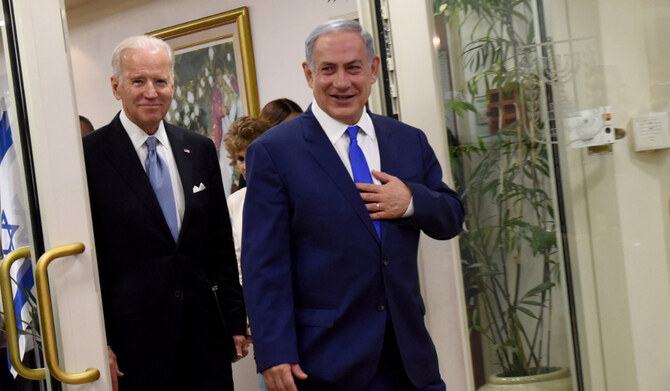
US President Joe Biden and Israeli Prime Minister Benjamin Netanyahu arrive to deliver joint statements in the prime minister's office in Jerusalem on March 9, 2016. (AFP file photo)
Short Url
Updated 15 October 2024
Follow

Israel says to hit back at Iran based on ‘national interest’

  • Benjamin Netanyahu: ‘We listen to the opinions of the United States, but we will make our final decisions based on our national interest’

JERUSALEM: Israel will consider the United States’s opinion but will act against an Iranian missile attack based on its own “national interests,” Prime Minister Benjamin Netanyahu’s office said Tuesday.

US President Joe Biden has cautioned Israel against striking Iran’s nuclear or oil facilities to avoid a further regional escalation and amid concerns over global energy prices.

“We listen to the opinions of the United States, but we will make our final decisions based on our national interest,” the office said.

The statement followed a Washington Post report, citing unnamed US officials, that Netanyahu had reassured the White House any counterstrike would be limited to military sites.

The Wall Street Journal, also anonymous US officials, said the assurance was made in a call last week between Netanyahu and Biden, as well as in conversations between US Defense Secretary Lloyd Austin and his Israeli counterpart, Yoav Gallant.

The plan “was met with relief in Washington,” the Washington Post reported.

Iran launched about 200 missiles at Israel on October 1 in retaliation for an Israeli strike in Beirut that killed Hezbollah leader Hassan Nasrallah and Iranian general Abbas Nilforoushan.

Israel has vowed to retaliate for the Iranian missile attack, with Defense Minister Gallant saying the response would be “deadly, precise, and surprising.”


Tehran residents keep up semblance of normality amid destruction

Updated 5 sec ago
Follow

Tehran residents keep up semblance of normality amid destruction

  • Chaotic scenes followed of panicked passers-by, parents scrambling to retrieve their children from school, queues at bakeries and endless traffic jams
  • A week on, the noise and energy have ebbed, giving way to a rare, disquieting calm in a capital usually thronging with 10 million people

TEHRAN: For a moment Tehran resembled a city at peace, with birdsong, joggers and tranquil views of the snow-capped Alborz mountains in the distance. Then the sound of another explosion ripped through the air.
A week ago, opening strikes by the US and Israel killed Iran’s supreme leader Ayatollah Ali Khamenei, upended residents’ lives and transformed the city streets into a battleground.
In Tehran’s west, a block that belonged to the security forces had been blasted apart, and the entire surrounding area was choked with rubble.
Bizarrely, a green gate and fence enclosing the site stood untouched.
None were surprised by the war, and few had believed the nuclear talks then taking place between Iran and the US would avert it.
The broad-daylight strike at the country’s power center was nevertheless a shock.
Chaotic scenes followed of panicked passers-by, parents scrambling to retrieve their children from school, queues at bakeries and endless traffic jams.
A week on, the noise and energy have ebbed, giving way to a rare, disquieting calm in a capital usually thronging with 10 million people.
The city is at times granted breaks of a few peaceful hours before another string of explosions shatters the air.


- Mushroom clouds -

Another block, this one in the city center, had also been gutted.
Men stood guard, some of them heavily armed despite their apparent youth.
The blast was powerful enough to sow chaos through a nearby primary school, breaking windows and carpeting the playground with rocks and rubble.
Dust coated a row of motorbikes parked nearby.
In another neighborhood, only the steel framework of a bombed-out building had survived, still supporting a massive antenna on the roof.
Local people busied themselves with clearing away the rubble and recovering a few possessions.
They loaded salvageable sofas and home appliances onto decrepit blue pickup trucks in the unmistakable 1960s design of local brand Zamyad.
On the horizon, yet another black mushroom cloud reached skywards.

- ‘Ramadan War’ -

In the first days of the war, Tehran could seem like a ghost town.
But pedestrians were again venturing outdoors: a father walking with his daughter on a scooter, children playing with a ball, or locals sunning themselves in a park.
Runners and cyclists resumed their exercise. More shops were open again.
But the semblance of normality is skin-deep.
Along major roads, armed men in plain clothes and others in military fatigues and body armor inspected random cars at checkpoints.
The blockades made for traffic jams on the avenues, where other traffic was mostly restricted to scooters and delivery riders.
Forbidding armored vehicles appeared on high alert, one of them flying the banner of the Islamic republic.
At prayer time, armed Revolutionary Guards checked the faithful as they filed into a mosque.
One week after his death, posters and placards bearing Khamenei’s image were everywhere on the streets.
Some walls bore street art-style portraits in his honor that appeared in recent days.
In a neighborhood grocery shop, one employee was anxiously following the latest in what state TV had dubbed the “Ramadan War” across the Middle East.