

Caves in Saudi Arabia’s northern region are windows to history, gates to adventure

1 / 3
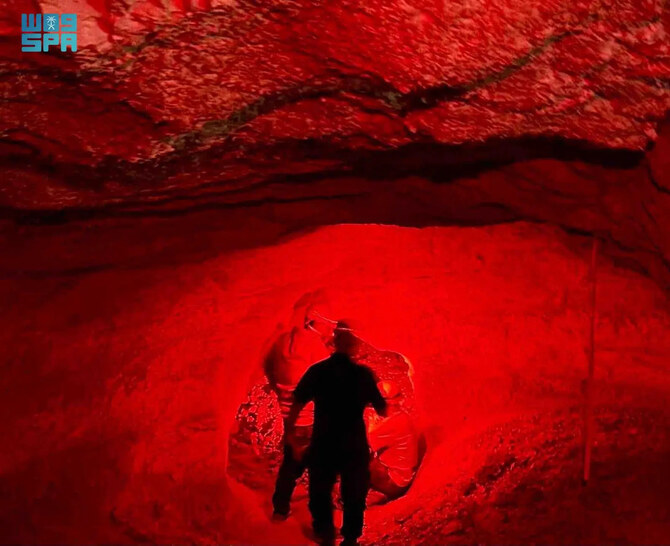
Caves and sinkholes offer a glimpse into the past, often revealing the secrets of humanity and unique geological formations. (SPA)
2 / 3
The rock structures, often featuring stalactites and stalagmites, create breathtaking views. (SPA)
3 / 3
Caves and sinkholes offer a glimpse into the past, often revealing the secrets of humanity and unique geological formations. (SPA)
Short Url
Updated 14 October 2024
Follow

Caves in Saudi Arabia’s northern region are windows to history, gates to adventure

  • Caves and sinkholes offer glimpse into the past with their unique geological formations
  • Kingdom’s 1,826 caves have underground tunnels formed naturally in dry limestone areas

Riyadh: At least 542 caves and sinkholes discovered in Saudi Arabia’s Northern Borders region offer more destinations for the increasing number of tourists, adventurers and researchers interested in these structures, the Saudi Press Agency reported on Sunday.

Of varying shapes, these structures offer a glimpse into the past with their unique geological formations, said the report, quoting Burjas Al-Falih, a speleologist and a member of the Afaq Society for Astronomy.

Among the most famous caves in the Kingdom are the Jabal Qarah in Hufuf, Dahl Heet in Riyadh city, and Shuwaimis in Hail region.


Caves and sinkholes offer a glimpse into the past, often revealing the secrets of humanity and unique geological formations. (SPA)

Saudi Arabia’s National Center for Wildlife has recently begun examining these structures in the Northern Borders region as a part of its Caves Exploration Program, which began in 2022.

According to the center, there are at least 1,826 caves in the Kingdom.

These consist of underground passages and tunnels formed by natural processes in dry limestone areas — evidence of a historical era that experienced prolonged rainy conditions.

The breathtaking rock structures often feature stalactites and stalagmites.


The rock structures, often featuring stalactites and stalagmites, create breathtaking views. (SPA)

Al-Falih emphasized the importance of documenting cave explorations. By classifying locations, types and access, adventurers can explore these sites responsibly, he said.

Organizing official trips to these locations can also help ensure their protection, he added.

In an earlier SPA report, Dr. Mohammed Ali Qurban, the chief executive officer of the NCW, explained that the discoveries in the caves hold significant environmental value for the Kingdom.

“The cave ecosystems serve as a historical museum, providing evidence of the biological diversity that has existed in the Kingdom throughout various historical eras, as well as the spatial, environmental, and climatic changes in the Arabian Peninsula,” he was quoted as saying.

He said the center’s earlier discovery of Arabian cheetah mummies in a cave — with some skeletons estimated to be over 4,000 years old — provided the first evidence of the species’ presence in the Kingdom.

Researchers from the center had also discovered rare bats and the remains of several extinct animals, he said.

The cave ecosystem is one of the rarest and most important of its kind in the world, recognized as a part of a nation’s natural heritage by UNESCO.


Saudi scientific organization celebrates 2025 Nobel Prize in Chemistry laureate Omar Yaghi

Updated 30 January 2026
Follow

Saudi scientific organization celebrates 2025 Nobel Prize in Chemistry laureate Omar Yaghi

  • King Abdulaziz City for Science and Technology honors him with a reception at its headquarters in Riyadh
  • Yaghi, the first Saudi recipient of a Nobel Prize, shared the Nobel Prize with 2 other scientists for their pioneering work in molecular chemistry

LONDON: King Abdulaziz City for Science and Technology in Riyadh honored Omar Yaghi, the Saudi scientist and recipient of the 2025 Nobel Prize in Chemistry, with a reception at its headquarters in Riyadh on Thursday.

Yaghi is the first Saudi scientist awarded a Nobel Prize. He received it in December, alongside two other scientists, for their pioneering work in the field of molecular chemistry, and for contributions to energy, the environment and advanced materials.

He is also supervisor of the Center of Excellence for Nanomaterials for Clean Energy Applications, a collaboration between KACST and the University of California, Berkeley.

Munir Eldesouki, the president of KACST, said that the Kingdom is keen to recognize its scientific talents, in keeping with Saudi Vision 2030 and its goals relating to the fostering of scientific research. 

King Abdulaziz City for Science and Technology in Riyadh honored Omar Yaghi, the Saudi scientist and recipient of the 2025 Nobel Prize in Chemistry. (SPA)

Yaghi said he appreciated the support he had received from Saudi leaders during his career, and praised them for creating an enabling environment in which scientists are able to pursue world-class research, development and innovation.

Investment in national talent has created a research ecosystem that positions Saudi Arabia among the leading scientific nations, he added.

Thursday’s event, attended by the organization’s staff and students, also honored the winning teams from the recent “GenAI for Materials Discovery Hackathon,” which KACST organized in partnership with the University of California, Berkeley, and Academy 32, a nonprofit Saudi organization dedicated to research, development and innovation.

The celebration concluded with an interactive discussion session during which Yaghi talked with students and researchers, reflected on key milestones in his scientific journey, and shared insights into the factors that helped shape his career, the Saudi Press Agency reported.