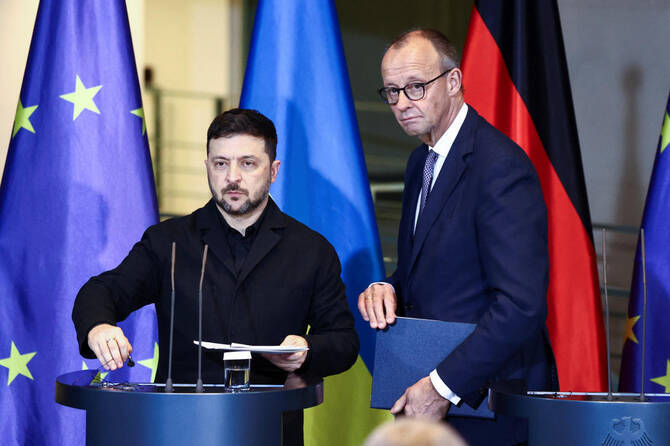
BERLIN: German Chancellor Friedrich Merz and President Volodymyr Zelensky on Thursday welcomed “efforts in favor of a truce,” Berlin said, after Donald Trump said Vladimir Putin had agreed to a week-long halt on attacks on Ukraine’s power grid.
Merz at the same time stressed that “the systematic and brutal destruction of Ukraine’s civilian infrastructure by Russian attacks” was “still ongoing,” which he condemned “in the strongest terms,” his spokesman, Stefan Kornelius, said.

Germany’s Merz and Ukraine’s Zelensky praise truce efforts
Short Url
https://arab.news/rypfr
Germany’s Merz and Ukraine’s Zelensky praise truce efforts
- Donald Trump said Vladimir Putin had agreed to a week-long halt on attacks
New START nuclear treaty ‘was flawed’: senior US official
- The New START treaty ended at the turn of the calendar on February 5
- Russia and the US together control more than 80 percent of the world’s nuclear warheads
GENEVA: A senior US official on Friday criticized the last nuclear treaty between Russia and the United States for failing to include Beijing, speaking at the United Nations a day after the New START deal expired.
“In a nutshell, New START was flawed,” said Thomas G. DiNanno, US Under Secretary of State for Arms Control and International Security, pointing out that it had not covered all nuclear weapons, “and it didn’t include China.”
Speaking to reporters in Geneva before addressing the Conference on Disarmament, he said US President Donald Trump “has been pretty clear that he wants a better agreement,” and “clarified again last night that he wants a new treaty.”
“He’s been crystal clear. He’s been consistent on it too, since his first administration,” DiNanno said.
“So we’ll see how it plays out.”
Asked if China had agreed to anything, DiNanno said: “We’re always willing to talk to them.”
China said on Thursday it would not join nuclear talks “at this stage” after the treaty’s expiry that day triggered fears of a new global arms race.
Campaigners have warned that the expiry, which ended decades of restrictions on how many warheads Russia and the United States deploy, could encourage China to expand its own arsenal.
The New START treaty ended at the turn of the calendar on February 5, after Trump did not follow up on Russian counterpart Vladimir Putin’s proposal to extend warhead limits in the agreement for one year.
Russia and the United States together control more than 80 percent of the world’s nuclear warheads, but arms agreements have been withering away.
New START, first signed in 2010, limited each side’s nuclear arsenal to 1,550 deployed strategic warheads — a reduction of nearly 30 percent from the previous limit set in 2002.
It also allowed each side to conduct on-site inspections of the other’s nuclear arsenal, although these were suspended during the COVID-19 pandemic and have not resumed since.
The Conference on Disarmament negotiating forum, which is comprised of 65 member states and meets in Geneva.
“In a nutshell, New START was flawed,” said Thomas G. DiNanno, US Under Secretary of State for Arms Control and International Security, pointing out that it had not covered all nuclear weapons, “and it didn’t include China.”
Speaking to reporters in Geneva before addressing the Conference on Disarmament, he said US President Donald Trump “has been pretty clear that he wants a better agreement,” and “clarified again last night that he wants a new treaty.”
“He’s been crystal clear. He’s been consistent on it too, since his first administration,” DiNanno said.
“So we’ll see how it plays out.”
Asked if China had agreed to anything, DiNanno said: “We’re always willing to talk to them.”
China said on Thursday it would not join nuclear talks “at this stage” after the treaty’s expiry that day triggered fears of a new global arms race.
Campaigners have warned that the expiry, which ended decades of restrictions on how many warheads Russia and the United States deploy, could encourage China to expand its own arsenal.
The New START treaty ended at the turn of the calendar on February 5, after Trump did not follow up on Russian counterpart Vladimir Putin’s proposal to extend warhead limits in the agreement for one year.
Russia and the United States together control more than 80 percent of the world’s nuclear warheads, but arms agreements have been withering away.
New START, first signed in 2010, limited each side’s nuclear arsenal to 1,550 deployed strategic warheads — a reduction of nearly 30 percent from the previous limit set in 2002.
It also allowed each side to conduct on-site inspections of the other’s nuclear arsenal, although these were suspended during the COVID-19 pandemic and have not resumed since.
The Conference on Disarmament negotiating forum, which is comprised of 65 member states and meets in Geneva.
© 2026 SAUDI RESEARCH & PUBLISHING COMPANY, All Rights Reserved And subject to Terms of Use Agreement.