

Saudi Arabia’s caves: more than just rock cavities

1 / 3
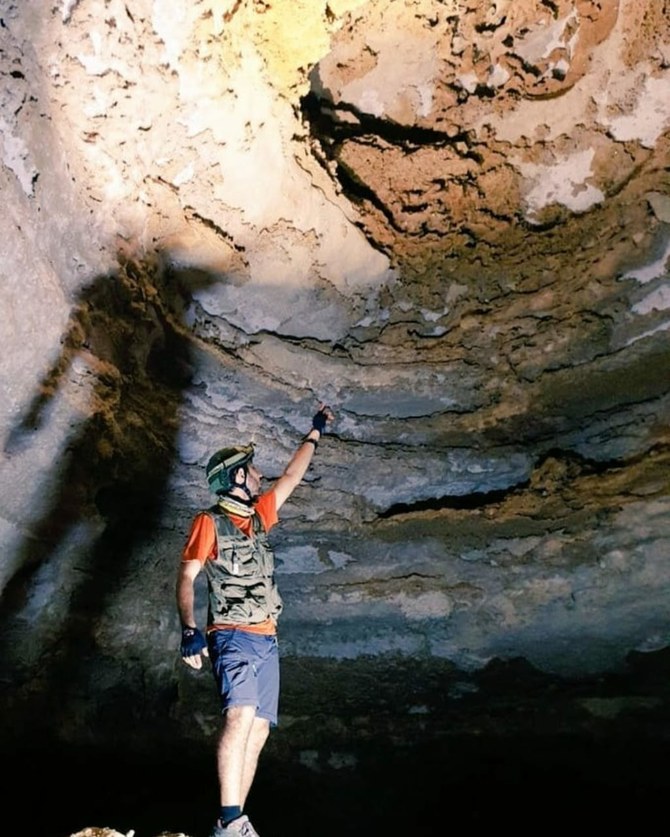
Over 300 caves have been discovered in the Saudi Arabia’s deserts. (Tareq Mohammed)
2 / 3
Over 300 caves have been discovered in the Saudi Arabia’s deserts. (Tareq Mohammed)
3 / 3
Over 300 caves have been discovered in the Saudi Arabia’s deserts. (Tareq Mohammed)
Short Url
Updated 14 April 2024
Follow

Saudi Arabia’s caves: more than just rock cavities

  • Formed over millions of years, efforts are underway to turn them into tourist sites
  • Geometric features unique to the Kingdom, plus mild temperatures, make it a year-round tourism industry

MAKKAH: Over 300 caves have been discovered in the Kingdom’s deserts. A divine gift to Saudi Arabia, these earth treasures were formed in the ground in the shape of unique geometric landmarks, natural sculptures and fascinating limestone and gypsum shapes.

Large numbers and different types of deep and superficial caves and “duhool” (caves lying below the earth’s surface) are found in the Kingdom. They formed over millions of years following the dissolution of limestone rocks due to rain and floods leaking into the ground through cracks and faults, resulting in cavities of different sizes and lengths.

Mahmoud Al-Shanti, a senior geologist specializing in caves and “duhool” at the Saudi Geological Survey, told Arab News that the SGS is working on locating caves, exploring their interiors and studying their types and formation.

He said these caves are considered a valuable natural national treasure that attract explorers, researchers and those interested in the field.

“As the lava of the volcano stops flowing in the subsoil, the last remaining quantity of the lava rushes forward, leaving behind an often regular longitudinal vacuum,” he said.

“When this quantity stops flowing and completely hardens, it creates a cave or a volcanic tubular tunnel that extends beneath the earth’s surface. Examples of this type of cavities are the Ghar Al-Habashi cave in Harrat Al-Buqum, and the Umm Jirsan cave in Harrat Khaybar, north of Madinah, which is about 1,500 meters long.”

He also talked about “duhool” and caves made of limestone rocks in the northern border areas, the central region and the eastern region of Saudi Arabia.

He explained that they are called limestone caves, adding that limestone is a hardened sedimentary rock composed of sediment shells, living remnants, and dead micro and macro marine organisms. All these components gathered and accumulated on top of each other randomly under the waters of lakes and oceans over millions of years, forming rigid and coherent rock layers as a result of constant pressure and cohesion, which resulted in this type of rock called limestone rock.

He said there are other species of mammals that also live inside the caves, such as weasels and wildcats. In the Kingdom’s deserts, there are some carnivores that take shelter in caves, such as foxes, hyenas and wolves. These animals take care of their cubs inside the dark tunnels during the day and go out at night to hunt.

Tareq Mohammed is a young Saudi man in his twenties from Madinah. He specializes in cave tourism and has delved deep into geotourism in the Kingdom.

Mohammed said: “When we talk about geotourism, the first thing that comes to mind are beaches, forests, deserts, mountains, underground wells, hot springs and areas of dormant volcanoes. But Saudi Arabia is also full of monuments and caves.”

According to Mohammed, there are five basic types of cave in Saudi Arabia based on their geological division: ice caves, which are formed of ice in cold regions; marine caves formed by waves, oceans or rivers flowing into large rocks or mountains, creating large cavities over thousands of years; basaltic caves, known as volcanic caves; limestone caves; and sand caves that form inside sandy mountains.

“An example of basaltic caves is the Maker Al-Shaiheen cave, which is classified as the longest basaltic cave in the Middle East with a length of about 3,700 meters,” he said.

The cave, a long tunnel formed by volcanic lava, was made when the surface of the lava began to freeze, with the lava below ground remaining as liquid due to the high temperature.

“The lava continues to flow until it reaches the end of the tube. The dimensions of the cave vary between 4-12 meters in width and 1.5-12 meters in length,” he said.

The Maker Al-Shaiheen cave is located in the west of the Kingdom in Harrat Khaybar, Madinah region.

He added: “Al-Qarah Mountain in the eastern region is an excellent example of sandy mountains. As for limestone caves, they are formed by the dissolution of biodegradable rocks. Rainwater mixed with carbon dioxide dissolves the limestone, leaving cavities underground.

“Al-Murabba (square) cave and the Tahaleb (algae) cave are examples of limestone caves. The Tahaleb cave is characterized by moisture and the presence of some types of algae at its entrance, hence the name,” he said.

“These caves are the most beautiful in terms of their different formations and shapes, such as the different limestone stalactites and stalagmites.”

He added that the central region of the Kingdom is characterized by these types of caves, advising everyone to try cave tourism throughout the year, as the caves’ temperatures remain constant between 24-26 C.

He said that any visit should be led by a specialized guide, who will highlight the characteristics of the caves.

Firas Al-Hazabi, a tourist who is passionate about cave tourism, said it is an amazing and different experience filled with suspense and excitement, adding that these caves are not visited enough by tourists.


Balad Beast brings global beats to historic streets

Updated 31 January 2026
Follow

Balad Beast brings global beats to historic streets

  • ‘MDLBEAST put us on the international map,’ say Saudi electronic duo Dish Dash

JEDDAH: The music festival Balad Beast concluded its fourth edition this weekend, having transformed Jeddah’s UNESCO World Heritage district of Al-Balad into an open-air celebration of music, culture and creativity that attracted thousands of music lovers over two nights.

The festival, organized by Saudi music platform MDLBEAST, featured more than 70 local, regional and international artists across four stages, offering audiences a diverse journey through electronic, hip-hop and global sounds.

French Haitian singer-songwriter Naïka performed on the second night of Balad Beast. (Supplied)

Speaking to Arab News, MDLBEAST chief creative officer Ahmad Al-Ammary, also known as DJ Baloo, described Balad Beast as a “cultural takeover” adding that finding the right spaces for dance floors was a challenge, “but Balad is constantly evolving and we work with that change.”

Addressing the challenges of working in a heritage area, he said: “Balad is sensitive and condensed, so logistics can be complex. In our first year, heavy rain flooded one of the planned squares and we had to relocate the Souq Stage to a much smaller space, but it worked and it has remained there ever since.

HIGHLIGHT

Reggae superstar Shaggy noted that the reality of playing live in Saudi Arabia often surprises those who arrive with preconceptions.

“Yes, the alleys are narrow and the district is old, but they’re full of ideas, patterns, colors and visuals. Everything flows here,” he continued. “As a festival, it’s hard to define Balad, because it gives so much of itself creatively. It’s incredibly generous with its ideas and details, and inspiration comes from everywhere.”

Balad Beast featured more than 70 local, regional and international artists across four stages, offering audiences a diverse journey through electronic, hip-hop and global sounds. (Supplied)

Balad Beast featured performances from international artists including US rapper Playboi Carti, making his first appearance in Saudi Arabia; US rapper Destroy Lonely; Swedish DJ and producer Alesso; and Bosnian-German DJ Solomun on the opening night. The following night saw French-Haitian singer-songwriter Naïka, reggae superstar Shaggy, Dutch DJ Franky Rizardo, British DJ Pawsa, and US rapper Tyga, and more take the stage, while Saudi and regional artists including Cosmicat, TUL8TE, Zeina, Vinyl Mode, Moayed, Dish Dash, Musab, Varoo and HiFi appeared across the festival, offering audiences a mix of global and local talent.

Saudi electronic duo Dish Dash reflected on the festival organizer’s impact for local artists.

As a festival, it’s hard to define Balad, because it gives so much of itself creatively. It’s incredibly generous with its ideas and details, and inspiration comes from everywhere.

Ahmad Al-Ammary, MDLBEAST chief creative officer

“MDLBEAST put us on the international map,” the brothers told Arab News. “It helped us get recognized by festivals, promoters and event organizers abroad. When we travel, people don’t expect this level of talent coming from Saudi Arabia, especially considering we didn’t have this scene before.”

Shaggy, who performed a hit-filled set during the festival, told Arab News: “I’ve been blessed with some incredible songs, and I see music as a gift and a tool for service. When I go on stage, I’m there to entertain people, to make them smile and feel good, but that service also supports many livelihoods from the people working at this festival to those who work with me. These songs have become part of people’s lives, and I don’t take that lightly.”

Balad Beast featured more than 70 local, regional and international artists across four stages, offering audiences a diverse journey through electronic, hip-hop and global sounds. (Supplied)

Shaggy also noted that the reality of playing live in Saudi Arabia often surprises those who arrive with preconceptions.

“I’ve performed in Saudi Arabia more than once, and while there are certain rules that are different, it’s not an issue for me. My focus is always on delivering the hits and giving the audience a great time,” he said.

“There’s a big misconception. People have more freedom than (outsiders) think. Everyone has been extremely nice.”

Asked what advice he would offer to aspiring artists, Shaggy said: “Understand that what you’re given is a gift and a form of service. Stay humble, do the work, and remember why you’re doing it.”

As Al-Ammary noted, there are many such aspiring artists now making a name for themselves in the Kingdom.

“Talent is emerging everywhere, at different levels,” he said. “The scene is still in a mysterious and surprising phase. There’s a rawness to it.”