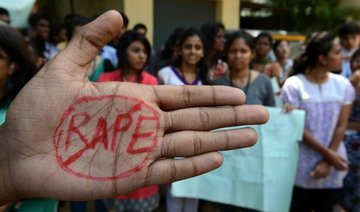
MUMBAI: India’s government has asked the country’s top court not to toughen criminal penalties against marital rape during an ongoing case brought by campaigners seeking to outlaw it.
The penal code introduced in the 19th century during British colonial rule of India explicitly states that “sexual acts by a man with his own wife... is not rape.”
Prime Minister Narendra Modi’s government enacted an overhauled code in July which retains that clause, despite the decade-long court challenge by activists seeking to make marital rape illegal.
India’s interior ministry filed an affidavit to the Supreme Court on Thursday stating that while marital rape should result in “penal consequences,” the legal system should treat it more leniently than rape committed outside of marriage.
“A husband certainly does not have any fundamental right to violate the consent of his wife,” the affidavit said, according to The Indian Express newspaper.
“However, attracting the crime in the nature of ‘rape’ as recognized in India to the institution of marriage can be arguably considered to be excessively harsh.”
India’s current penal code mandates a minimum 10-year sentence for those convicted of rape.
The government’s statement said that marital rape was adequately addressed in existing laws, including a 2005 law protecting women from domestic violence.
That law recognizes sexual abuse as a form of domestic violence but does not prescribe any criminal penalties to perpetrators.
Another section of the penal code punishes broadly defined acts of “cruelty” by a husband against their wife with prison terms of up to three years.
Six percent of Indian married women aged 18-49 have reported spousal sexual violence, according to the government’s latest National Family Health Survey conducted from 2019 to 2021.
In the world’s most populous country, that implies more than 10 million women have been victims of sexual violence at the hands of their husbands.
Nearly 18 percent of married women also feel they cannot say no if their husbands want sex, according to the survey.
Divorce remains taboo across much of India with only one in every 100 marriages ending in dissolution, often owing to family and social pressure to sustain unhappy marriages.
Chronic backlogs in India’s criminal justice system mean some cases take decades to reach a resolution, and the case pushing for the criminalization of marital rape has made painfully slow progress.
It was referred to the Supreme Court after a two-judge bench in the Delhi High Court issued a split verdict in May 2022.
One judge in that case ruled that while “one may disapprove” of a husband forcibly having sex with his wife, that “cannot be equated with the act of ravishing by a stranger.”

India asks top court not to toughen marital rape penalties
https://arab.news/b3vfe
India asks top court not to toughen marital rape penalties
- Penal code introduced during British colonial rule of India explicitly states that ‘sexual acts by a man with his own wife... is not rape’
- India’s current penal code mandates a minimum 10-year sentence for those convicted of rape
The man killed by a US Border Patrol officer in Minneapolis was an ICU nurse, family says
- Family members said Pretti owned a handgun and had a permit to carry a concealed handgun in Minnesota. They said they had never known him to carry it
MINNEAPOLIS: Family members say the man killed by a US Border Patrol officer in Minneapolis on Saturday was an intensive care nurse at a VA hospital who cared deeply about people and was upset by President Donald Trump’s immigration crackdown in his city.
Alex Jeffrey Pretti, 37, was an avid outdoorsman who enjoyed getting in adventures with Joule, his beloved Catahoula Leopard dog who also recently died. He worked for the US Department of Veterans Affairs and had participated in protests following the Jan. 7 killing of Renee Good by an Immigration and Customs officer .
“He cared about people deeply and he was very upset with what was happening in Minneapolis and throughout the United States with ICE, as millions of other people are upset,” said Michael Pretti, Alex’s father. “He thought it was terrible, you know, kidnapping children, just grabbing people off the street. He cared about those people, and he knew it was wrong, so he did participate in protests.”
Pretti was a US citizen, born in Illinois. Like Good, court records showed he had no criminal record and his family said he had never had any interactions with law enforcement beyond a handful of traffic tickets.
In a recent conversation with their son, his parents, who live in Colorado, told him to be careful when protesting.
“We had this discussion with him two weeks ago or so, you know, that go ahead and protest, but do not engage, do not do anything stupid, basically,” Michael Pretti said. “And he said he knows that. He knew that.”
The Department of Homeland Security said that the man was shot after he “approached” Border Patrol officers with a 9 mm semiautomatic handgun. Officials did not specify if Pretti brandished the gun. In bystander videos of the shooting that emerged soon after, Pretti is seen with a phone in his hand but none appears to show him with a visible weapon.
Family members said Pretti owned a handgun and had a permit to carry a concealed handgun in Minnesota. They said they had never known him to carry it.
Alex Pretti’s family struggles for information about what happened
The family first learned of the shooting when they were called by an Associated Press reporter. They watched the video and said the man killed appeared to be their son. They then tried reaching out to officials in Minnesota.
“I can’t get any information from anybody,” Michael Pretti said Saturday. “The police, they said call Border Patrol, Border Patrol’s closed, the hospitals won’t answer any questions.”
Eventually, the family called the Hennepin County Medical Examiner, who they said confirmed had a body matching the name and description of their son.
As of Saturday evening, the family said they had still not heard from anyone at a federal law enforcement agency about their son’s death.
Alex Pretti grew up in Green Bay, Wisconsin, where he played football, baseball and ran track for Preble High School. He was a Boy Scout and sang in the Green Bay Boy Choir.
After graduation, he went to the University of Minnesota, graduating in 2011 with a bachelor’s degree in biology, society and the environment, according to the family. He worked as a research scientist before returning to school to become a registered nurse.
Alex Pretti had protested before
Pretti’s ex-wife, Rachel N. Canoun, said she was not surprised he would have been involved in protesting Trump’s immigration crackdown. She said she had not spoken to him since they divorced more than two years ago and she moved to another state.
She said he was a Democratic voter and that he had participated in the wave of street protests following the killing of George Floyd by a Minneapolis police officer in 2020, not far from the couple’s neighborhood. She described him a someone who might shout at law enforcement officers at a protest, but she had never known him to be physically confrontational.
“These kinds of things, you know, he felt the injustice to it,” Canoun said. “So it doesn’t surprise me that he would be involved.”
Canoun said Pretti got a permit to carry a concealed firearm about three years ago and that he owned at least one semiautomatic handgun when they separated.
“He didn’t carry it around me, because it made me uncomfortable,” she said.
Pretti had ‘a great heart’
Pretti lived in a four-unit condominium building about 2 miles (3.2 kilometers) from where he was shot. Neighbors described him as quiet and warmhearted.
“He’s a wonderful person,” said Sue Gitar, who lived downstairs from Pretti and said he moved into the building about three years ago. “He has a great heart.”
If there was something suspicious going on in the neighborhood, or when they worried the building might have a gas leak, he would jump in to help.
Pretti lived alone and worked long hours as a nurse, but he was not a loner, his neighbors said, and would sometimes have friends over.
His neighbors knew he had guns — he’d occasionally take a rifle to shoot at a gun range — but were surprised at the idea that he might carry a pistol on the streets.
“I never thought of him as a person who carried a gun,” said Gitar.
Pretti was also passionate about the outdoors
A competitive bicycle racer who lavished care on his new Audi, Pretti had also been deeply attached to his dog, who died about a year ago.
His parents said their last conversation with their son was a couple days before his death. They talked about repairs he had done to the garage door of his home. The worker was a Latino man, and they said with all that was happening in Minneapolis he gave the man a $100 tip.
Pretti’s mother said her son cared immensely about the direction the county was headed, especially the Trump administration’s rollback of environmental regulations.
“He hated that, you know, people were just trashing the land,” Susan Pretti said. “He was an outdoorsman. He took his dog everywhere he went. You know, he loved this country, but he hated what people were doing to it.”