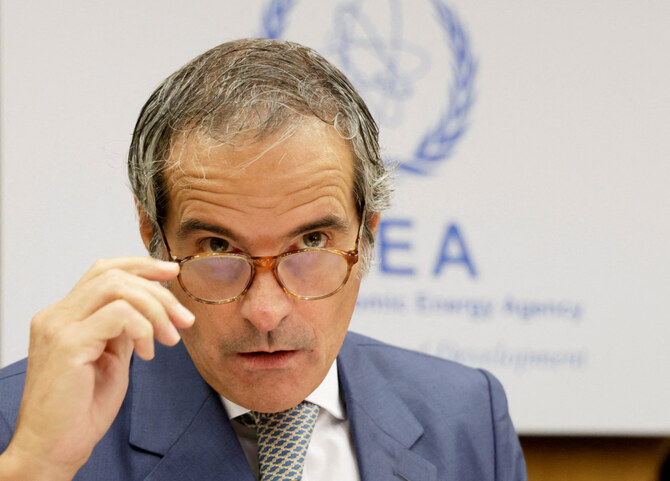
UNITED NATIONS: UN nuclear watchdog chief Rafael Grossi said on Tuesday he had sensed a greater willingness by Iranian officials to engage with the agency in a more meaningful way after talks in New York, and that he hoped to travel to Tehran in October.
Several long-standing issues have dogged relations between Iran and the International Atomic Energy Agency, including Tehran’s barring of uranium-enrichment experts on the inspection team and its failure for years to explain uranium traces found at undeclared sites.
Grossi held talks with Iranian Foreign Minister Abbas Araqchi, one of the key architects to the 2015 accord that limited Iran’s ability to enrich uranium in return for a lifting of Western sanctions, on the sidelines of the UN General Assembly. “What I see is an expressed willingness to re-engage with us in a more meaningful fashion,” Grossi told Reuters in an interview.
With nuclear diplomacy largely stalled between the Iranian presidential election and the US one on Nov. 5, Iranian and European officials have met in New York to test their mutual willingness to reduce tensions amid Tehran’s disputed nuclear program, its role in Ukraine and mounting regional tensions.
Grossi said he wanted to make real progress in restoring proper technical discussions with Iran quickly and was aiming to travel to Tehran in October to meet with Iranian President Masoud Pezeshkian.
“Of course now we have to give content and substance to this because we are not starting from zero. We have had relatively protracted process without replies to some of the questions we have,” he said.
“We also need to calibrate together with them how we go through this period where they are waiting to see what is going to happen with their other partners, starting with the United States.”
IAEA board resolutions ordering Iran to cooperate urgently with the investigation into the uranium traces and calling on it to reverse its barring of inspectors have brought little change, and quarterly IAEA reports seen by Reuters on Aug. 29 showed no progress.
Development of Iran’s nuclear program has also advanced. By the end of the quarter, the latest IAEA reports showed Iran had completed installation of eight new cascades at Fordow but still not brought them online.
At its larger underground site at Natanz, which is enriching to up to 5 percent purity, it had brought 15 new cascades of other advanced models online.
“Iran has kept a regular pace without accelerating too much, but it continues,” Grossi said, adding that the Fordow cascades remained offline.
Iran has stepped up nuclear work since 2019, after then-US President Donald Trump abandoned an agreement reached under his predecessor Barack Obama.
When asked about the prospects of a revival of nuclear talks, Grossi said the preparatory work needed to start now, notably for the IAEA to get the necessary clarity on Iran’s activities since it reduced cooperation with the agency.
“I think we need to, or the ambition should be to get results in a different way, because the old way is simply not going to be possible anymore,” he said, adding that he foresaw a more active role for the agency.


![]()

IAEA chief sees willingness from Iran to re-engage on nuclear file
Short Url
https://arab.news/6ta2s
IAEA chief sees willingness from Iran to re-engage on nuclear file
- IAEA board resolutions ordering Iran to cooperate urgently with the investigation into the uranium traces


Latest updates


© 2026 SAUDI RESEARCH & PUBLISHING COMPANY, All Rights Reserved And subject to Terms of Use Agreement.