

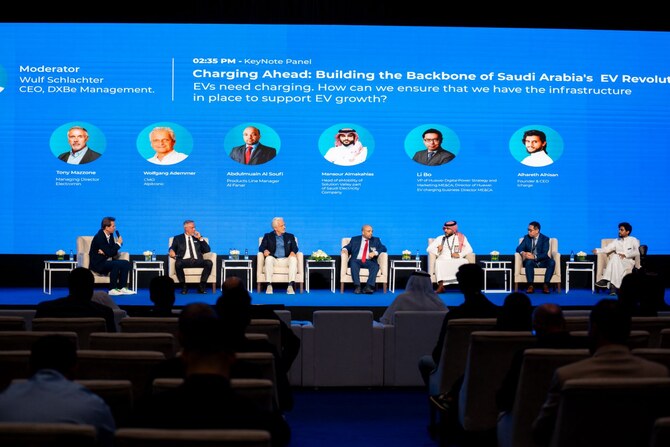

RIYADH: The Saudi government holds the key to developing the necessary infrastructure for electric vehicles, a top official said on the first day of the EV Auto Show underway in Riyadh.
Speaking at a panel discussion titled “Charging Ahead: Building the Backbone of Saudi Arabia’s EV Revolution,” Mansour Al-Makahlas, head of the eMobility division at Solutions Valley, a part of Saudi Electric Co., outlined the essential steps needed to advance the market.
Al-Makahlas stressed the importance of expanding charging infrastructure to encourage participation from chief product officers.
“In order to attract users to come to Saudi (Arabia) or to buy this vehicle, they need to release the incentive. They need to build more charging stations; they need to support the CPO to get into this market.”
He continued:, “There must be an incentive from the government, such as the case in Europe and the US. CPOs know that the return on investment is long-term. It’s not short-term. So an incentive must be there.”
During the same discussion, Alhareth Al-Hisan, founder and CEO of iCharge, noted that Saudi Arabia has a strong foundation for EV adoption globally. “It has the grid capacity, it has the political will, and it has the ability for the customer to spend on the expensive electric vehicle.”
Al-Hisan pointed out that planning is a primary concern in the regional EV industry and suggested that Saudi Arabia could benefit from Europe’s approach to infrastructure development. “When the infrastructure for electric vehicles started in Europe, it was heavily planned and very detailed where to place them, how to place them,” he said.
Wolfgang Ademmer, chief marketing officer at the sustainable mobility firm Alpitronic, also encouraged Saudi Arabia to follow Europe’s lead. “There’s a learning from Europe for other markets. I’m always a big fan of shortcutting learning curves, and we can do this in Saudi Arabia.”
Ademmer emphasized the need for a comprehensive plan to support industry participants and ensure their success in the EV sector. “Coming up with a clear plan, giving confidence to all market players, including those inherently starting the business right now. Encourage them to stay and invest with the right guidelines, and then also convince, subsequently, the users, the car drivers, to use and to drive EVs.”
Li Bo, vice president of Huawei Digital Power Strategy and Marketing for the Middle East and Central Asia, and director of Huawei EV Charging Business for the same region, predicted a rise in the vehicle-to-EV charging ratio.
Li noted that renewable energy development is advancing in Saudi Arabia and expects that new regulations will lead to a greater focus on renewable sources and storage solutions for EV charging stations.
Toward the end of the panel discussion, Al-Makahlas predicted significant growth in the EV market. “So, I believe that the market will double by next year. You will be shocked by next year; I can guarantee you.”
The EV Auto Show in Riyadh underscores Saudi Arabia’s Vision 2030, highlighting its commitment to electric vehicles and sustainable technology. The exhibition serves as a key event for the Kingdom’s burgeoning EV ecosystem, attracting 10,000 attendees from 50 countries, including industry leaders, automotive manufacturers, charging solution providers, and policymakers, to discuss the future of mobility in the region.


