Syria’s leader set to visit Berlin with deportations in focus

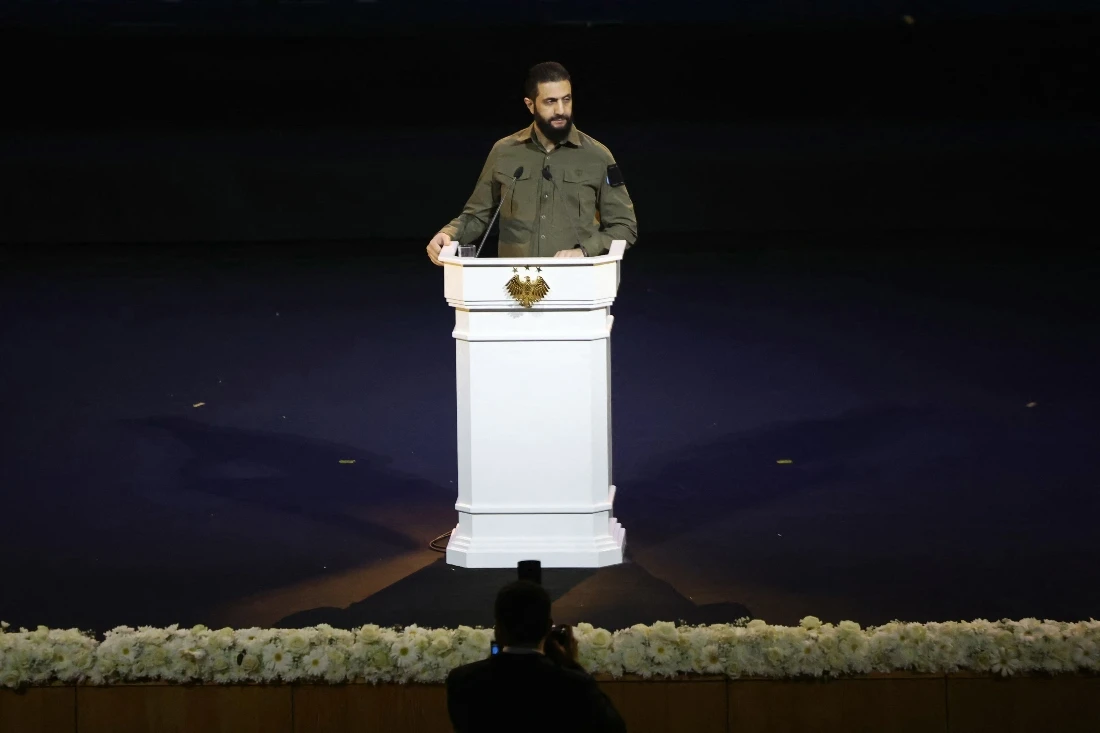
Syrian President Ahmed al-Sharaa delivers a speech during a ceremony at the Convention Center as Syrians celebrate the first anniverasy of the fall of the Assad regime, in the Syrian capital Damascus. (AFP)
Short Url
Updated 16 January 2026
Follow

Syria’s leader set to visit Berlin with deportations in focus

  • Sharaa is scheduled to meet his counterpart Frank-Walter Steinmeier, the German president’s office said

BERLIN: Syrian President Ahmed Al-Sharaa is expected in Berlin on Tuesday for talks, as German officials seek to step up deportations of Syrians, despite unease about continued instability in their homeland.
Sharaa is scheduled to meet his counterpart Frank-Walter Steinmeier, the German president’s office said.
Chancellor Friedrich Merz’s office has yet to announce whether he would also hold talks with Sharaa during the visit.
Since ousting Syria’s longtime leader Bashar Assad in late 2024, Sharaa has made frequent overseas trips as the former Islamist rebel chief undergoes a rapid reinvention.
He has made official visits to the United States and France, and a series of international sanctions on Syria have been lifted.
The focus of next week’s visit for the German government will be on stepping up repatriations of Syrians, a priority for Merz’s conservative-led coalition since Assad was toppled.
Roughly one million Syrians fled to Germany in recent years, many of them arriving in 2015-16 to escape the civil war.
In November Merz, who fears being outflanked by the far-right AfD party on immigration, insisted there was “no longer any reason” for Syrians who fled the war to seek asylum in Germany.
“For those who refuse to return to their country, we can of course expel them,” he said.

- ‘Dramatic situation’ -

In December, Germany carried out its first deportation of a Syrian since the civil war erupted in 2011, flying a man convicted of crimes to Damascus.
But rights groups have criticized such efforts, citing continued instability in Syria and evidence of rights abuses.
Violence between the government and minority groups has repeatedly flared in multi-confessional Syria since Sharaa came to power, including recent clashes between the army and Kurdish forces.
Several NGOs, including those representing the Kurdish and Alawite Syrian communities in Germany, have urged Berlin to axe Sharaa’s planned visit, labelling it “totally unacceptable.”
“The situation in Syria is dramatic. Civilians are being persecuted solely on the basis of their ethnic or religious affiliation,” they said in a joint statement.
“It is incomprehensible to us and legally and morally unacceptable that the German government knowingly intends to receive a person suspected of being responsible for these acts at the chancellery.”
The Kurdish Community of Germany, among the signatories of that statement, also filed a complaint with German prosecutors in November, accusing Sharaa of war crimes, genocide and crimes against humanity.
There have also been voices urging caution within government.
On a trip to Damascus in October, Foreign Minister Johann Wadephul said that the potential for Syrians to return was “very limited” since the war had destroyed much of the country’s infrastructure.
But his comments triggered a backlash from his own conservative Christian Democratic Union party.

Top Hamas leader rejects disarmament or ‘foreign rule’

Updated 7 sec ago
Follow

Top Hamas leader rejects disarmament or ‘foreign rule’

  • “As long as there is occupation, there is resistance. Resistance is a right of peoples under occupation” said Meshal

DOHA: A senior Hamas leader said Sunday that the Palestinian Islamist movement would not surrender its weapons nor accept foreign intervention in Gaza, pushing back against US and Israeli demands.
“Criminalizing the resistance, its weapons, and those who carried it out is something we should not accept,” Khaled Meshal said at a conference in Doha.
“As long as there is occupation, there is resistance. Resistance is a right of peoples under occupation ... something nations take pride in,” said Meshal, who previously headed the group.
Hamas, an Islamist movement, has waged an armed struggle against what it sees as Israel’s occupation of Palestinian territories. It launched a deadly cross-border raid into Israel from Gaza on October 7, 2023, which triggered the latest war.
A US-brokered ceasefire in Gaza is in its second phase, which foresees that demilitarization of the territory — including the disarmament of Hamas — along with a gradual withdrawal of Israeli forces.
Hamas has repeatedly said that disarmament is a red line, although it has indicated it could consider handing over its weapons to a future Palestinian governing authority.
Israeli officials say that Hamas still has around 20,000 fighters and about 60,000 Kalashnikovs in Gaza.
A Palestinian technocratic committee has been set up with a goal of taking over the day-to-day governance in the battered Gaza Strip, but it remains unclear whether, or how, it will address the issue of demilitarization.
The committee operates under the so-called “Board of Peace,” an initiative launched by US President Donald Trump.
Originally conceived to oversee the Gaza truce and post-war reconstruction, the board’s mandate has since expanded, prompting concerns among critics that it could evolve into a rival to the United Nations.
Trump unveiled the board at the World Economic Forum in the Swiss ski resort of Davos last month, where leaders and officials from nearly two dozen countries joined him in signing its founding charter.
Alongside the Board of Peace, Trump also created a Gaza Executive Board — an advisory panel to the Palestinian technocratic committee — comprising international figures including US envoys Steve Witkoff and Jared Kushner, as well as former British prime minister Tony Blair.
On Sunday, Meshal urged the Board of Peace to adopt what he called a “balanced approach” that would allow for Gaza’s reconstruction and the flow of aid to its roughly 2.2 million residents, while warning that Hamas would “not accept foreign rule” over Palestinian territory.
“We adhere to our national principles and reject the logic of guardianship, external intervention, or the return of a mandate in any form,” Meshal said.
“Palestinians are to govern Palestinians. Gaza belongs to the people of Gaza and to Palestine. We will not accept foreign rule,” he added.