Orban ramps up anti‑Ukraine campaign with ‘petition’ as election battle tightens

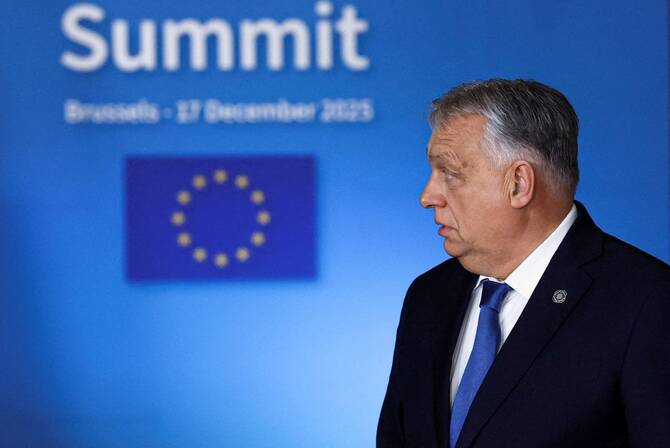
Hungarian Prime Minister Victor Orban looks on as he arrives at a European Union-Western Balkans summit in Brussels, Belgium. (Reuters)
Short Url
Updated 16 January 2026
Follow

Orban ramps up anti‑Ukraine campaign with ‘petition’ as election battle tightens

  • Orban has framed the election as a choice between war and peace, portraying Ukraine as undeserving of support and his government as the only safeguard against conflict and economic spillover

BUDAPEST: Hungarian Prime Minister Viktor Orban, gearing up for a tough election in April, said on Friday he would launch a “national petition” seeking backing for his policy of ​rejecting EU funding for neighboring Ukraine as it fights a Russian invasion.
With the war showing no sign of ending and Hungary’s economy stagnating, Orban has framed the election as a choice between war and peace, portraying Ukraine as undeserving of support and his government as the only safeguard against conflict and economic spillover.
Since last year, election billboards ‌for Orban’s ‌Fidesz party have sought to associate ‌opposition ⁠leader ​Peter Magyar with ‌Brussels and Ukraine, suggesting that voting for his Tisza party means voting for tanks and war.
Orban’s campaign primarily targets rural voters and echoes his past anti-migrant campaigns as most polls show Fidesz trailing Tisza.
Details of the “petition” were unclear, but it appeared to amount to an informal referendum, in the form ⁠of a ballot paper sent to citizens.
“Everybody will get this (national petition) and ‌will get the chance to say ‘no’ and ‍to say, together with the ‍government, that we will not pay,” Orban told state ‍radio on Friday, accusing the opposition of being pro-Ukraine.
Orban said, without citing any evidence, that the European Union would put pressure on Hungary to send its young people to fight in Ukraine, “and there ​is rightful fear that pro-Ukrainian forces would give in to pressure from Brussels.”
Magyar has said Tisza ⁠supports peace in Ukraine, rejects the idea of conscription, and will not support any escalation in the war.
The European Commission on Wednesday put forward its proposal to loan Ukraine 90 billion euros.
In December, when the plan was sealed, Hungary, Slovakia and the Czech Republic agreed as long as it did not affect them financially.
A survey in December by Policy Solutions and Zavecz Research indicated growing opposition in Hungary to EU funding for Ukraine. In 2023, 57 percent were in favor and ‌41 percent opposed but, by last year, only 36 percent were in favor, with 63 percent against.


Europeans push back at US over claim they face ‘civilizational erasure’

Updated 6 sec ago
Follow

Europeans push back at US over claim they face ‘civilizational erasure’

  • “Contrary to what some may say, woke, decadent Europe is not facing civilizational erasure,” Kallas told the conference

MUNICH: A top European Union official on Sunday rejected the notion that Europe faces “civilizational erasure,” pushing back at criticism of the continent by the Trump administration.
EU foreign policy chief Kaja Kallas addressed the Munich Security Conference a day after US Secretary of State Marco Rubio offered a somewhat reassuring message to European allies. He struck a less aggressive tone than Vice President JD Vance did in lecturing them at the same gathering last year but maintained a firm tone on Washington’s intent to reshape the trans-Atlantic alliance and push its policy priorities.
Kallas alluded to criticism in the US national security strategy released in December, which asserted that economic stagnation in Europe “is eclipsed by the real and more stark prospect of civilizational erasure.” It suggested that Europe is being enfeebled by its immigration policies, declining birth rates, “censorship of free speech and suppression of political opposition” and a “loss of national identities and self-confidence.”
“Contrary to what some may say, woke, decadent Europe is not facing civilizational erasure,” Kallas told the conference. “In fact, people still want to join our club and not just fellow Europeans,” she added, saying she was told when visiting Canada last year that many people there have an interest in joining the EU.
Kallas rejected what she called “European-bashing.”
“We are, you know, pushing humanity forward, trying to defend human rights and all this, which is actually bringing also prosperity for people. So that’s why it’s very hard for me to believe these accusations.”
In his conference speech, Rubio said that an end to the trans-Atlantic era “is neither our goal nor our wish,” adding that “our home may be in the Western hemisphere, but we will always be a child of Europe.”
He made clear that the Trump administration is sticking to its guns on issues such as migration, trade and climate. And European officials who addressed the gathering made clear that they in turn will stand by their values, including their approach to free speech, climate change and free trade.
British Prime Minister Keir Starmer said Saturday that Europe must defend “the vibrant, free and diverse societies that we represent, showing that people who look different to each other can live peacefully together, that this isn’t against the tenor of our times.”
“Rather, it is what makes us strong,” he said.
Kallas said Rubio’s speech sent an important message that America and Europe are and will remain intertwined.
“It is also clear that we don’t see eye to eye on all the issues and this will remain the case as well, but I think we can work from there,” she said.