

Pakistan confirms fifth case of mpox virus

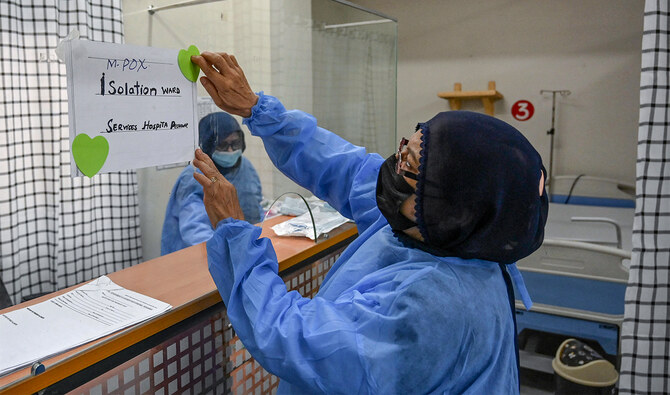
A health worker install a poster indicating an isolation ward prepared for mpox patients at the Police and Services hospital in Peshawar on August 20, 2024. (AFP/File)
Short Url
Updated 11 September 2024
Follow

Pakistan confirms fifth case of mpox virus

  • Patient hails from Lower Dir in northwest Pakistan and has history of traveling to Gulf countries
  • Health authorities had earlier declared Khyber Pakhtunkhwa province mpox free on September 8 

KARACHI: Pakistani health authorities confirmed a fifth case of the mpox virus in the country on Wednesday, identifying the patient as a resident of the northwestern district of Lower Dir who had been isolated at home after displaying symptoms of the disease and testing positively for it.

The World Health Organization has declared a global health emergency over the spread of a new mutated strain of mpox named clade I, which first emerged in the Democratic Republic of Congo and has since spread to several countries, leading to increased monitoring and preventive measures worldwide.

Since it confirmed its first mpox case last month, Pakistan has implemented stringent screening protocols at all airports and border entry points. 

“The fifth case of mpox reported in Pakistan,” the health ministry spokesperson in a statement said on Wednesday. “The citizen belongs to Lower Dir and has travel history from Gulf countries.”

The statement said the patient was referred for testing by the health department of the northwestern Khyber Pakhtunkhwa province based on symptoms he displayed during screening at the airport. He was now isolating at home, the ministry said. 

Dr. Mukhtar Bhart, the Prime Minister’s Coordinator for Health, said the federal ministry of health was working closely with provincial authorities to monitor new cases. 

Patients who contract mpox get flu-like symptoms and pus-filled lesions. Mpox is usually mild but can kill, and children, pregnant women and people with weakened immune systems are at higher risk of complications from the infection.

Earlier this week, health authorities had declared Pakistan’s KP province mpox-free after all four patients previously infected with the virus recovered.


Pakistan’s Mahnoor Omer named among TIME’s ‘Women of the Year’ for 2026

Updated 01 March 2026
Follow

Pakistan’s Mahnoor Omer named among TIME’s ‘Women of the Year’ for 2026

  • Omer moved a Pakistani court against the so-called ‘period tax’ in Sept. 2025 which has since sparked a national debate
  • Taxes on sanitary pads in Pakistan can add up to 40 percent to retail price, UNICEF says only around 12 percent women use such products

ISLAMABAD: Pakistani women’s rights activist Mahnoor Omer, who fought against taxes on menstrual products, has been named among the TIME magazine’s ‘Women of the Year’ for 2026.

Omer’s efforts have been recognized alongside 16 activists, artists, athletes and businesswomen in the TIME’s Women of the Year 2026 list, including Olympic gold medalist Sydney McLaughlin-Levrone and Oscar-nominated filmmaker Chloe Zhao.

Dissatisfied with the efforts to educate Pakistani girls about sexual violence, Omer founded the Noor Foundation at the age of 14 and held her own workshops with village girls about everything from climate change to menstruation, according to the TIME magazine.

Two years later, a conversation with a domestic worker about the price of pads made her realize that not everyone could afford these essentials. She moved a court against the so-called “period tax” in Sept. 2025 and the case has sparked a national debate on the subject, considered a taboo by many in Pakistan, since its first hearing late last year.

“A decade and one law degree after her interest in activism was sparked, Omer, now 25, is putting her passion and expertise to work in the name of gender equity,” TIME wrote about Omer on its website.

Taxes imposed on sanitary products in Pakistan can add up to 40 percent to the retail price. UNICEF estimates just 12 percent of women in the country use commercially produced pads or tampons. The alternative, using cloth, risks health impacts including rashes and infections, and can make it impossible for girls to attend school while menstruating.

Omer’s suit, which awaits the government response, has sparked a national discussion. She says she spoke about menstruation to her father and male cousins, who thanked her for standing up for their daughters.
The 25-year-old, who is currently enrolled in a master’s degree in gender, peace, and security at the London School of Economics, sees this case as just the first of many.

“I’m not free until every woman is free,” she was quoted as saying by TIME. “I want to leave no stones unturned in terms of what I can do with the next few decades, as a lawyer for the women in my country and gender minorities in general.”
