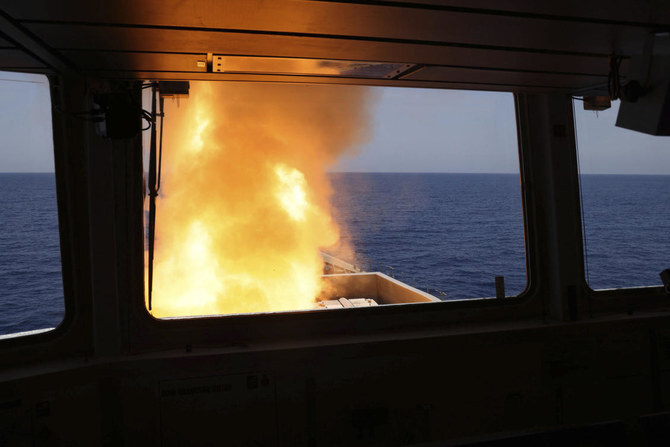
AL-MUKALLA: The US Central Command said on Wednesday that its forces had destroyed a missile system in a Houthi-held Yemeni territory that was targeting ships in international waters.
This is the second time in the past 24 hours that the US military has said that it is targeting Houthi missile systems in undefined locations in Houthi-controlled Yemeni territory.
“It was determined this system presented an imminent threat to US and coalition forces, and merchant vessels in the region,” CENTCOM said.
Local media and people reported hearing loud explosions and seeing heavy smoke pouring from a Houthi military facility in the province of Ibb on Tuesday, apparently struck by the US, as CENTCOM announced the destruction of two Houthi missile systems on the ground in Yemen.
Since January, the US and the UK have launched dozens of strikes on Houthi targets in Sanaa, Hodeidah, Saada, Ibb and other Yemeni provinces held by the Houthis, reportedly striking drone and missile launchers and storage facilities, as well as remotely controlled and explosives-laden boats preparing to target ships in international shipping lanes off Yemen.
Houthi leader Mohammed Ali Al-Houthi on Tuesday night denied that their troops had targeted the Saudi oil ship Amjad in the Red Sea on Monday and accused the US military of “spreading false information.”
This came as Saudi shipping company Bahri said that its vessel, Amjad, was in the Red Sea when another oil tanker was targeted, and that it was not the target.
Since November, the Houthis have destroyed two commercial ships, including one carrying more than 21,000 tons of fertilizer, seized another, and fired hundreds of ballistic missiles, drones, and drone boats at more than 100 ships in Yemen’s commercial channels.
The Yemeni militia claims that they exclusively target ships with links to Israel to put pressure on Israel to halt its war in the Gaza Strip.
Similarly, Yemen’s government has asked that the Houthis be designated as a terrorist group and their leaders’ assets frozen for attacking ships and endangering the environment off Yemen’s coast.
In a post on X, Yemeni Information Minister Muammar Al-Eryani said the Houthi attack on the MV Blue Lagoon I oil tanker is the 10th attack on oil and chemical tankers since the start of their campaign, and that the attack on the tanker is a “systematic terrorism” that risks an environmental, economic, and humanitarian disaster that would primarily affect Yemenis.
“The Houthi militia’s repeated targeting of oil and chemical product tankers demonstrates its disregard for the catastrophic consequences of any oil spill in the Red Sea, Bab Al-Mandab Strait, and Gulf of Aden on our country’s economic, agricultural, and fisheries sectors,” the Yemeni minister said.


![]()

US destroys Houthi missile system in Yemen
Short Url
https://arab.news/6v6fz
US destroys Houthi missile system in Yemen
- “It was determined this system presented an imminent threat to US and coalition forces, and merchant vessels in the region,” CENTCOM said
- Local media and people reported hearing loud explosions and seeing heavy smoke pouring from a Houthi military facility in the province of Ibb


Latest updates




© 2026 SAUDI RESEARCH & PUBLISHING COMPANY, All Rights Reserved And subject to Terms of Use Agreement.