

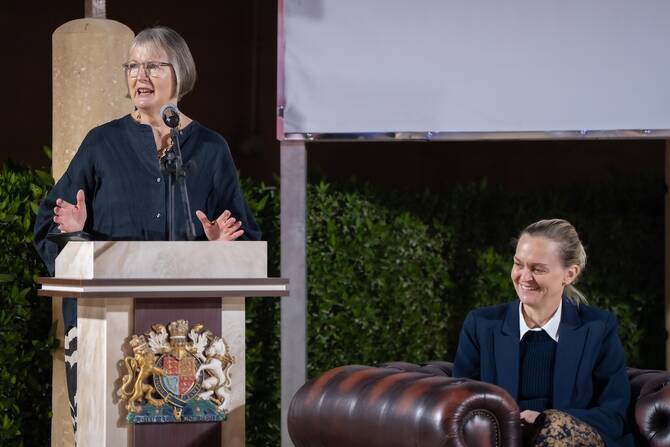
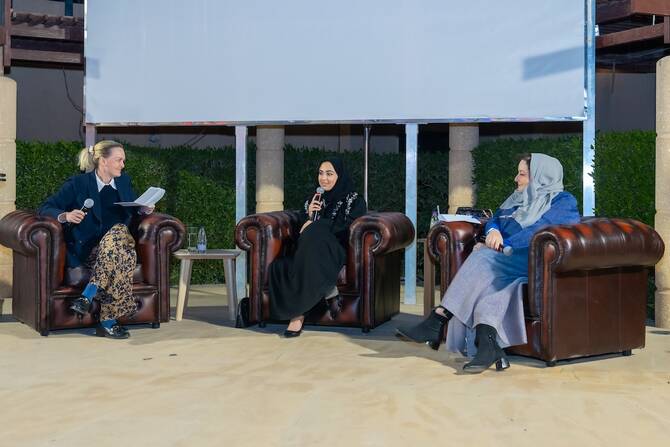

RIYADH: Dr Alice Burt, UK deputy Ambassador to Saudi Arabia, hosted a networking event on Sunday at the British Embassy in Riyadh to discuss the transformative progress of gender empowerment in the Kingdom.
She was joined by special guest Baroness Harriet Harman KC on stage with former member of Shoura Council Hoda Al-Helaissi and Arab News journalist Lama AlHamawi
The event, Empower Together: Why Gender Equality is Everyone’s Problem, attracted an audience of mainly women from various industries and backgrounds.
Topics discussed included the Kingdom’s history and Vision 2030, and debunking false narratives around Saudi women’s experiences.
One of the most important pillars under Vision 2030 and women’s empowerment comes from policies that encourage economic autonomy.
AlHamawi told the audience: “The government put these reforms in place to encourage women to get back to the workplace.
“So when you look at it, there’s obviously legislation reforms lifting a certain fence that limited women.”
On those legislations, she referred to childcare support, transport and subsidization efforts.
Al-Helaissi shared AlHamawi’s perspective while also shedding light on the history of the Kingdom, saying: “First of all we need to put Saudi Arabia in context, it’s very easy for us to talk about reforms and changes without looking at Saudi Arabia’s past, because it is through that past that we have come to where we are today, here.”
The transformation happening on the ground in the Kingdom has been noted by international media and onlookers, some of which are critical and others who are inspired.
On that international perspective, the panelists shared in-depth insight on the nitty-gritty of responding to international commentary regarding women’s empowerment in the Kingdom.
AlHamawi said: “Our presence abroad is changing these narratives … The next generation, we have influencers, content creators that are showcasing what’s actually happening in Saudi Arabia, but I think it will take time, just like everything else.”
Al-Helaissi added another angle to the topic of international stereotypes by bringing up the tendency for international media to be driven by sensationalized headlines rather than truth, particularly on the topic of women in the Kingdom.
“The woman in her abaya without a voice, the woman who has no job, the woman who needs a man … these are cliches … I know where we are in our evolution,” she told the audience as she emphasized that change is constant, and that a lack of research from international biased angles does not take away from that.
On the intersection of religion and culture as elements that have been weaponized by international media against women’s empowerment in the Kingdom, the panelists described their experience managing and responding to that backlash as Arab Muslim women.
Al-Helaissi said: “We need to learn to co-exist, we need to be tolerant enough to learn to say, this is my way and that is your way … it doesn’t stop us from being similar … we all have the same ambitions, we all want the same things — not just for ourselves, (but) for our children, for our societies.”
Baroness Harman spoke about her visit to the Kingdom as symbolic of her eagerness to understand women’s empowerment in all fields, including in education and the economy.
“I think that there is a real opportunity for the longstanding relationship that there has been between the UK and Saudi Arabia to be enhanced by an understanding of the situation of women and close relationships between women in those two countries,” she said.
On the importance of bringing both genders together to encourage women’s empowerment, Baroness Harman said: “There are a new generation of men, who I call the sons of the women’s movement.
“They have been brought up by women who believe in equal rights and who have led a more equal life.”
Adding to the discussion on the push for equal rights, Baroness Harman emphasized this unity not only between the genders, but also between women from diverse backgrounds to unite and “tackle the misconceptions about each other, and we can work together for what we want to do in our own journey … no woman in the world or the UK has got the right to know what it is that a Saudi woman wants, that is for Saudi women.”
Speaking to Arab News after her speech, Baroness Harman elaborated on the importance of amplifying Saudi women’s voices as the journey for empowerment progresses: “I’m interested to hear from Saudi women themselves the amazing progress that has been made, but also what the further aspirations are; and also to have more interaction so that we have a better understanding and close relations between women in Saudi and women in the UK.”


