Burning oil tanker in Red Sea unsafe to tow, EU naval mission says

1 / 2
2 / 2
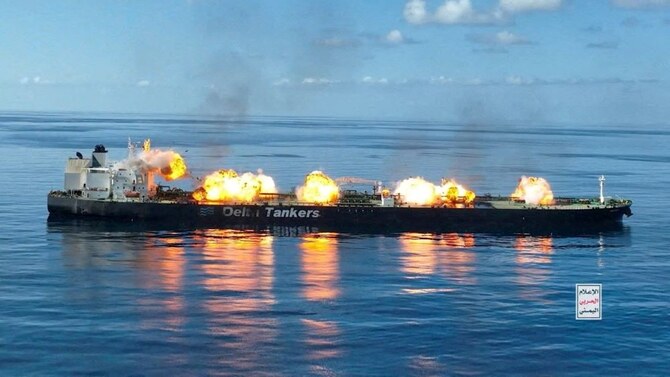
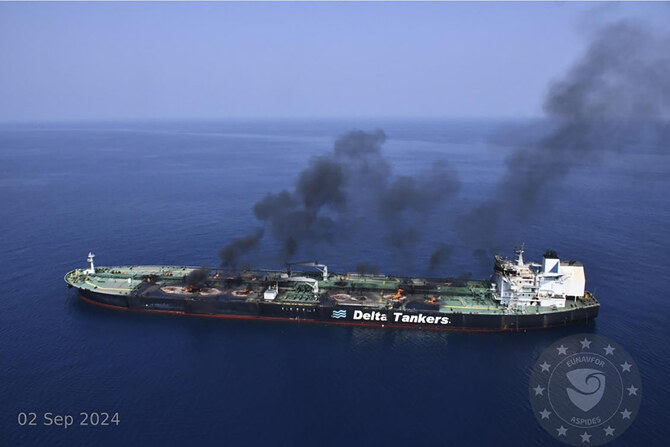
Greek-flagged oil tanker Sounion burns in the Red Sea following a series of attacks by the Houthis on Monday, Sept. 2, 2024. (AP Photo)
Short Url
Updated 03 September 2024
Follow

Burning oil tanker in Red Sea unsafe to tow, EU naval mission says

  • EUNAVFOR Aspides said that tugboats from private companies that arrived at the Sounion oil tanker in the Red Sea discovered that to move the ship from its current position is not viable
  • Greek-flagged Sounion, carrying 150,000 tonnes of crude oil, has been abandoned and engulfed in flames in the Red Sea since late last month

AL-MUKALLA: A burning oil tanker in the Red Sea loaded with almost a million barrels of oil cannot be moved to another position to be saved, the EU naval operation in the Red Sea said on Tuesday, dashing hopes of avoiding a tragedy in the important maritime channel.

The EU mission, known as EUNAVFOR Aspides, said that tugboats from private companies that arrived at the Sounion oil tanker in the Red Sea discovered that to move the ship from its current position is not viable and that rescuers are evaluating other on-site solutions. 

“The private companies responsible for the salvage operation have concluded that the conditions were not met to conduct the towing operation and that it was not safe to proceed. Alternative solutions are now being explored by the private companies,” the EU mission said on X.

The Greek-flagged Sounion, carrying 150,000 tonnes of crude oil, has been abandoned and engulfed in flames in the Red Sea since late last month, when the Houthis attacked it first with light arms fire, projectiles, and a drone boat, then boarded it and planted explosives that sparked fires on various parts of the ship.

The Houthi assault on the oil tanker has provoked worldwide condemnation, as well as warnings of a significant danger to Red Sea trade and marine life.

Wim Zwijnenburg of the Humanitarian Disarmament Project at the Dutch peace organization PAX told Arab News on Tuesday that the EU mission’s remark suggests that moving the tanker to another location is impossible and that rescuers may consider salvaging it at its current location, which will probably mean extinguishing the fires first.

“It means they can’t start with the rescue operations. The ship is probably not stable enough to tow it away and be salvaged at another location. So they are probably looking for on-site solutions, putting out the fire perhaps?” he said.

Earlier, the EU mission said on X that its warships had given protection to the tugboats that arrived at the scene of the burning ship, warning of an ecological disaster in the Red Sea if the ship was not salvaged.

“Since September 1st, 2024, EUNAVFOR ASPIDES assets have been engaged in protecting the tugs involved in the MV SOUNION salvage operation, aiming to facilitate the prevention of an unprecedented environmental disaster in the region.”

The post came as a Yemeni government official in the southern city of Aden, Yemen’s temporary capital, told Arab News on Tuesday that two tugboats from a port in Djibouti arrived at the Sounion’s location and started assessing the ship to determine how to rescue it.  

The US Central Command, which condemned the Houthis for assaulting two oil tankers in the Red Sea on Monday, also warned of an ecological catastrophe in the Red Sea from the burning ship.

“Currently, salvage efforts are underway in the southern Red Sea for the disabled MV Delta Sounion, which is still on fire and threatens the possibility of a major environmental disaster,” CENTCOM said on Tuesday morning.

CENTCOM said that its troops had destroyed two missile systems aimed at international ships in a Houthi-controlled part of Yemen.

On Monday, local media and people reported loud explosions and thick smoke billowing from the Al-Hamza military base in the Houthi-controlled Ibb governorate, reportedly attacked by the US military.  


Efforts to heal Syria’s ‘deep divisions’ arduous but ‘not insurmountable,’ UN chief says on anniversary of Assad’s fall

Updated 5 sec ago
Follow

Efforts to heal Syria’s ‘deep divisions’ arduous but ‘not insurmountable,’ UN chief says on anniversary of Assad’s fall

  • Antonio Guterres hails ‘end of a decades-old system of repression,’ Syrians’ ‘resilience and courage’— Transition offers opportunity to ‘forge a nation where every Syrian can live securely, equally, and with dignity’

NEW YORK: Efforts to heal Syria’s “deep divisions” will be long and arduous but the challenges ahead are “not insurmountable,” UN Secretary-General Antonio Guterres said on Sunday as he marked the first anniversary of the fall of the Assad regime.

A surprise offensive by a coalition of rebel forces led by Hayat Tahrir al-Sham and allied militias rapidly swept through regime-held areas in late November 2024. Within days, they seized key cities and ultimately captured the capital Damascus.

On Dec. 8 last year, as regime defenses collapsed almost overnight, then-President Bashar Assad fled the Syrian Arab Republic, ending more than 50 years of brutal rule by his family.

“Today marks one year since the fall of the Assad government and the end of a decades-old system of repression,” Guterres said, praising the “resilience and courage” of Syrians “who never stopped nurturing hope despite enduring unimaginable hardship.”

He added that the anniversary was both a moment of reflection on the sacrifices made in pursuit of “historic change,” and a reminder of the difficult path ahead for the country.

“What lies ahead is far more than a political transition; it is the chance to rebuild shattered communities and heal deep divisions,” he said, adding that the transition offers an opportunity to “forge a nation where every Syrian — regardless of ethnicity, religion, gender or political affiliation — can live securely, equally, and with dignity.”

Guterres stressed that the UN will continue supporting Syrians as they shape new political and civic institutions.

“The challenges are significant, but not insurmountable,” he said. “The past year has shown that meaningful change is possible when Syrians are empowered and supported in driving their own transition.”

He added that communities across the country are building new governance structures, and that “Syrian women continue to lead the charge for their rights, justice, and equality.”

Though humanitarian needs remain “immense,” he pointed to progress in restoring services, widening aid access, and creating conditions for the return of refugees and displaced people.

Transitional justice efforts are under way, he added, alongside broader civic engagement. Guterres urged governments to stand firmly behind a “Syrian-led, Syrian-owned transition,” saying support must include respect for sovereignty, removal of barriers to reconstruction, and robust funding for humanitarian and economic recovery.

“On this anniversary, we stand united in purpose — to build a foundation of peace and prosperity and renew our pledge to a free, sovereign, united, and inclusive Syria,” he added.