

Saudi automotive industry to get a boost with high-level East Asia visit

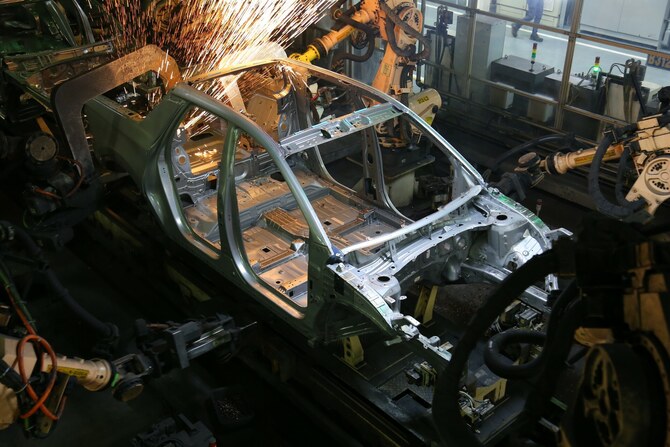
The Saudi automotive market holds considerable regional influence, accounting for 40 percent of total sales in the Middle East and North Africa. File/Getty Images
Short Url
Updated 01 September 2024
Follow

Saudi automotive industry to get a boost with high-level East Asia visit

  • Minister of Industry and Mineral Resources Bandar Alkhorayef will lead a delegation to China and Singapore from Sept. 1 to 8
  • Visit aims to bolster bilateral relations, attract investment to the Kingdom, and explore joint-venture opportunities in the industrial sector

RIYADH: Saudi Arabia’s efforts to localize its automotive industry are set to gain significant traction with a high-profile ministerial visit to East Asia.

Minister of Industry and Mineral Resources Bandar Alkhorayef will lead a delegation to China and Singapore from Sept. 1 to 8. The visit aims to bolster bilateral relations, attract investment to Saudi Arabia, and explore joint-venture opportunities in the industrial sector, as reported by the Saudi Press Agency.

The Saudi automotive market holds considerable regional influence, accounting for 40 percent of total sales in the Middle East and North Africa. This visit aligns with the Kingdom’s ambition to become a major automotive hub and a leader in innovative, eco-friendly vehicle solutions.

This initiative supports Saudi Vision 2030, which seeks to diversify the economy and establish Saudi Arabia as a global leader in industrial development.


Saudi Arabia and China share a robust strategic relationship that has flourished over more than 80 years, growing rapidly in economic, developmental, and cultural fields. China is Saudi Arabia’s largest trading partner, with trade exceeding $100 billion in 2023. Notable Chinese investments in Saudi Arabia last year included $5.6 billion in automotive manufacturing, $5.26 billion in the minerals sector, and $4.26 billion in semiconductors.

The visit will also involve meetings with prominent global companies in automation and technology. Notably, discussions with Huawei in Guangzhou will focus on collaboration in smart solutions and leveraging technologies from the Fourth Industrial Revolution — an era characterized by rapid technological advancements integrating digital, biological, and physical domains.

Additional meetings in Guangzhou will include talks with GAC Group and General Lithium. In Hong Kong, the delegation will engage with officials from the Trade and Industry Department, the Innovation and Technology Bureau, logistics firm Hutchison Ports, and the Federation of Hong Kong Industries. They will also meet with Cyberport, a leader in advanced technology, and automotive firm Johnson Electric, among other key commercial and industrial players.

In Singapore, the agenda features discussions with the deputy prime minister, the minister of trade and industry, and the minister of manpower. The delegation will also meet with A*STAR, the Singapore Manufacturing Federation, and visit Tuas Port, the world’s largest automated port, alongside additional ministries and companies.

In 2023, Saudi non-oil exports to Singapore totaled SR9.3 billion ($2.47 billion), while imports amounted to SR5.9 billion. Key exports included plastics, chemicals, electrical appliances, and metals, while major imports from Singapore were ships, optical instruments, medical devices, and pharmaceuticals.

The automotive sector remains a focal point of Saudi Arabia’s national industry strategy, emphasizing the development of innovative technologies and market growth.


Lebanese social entrepreneur Omar Itani recognized by Schwab Foundation

Updated 23 January 2026
Follow

Lebanese social entrepreneur Omar Itani recognized by Schwab Foundation

  • FabricAID co-founder among 21 global recipients recognized for social innovation

DAVOS: Lebanon’s Omar Itani is one of 21 recipients of the Social Entrepreneurs and Innovators of the Year Award by the Schwab Foundation for Social Entrepreneurship.

Itani is the co-founder of social enterprise FabricAID, which aims to “eradicate symptoms of poverty” by collecting and sanitizing secondhand clothing before placing items in stores in “extremely marginalized areas,” he told Arab News on the sidelines of the World Economic Forum in Davos, Switzerland.

With prices ranging from $0.25 to $4, the goal is for people to have a “dignified shopping experience” at affordable prices, he added.

FabricAID operates a network of clothing collection bins across key locations in Lebanon and Jordan, allowing people to donate pre-loved items. The garments are cleaned and sorted before being sold through the organization’s stores, while items that cannot be resold due to damage or heavy wear are repurposed for other uses, including corporate merchandise.

Since its launch, FabricAID has sold more than 1 million items, reached 200,000 beneficiaries and is preparing to expand into the Egyptian market.

Amid uncertainty in the Middle East, Itani advised young entrepreneurs to reframe challenges as opportunities.

“In Lebanon and the Arab world, we complain a lot,” he said. Understandably so, as “there are a lot of issues” in the region, resulting in people feeling frustrated and wanting to move away. But, he added, “a good portion of the challenges” facing the Middle East are “great economic and commercial opportunities.”

Over the past year, social innovators raised a combined $970 million in funding and secured a further $89 million in non-cash contributions, according to the Schwab Foundation’s recent report, “Built to Last: Social Innovation in Transition.”

This is particularly significant in an environment of geopolitical uncertainty and at a time when 82 percent report being affected by shrinking resources, triggering delays in program rollout (70 percent) and disruptions to scaling plans (72 percent).

Francois Bonnici, director of the Schwab Foundation for Social Entrepreneurship and a member of the World Economic Forum’s Executive Committee, said: “The next decade must move the models of social innovation decisively from the margins to the mainstream, transforming not only markets but mindsets.”

Award recipients take part in a structured three-year engagement with the Schwab Foundation, after which they join its global network as lifelong members. The program connects social entrepreneurs with international peers, collaborative initiatives, and capacity-building support aimed at strengthening and scaling their work.