Saudia launches first direct flight to Medan, Indonesia

1 / 2
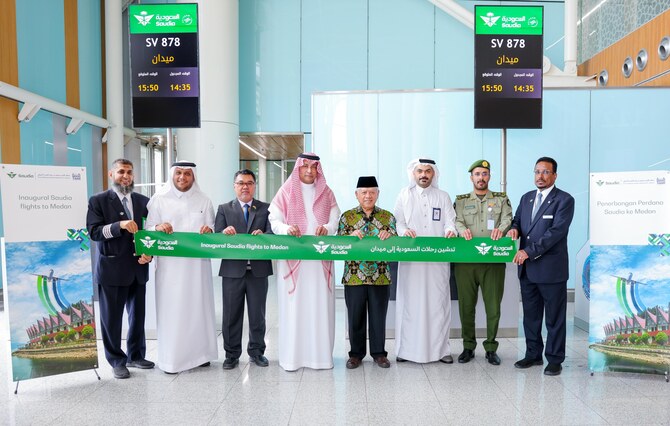
Saudia celebrated the inaugural flight to Medan with a ribbon-cutting ceremony at Prince Mohammed bin Abdulaziz International Airport. X/@SaudiaGroup
2 / 2
Saudia celebrated the inaugural flight to Medan with a ribbon-cutting ceremony at Prince Mohammed bin Abdulaziz International Airport. X/@SaudiaGroup
Short Url
Updated 01 September 2024
Follow

Saudia launches first direct flight to Medan, Indonesia

  • National carrier to offer four weekly services from Jeddah and Madinah
  • Air Connectivity Program aims to enhance Kingdom’s air routes to 250 destinations worldwide and transport 330 million passengers by 2030

JEDDAH: Saudi Arabia’s national carrier, Saudia, has launched its first direct flight to Medan in North Sumatra, offering four weekly services from the western cities of Jeddah and Madinah. 

Marking the second destination in Indonesia after Jakarta to be served by the carrier, the announcement, which was made on Aug. 31., aligns with the airlines’ commitment to connecting the world with the Kingdom and advancing Saudi Vision 2030, particularly in enhancing services for pilgrims and visitors to the two holy mosques. 

The air carrier celebrated the inaugural flight to Medan with a ribbon-cutting ceremony at the Madinah-based Prince Mohammed bin Abdulaziz International Airport, in the presence of Indonesia’s ambassador to the Kingdom, Abdulaziz Ahmed, and the assistant vice president of KSA Sales at Saudia, Wail Basaffar, as well as relevant stakeholders. 

Established in 2021, Saudi Arabia’s Air Connectivity Program aims to enhance the country’s air routes to 250 destinations worldwide and transport 330 million passengers by 2030. The initiative also seeks to streamline market entry and promote expansion opportunities for flight travel partners in the Kingdom. 

By developing new routes, the ACP strives to position the nation as a global leader in tourism air connectivity.

In its statement, Saudia said it offers a range of services designed to elevate the guest experience, including digital platforms allowing users to plan their journeys, complete necessary procedures, and access after-sales support. 

It added that it provides on-site services at airports to expedite processes and ensure a seamless travel experience. 

With a fleet of 143 aircraft, the company’s international operations are continuously evolving to expand its market share and set new benchmarks in guest transportation, catering to tourists, visitors, and pilgrims. 

The air carrier emphasized that it is committed to increasing the volume of transit traffic between continents via the Kingdom, adding that this is a key pillar of its strategic vision and new era. 

Despite June being a peak travel month due to the Hajj pilgrimage and summer travel season, the airline topped the global rankings for the month with an 88.22 percent on-time arrival rate, according to new data from the independent aviation tracking site Cirium. 

Saudia also recorded an on-time departure rate of 88.73 percent, while operating 16,133 flights across its network of over 100 destinations on four continents. 

In May, Saudia Group signed an order for an additional 105 A320neo family planes, marking the largest aircraft deal with Airbus in the Kingdom’s history. 

The $19 billion deal, announced at the Future Aviation Forum in Riyadh by Ibrahim Al-Omar, the group’s director general, includes A320neo and A321neo models. These aircraft will be distributed between Saudia and flyadeal, the group’s low-cost carrier. 

Saudia will acquire 54 A321neo aircraft, while flyadeal will receive 12 A320neo and 39 A321neo models. The group is set to receive the first airliner in the first quarter of 2026.


Oman’s non-oil exports rise 7.5% as diversification gains traction 

Updated 7 sec ago
Follow

Oman’s non-oil exports rise 7.5% as diversification gains traction 

RIYADH: Oman’s non-oil exports rose 7.5 percent to 6.7 billion Omani rials ($17.4 billion) in 2025, highlighting diversification gains even as lower crude prices dragged overall export earnings lower. 

Data from the National Centre for Statistics and Information showed re-export activity grew faster, increasing 20.3 percent year on year to 2.05 billion rials, supported by stronger trade flows through the Sultanate’s ports and logistics hubs. 

The expansion reflects government efforts to boost industrial output and develop export-oriented sectors as Oman works to reduce reliance on hydrocarbons under its economic diversification strategy. 

The improvement in non-oil trade follows Fitch Ratings’ decision in December to upgrade Oman to investment-grade status, raising its long-term foreign-currency rating to BBB- from BB+. The agency cited stronger public finances, an improved external position, and continued fiscal discipline, noting government debt had declined to around 36 percent of gross domestic product in 2025 from about 68 percent in 2020. 

“The Sultanate of Oman has made notable advancements in diversifying its exports and enhancing its economy sustainably, particularly through non-oil sectors,” said Raymond Khoury, partner and public sector lead at Arthur D. Little Middle East.  

He added: “To build on this progress, it is crucial to increase investments in modern technologies like artificial intelligence, especially by establishing advanced data centers to support digital sovereignty and integrating AI into manufacturing and agriculture to boost productivity and further diversify the export portfolio.” 

The newly released data further showed that products from chemical and related industries, metal products, plastics, as well as machinery and electrical equipment were among the most prominent Omani non-oil exports last year. 

The figures also indicated a decline in the value of oil and gas exports, which fell to 14.5 billion rials, marking a 15.2 percent year-on-year decrease. 

Oil exports were affected by a drop in the average price of Omani crude to $71 per barrel last year, compared with $80.8 per barrel in 2024. 

Total oil exports last year reached 307.9 million barrels, compared with 308.4 million barrels in 2024, while average daily oil production increased from 992,600 barrels per day in 2024 to more than one million barrels per day in 2025. 

The data also showed that the value of Oman’s merchandise exports reached 23.2 billion rials last year, reflecting a 7.1 percent decline from 2024, mainly due to lower oil export revenues. Merchandise imports, meanwhile, rose by 2.7 percent during the same period to exceed 17.1 billion rials in 2025. 

Statistics further indicated that Oman’s total merchandise trade stood at 40.4 billion rials in 2025, compared with 41.7 billion rials in 2024, reflecting the decline in oil export values. 

Regarding trading partners for non-oil exports, the UAE topped the list with more than 1.31 billion rials in 2025, up 25.3 percent year on year. 

The value of Omani non-oil exports to Saudi Arabia rose from 849 million rials to 1.07 billion rials during the same period, while exports to India increased by 6 percent to approximately 700 million rials. Meanwhile, non-oil exports to South Korea and the US declined by 26.1 percent and 13.3 percent, respectively. 

The UAE also ranked as Oman’s largest partner in re-export activities last year, accounting for 35.2 percent of total re-export trade, which amounted to 2.05 billion rials. The value of goods re-exported to the UAE reached 724 million rials, marking annual growth of 27.2 percent. 

Iran ranked second with 365 million rials, registering a modest increase of 1.6 percent compared with the previous year. The UK came third with 207 million rials, followed by Saudi Arabia in fourth place with 191 million rials and India in fifth with 84 million rials. 

Merchandise imports from the UAE increased by 5.4 percent during the year, exceeding 4.1 billion rials. 

Imports from China rose by 5.7 percent to 1.93 billion rials, while imports from India declined by 3.8 percent to 1.44 billion rials. Imports from Kuwait fell from 1.69 billion rials to 1.31 billion rials, while imports from Saudi Arabia declined from 1.28 billion rials to 1.21 billion rials.