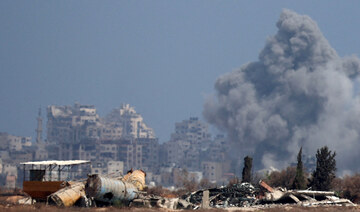
DEIR AL-BALAH, Gaza Strip: One of Gaza’s last functioning hospitals has been emptying out in recent days as Israel has ordered the evacuation of nearby areas and signaled a possible ground operation in a town that has been largely spared throughout the war, officials said Monday.
The Al-Aqsa Martyrs Hospital in Deir Al-Balah is the main hospital serving central Gaza. The Israeli military has not ordered its evacuation, but patients and people sheltering there fear that it may be engulfed in fighting or become the target of a raid.
Also on Monday, Israeli strikes in Gaza City and Khan Younis killed at least 19 people, according to local officials, and fighting between Israel and Hezbollah resumed across the Lebanon border.
Israeli forces have invaded several hospitals in Gaza over the course of the 10-month-old war, accusing Hamas of using them for military purposes, allegations denied by Palestinian health officials.
Israeli evacuation orders now cover around 84 percent of Gaza’s territory, according to the United Nations, which estimates that around 90 percent of Gaza’s population of 2.3 million have been forced from their homes. Many have been displaced multiple times.
The evacuation orders have reduced the size of the humanitarian zone declared by Israel at the start of the war while crowding more Palestinians into it. Thousands of Palestinian families have packed into tent camps along the beach where aid groups say food and clean water are scarce and disease spreads quickly.
The most recent satellite images available from PlanetLabs and analyzed by The Associated Press show the increase in tent density along the beachfront since July 19.
AP reporters saw people fleeing the hospital and surrounding areas on Monday, many on foot. Some pushed patients on stretchers or carried sick children, while others held bags of clothes, mattresses and blankets. Four schools in the area were also being evacuated.
“Where will we get medicine?” Adliyeh Al-Najjar said as she rested outside the hospital gate. “Where will patients like me go?”
Fatimah Al-Attar fought back tears as she left the hospital compound heading in the direction of the tent camps. “Our fate is to die,” she said. “There is no place for us to go. There is no safe place.”
The UN Office for Humanitarian Affairs known as OCHA said that since Friday the Israeli military has issued three evacuation orders for over 19 neighborhoods in northern Gaza and in Deir al Balah, affecting more than 8,000 people staying in these areas.
The order covers an area including or near UN and other humanitarian centers, the Al Aqsa hospital, two clinics, three wells, one water reservoir and one desalination plant, said Jens Laerke, a spokesman for OCHA.
“This effectively upends a whole lifesaving humanitarian hub,” Laerke said.
Doctors Without Borders, an international charity known by its French acronym MSF, said an explosion around 250 meters (yards) from the hospital on Sunday caused panic, accelerating the exodus.
“As a result, MSF is considering whether to suspend wound care for the time being, while trying to maintain life-saving treatment,” it said on the platform X.
The hospital says it was treating over 600 patients before the evacuation orders, which apply to residential areas about a kilometer (0.6 mile) away. Around 100 patients remain, including seven in intensive care and eight in the children’s ward.
The Israeli military said it was operating against Hamas in Deir Al-Balah and working to dismantle its remaining infrastructure there. It said the evacuation orders were issued to protect civilians, and did not include nearby hospitals or medical facilities. It said it had also informed Palestinian health officials that the facilities did not need to be evacuated.
The army has excluded hospitals from past evacuation orders, but patients and others have still fled, fearing for their safety.
Israel’s military said Monday that its forces were expanding operations on the outskirts of Deir Al-Balah and had discovered weapons in a residential apartment and dismantled an underground Hamas tunnel about 700 meters (765 yards) long.
Local health officials said an Israeli airstrike hit a group of people on the seashore in Gaza City, killing at least seven men while they were fishing.
Another strike hit a vehicle inside the Israeli-declared humanitarian zone near the southern city of Khan Younis, killing at least five people, according to a Kuwaiti field hospital, where the bodies were taken.
The Israeli military did not immediately respond to a request for comment on those attacks.
Monday night, a strike hit a house in Maghazi, a refugee camp near Deir Al-Balah, and killed at least seven people, including four children and a woman, according to hospital records and AP journalists who counted the bodies. Ambulances recovered the bodies that were taken to Al Aqsa hospital.
The war began on Oct. 7 when Hamas-led militants attacked Israeli army bases and farming communities. The militants killed some 1,200 people, mostly civilians, and dragged around 250 hostages back to Gaza.
Israel’s retaliatory offensive has killed over 40,000 Palestinians, according to Gaza’s Health Ministry, and caused heavy destruction across much of the territory. Hamas is still holding around 110 hostages, about a third of whom are believed to be dead, after most of the rest were freed in a ceasefire last year.
Israel has continued carrying out strikes across Gaza as the United States, Egypt and Qatar have tried to broker a lasting ceasefire and the release of the remaining hostages. Major gaps remain despite several months of high-level negotiations.
Hospitals have repeatedly been turned into battlegrounds, both literally and in the rival narratives surrounding the war.
Israel’s army has raided a number of medical facilities since the start of the war and has provided some evidence that militants were inside some of them. Medical staff deny the allegations and accuse the army of reckless disregard for civilians.
Hospitals can lose their protected status under international law if they are used for military purposes, but any operations against them must be proportional and seek to spare civilians.
Only 16 of Gaza’s 36 hospitals are even partially functioning, according to the World Health Organization, even as they treat casualties from daily Israeli airstrikes across the territory. The difficulty of importing and distributing humanitarian aid in Gaza has contributed to widespread hunger and disease outbreaks, further stressing the health sector.


![]()

Main hospital in central Gaza empties out as Israeli forces draw near

Short Url
https://arab.news/jx3np
Main hospital in central Gaza empties out as Israeli forces draw near
- Israeli evacuation orders now cover around 84 percent of Gaza’s territory, according to the United Nations

Latest updates






© 2026 SAUDI RESEARCH & PUBLISHING COMPANY, All Rights Reserved And subject to Terms of Use Agreement.