

Five killed in Israeli strike on West Bank camp, Palestinian health ministry says

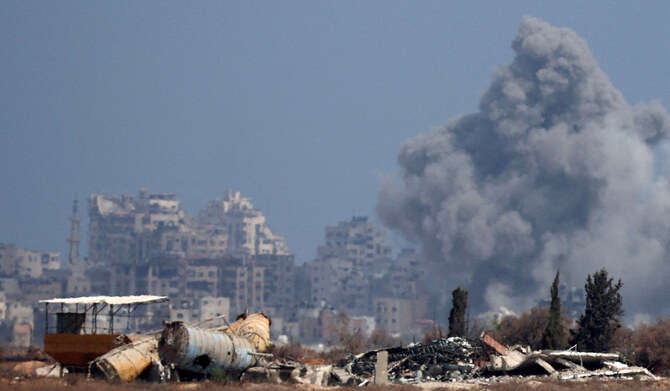
Smoke rises from an explosion in Gaza, amid the Israel-Hamas conflict, near the Israel-Gaza border, as seen from Israel, August 23, 2024. (REUTERS)
Short Url
Updated 26 August 2024
Follow

Five killed in Israeli strike on West Bank camp, Palestinian health ministry says

  • The camp near Tulkarem has been the target of multiple Israeli army operations

JERUSALEM: Israel said on Monday it carried out an air strike on the occupied West Bank, while the Palestinian Authority reported five killed in the incident.
“A short while ago, an aircraft struck an operational center in the area of Nur Shams,” an Israeli military spokesperson said, without providing a casualty count or specifying who was targeted.
“Five citizens were killed and others were injured,” the official Palestinian news agency Wafa said.
Violence in the West Bank has surged alongside the war in Gaza, with more than 640 Palestinians killed by Israeli troops and settlers since Hamas’s October 7 attack, according to an AFP tally based on Palestinian health ministry figures.
At least 19 Israelis have also died in Palestinian attacks during the same period, according to Israeli officials.
A correspondent for Wafa reported hearing four loud explosions and said Monday’s strike targeted a house in the Nur Shams refugee camp.
The camp near Tulkarem has been the target of multiple Israeli army operations.
Fourteen people died in one two-day Israeli operation in Nur Shams in April, according to the Palestinian Red Crescent.
And in July Israeli forces bulldozed the main street in Nur Shams during a raid that lasted 15 hours.


Syrian army deploys in Deir Ezzor province after Kurdish withdrawal

Updated 2 sec ago
Follow

Syrian army deploys in Deir Ezzor province after Kurdish withdrawal

  • Syria’s army on Monday deployed its forces in parts of the eastern Deir Ezzor province formerly controlled by Kurdish forces following their withdrawal from the area
DEIR EZZOR: Syria’s army on Monday deployed its forces in parts of the eastern Deir Ezzor province formerly controlled by Kurdish forces following their withdrawal from the area.
After two days of rapid gains in Kurdish-controlled territory, Syrian President Ahmed Al-Sharaa announced on Sunday a deal with their leader Mazloum Abdi that includes a ceasefire and the integration of the Kurdish administration and forces into the central state.
The government push captured Arab-majority areas that came under Kurdish control during the fight against the Daesh group.
In Deir Ezzor, an AFP correspondent saw dozens of military vehicles heading to the east of the Euphrates river, which once separated Damascus-controlled areas to the west from the US-backed, Kurdish-led Syrian Democratic Forces to the east.
Lines of cars, trucks and motorcycles formed in front of a small bridge leading to the eastern bank.
Some people were also heading there on foot.
“Our joy over liberation is indescribable,” Mohammed Khalil, a 50-year-old driver in Deir Ezzor, told AFP.
“We hope things will be better than before. There was... no freedom under the SDF.”
Safia Keddo, a 49-year-old teacher, told AFP “the past few years, but today we must turn the page.”
“We want children to return to school without fear, and for electricity, water, and bread to be restored. We’re not asking for a miracle; we just want stability and a normal life.”
The Syrian army said in a statement that it “started the deployment” into the eastern Jazira region “to secure it under the agreement between the Syrian state and the SDF.”
The agreement calls for the immediate handover of the provinces of the Arab-majority Raqqa and Deir Ezzor provinces.
The SDF had announced on Sunday that it was withdrawing from areas under its control in the eastern Deir Ezzor countryside, including the Al-Omar and Tanak oil fields.
Local fighters from tribes in the Arab-majority province sided with Damascus and took control of these areas before the arrival of government forces.
Some Arab tribes were previously allied with the SDF, which included a significant Arab component in its ranks.
The SDF had taken control of part of Deir Ezzor after defeating the Daesh group with the support of an international coalition led by the United States.