

Fires break out on abandoned Greek-flagged oil tanker Sounion that Yemen rebels attacked in Red Sea

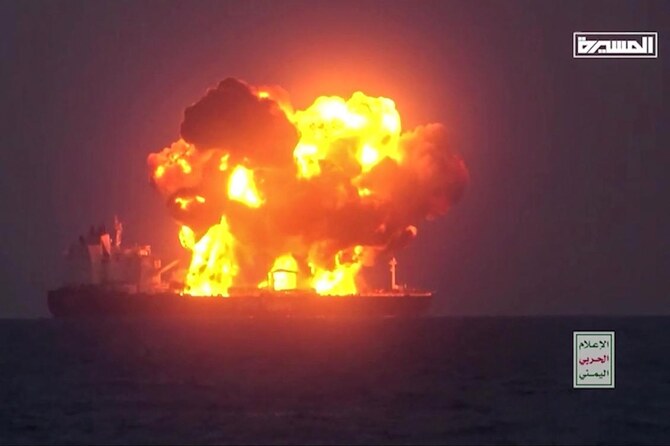
This image grab from a video released on August 23, 2024 by Yemen’s Houthi Ansarullah Media Center, shows what they say is the Greek-owned oil tanker Sounion which they reportedly hit by three projectiles on August 21, 2023. (AFP)
Short Url
Updated 25 August 2024
Follow

Fires break out on abandoned Greek-flagged oil tanker Sounion that Yemen rebels attacked in Red Sea

  • The rebels are suspected to have gone back and attacked at least one other vessel that later sank as part of their monthslong campaign against shipping in the Red Sea
  • The British military’s United Kingdom Maritime Trade Operations center reported the fires in a note to mariners on Friday night

DUBAI: Fires broke out Friday on a Greek-flagged oil tanker previously attacked by Yemen’s Houthi rebels this week, with the vessel now appearing to be adrift in the Red Sea, authorities said.
It wasn’t immediately clear what had happened to the oil tanker Sounion, which had been abandoned by its crew on Thursday and reportedly anchored in place.
The Houthis didn’t immediately acknowledge the fire. The rebels are suspected to have gone back and attacked at least one other vessel that later sank as part of their monthslong campaign against shipping in the Red Sea over the ongoing Israel-Hamas war in the Gaza Strip. The attacks have disrupted a trade route that typically sees $1 trillion in goods pass through it annually.
The British military’s United Kingdom Maritime Trade Operations center reported the fires in a note to mariners on Friday night.
“UKMTO have received a report that three fires have been observed on vessel,” the center said. “The vessel appears to be drifting.”
A United States defense official, speaking on condition of anonymity to discuss intelligence matters, said American officials were aware of the fires and continued to monitor the situation.

The vessel had been staffed by a crew of 25 Filipinos and Russians, as well as four private security personnel, who were taken by a French destroyer to nearby Djibouti, the European Union’s Aspides naval mission in the Red Sea said Thursday.
The Sounion has 150,000 tons of crude oil aboard and represents a “navigational and environmental hazard,” the mission warned. “It is essential that everyone in the area exercises caution and refrains from any actions that could lead to a deterioration of the current situation.”
Late Friday night, the Houthis released footage of an explosion striking the Sounion, their fighters on the water in the distance chanting the group’s slogan: “God is the greatest; death to America; death to Israel; curse the Jews; victory to Islam.”
A frame-by-frame analysis of the video conducted by The Associated Press suggested three simultaneous explosions struck the deck of the Sounion. That signature suggests an attack conducted by planted explosives, rather than a strike by missile or drone.
The Houthis have targeted more than 80 vessels with missiles and drones since the war in Gaza started in October. They seized one vessel and sank two in the campaign that also killed four sailors. One of the sunken vessels, the Tutor, went down after the Houthis planted explosives aboard it, after its crew abandoned the ship due to an earlier attack, the rebel group later acknowledged.
Other missiles and drones have either been intercepted by a US-led coalition in the Red Sea or failed to reach their targets.
The rebels maintain that they target ships linked to Israel, the US or the UK to force an end to Israel’s campaign against Hamas in Gaza. However, many of the ships attacked have little or no connection to the conflict, including some bound for Iran.
As Iran threatens to retaliate against Israel over the assassination of Hamas leader Ismail Haniyeh in Tehran, the US military told the USS Abraham Lincoln aircraft carrier strike group to sail more quickly to the area. Early Thursday, the US military’s Central Command said that the Lincoln had reached the waters of the Middle East, without elaborating.
Washington also has ordered the USS Georgia-guided missile submarine to the region, while the USS Theodore Roosevelt aircraft carrier strike group was in the Gulf of Oman.
Additional F-22 fighter jets have flown into the region and the USS Wasp, a large amphibious assault ship carrying F-35 fighter jets, is in the Mediterranean Sea.
Early Saturday, the US military’s Central Command said it had destroyed a Houthi missile system in Yemen over the last 24 hours.


Syria welcomes US House vote to end ‘Caesar Act’ sanctions

Updated 10 sec ago
Follow

Syria welcomes US House vote to end ‘Caesar Act’ sanctions

  • Representatives back defense bill that includes provisions to scrap wide-ranging sanctions imposed on former leader Bashar Assad
  • Syria’s new government says vote is ‘pivotal moment’ for country as it attempts to rebuild its economy

LONDON: A vote by the US House of Representatives in favor of ending tough sanctions on Syria was welcomed by Damascus on Thursday as a “pivotal moment.”

The “Caesar Act” sanctions regime was imposed in 2020 against former President Bashar Assad’s government over the human-rights abuses carried out during the civil war.

The move to repeal the sanctions, seen as a crucial step for the Syrian Arab Republic’s economic recovery, is contained in a wide-ranging defense bill that the lower house of Congress backed on Thursday.

The Syrian Foreign Ministry said the vote “paves the way for a broader economic recovery and the return of opportunities long denied to Syrians.”

The ministry described it as a first step toward improving trade flows, and increasing the availability of essential goods, and medical supplies.

The National Defense Authorization Act, or NDAA, will now pass to the US Senate where a vote is expected to be held by the end of the year.

Assad was forced from power a year ago after a rapid military campaign by opposition forces brought the 13-year conflict to an end.

The new president, Ahmad Al-Sharaa, who led the offensive, has made ending Syria’s isolation a priority as he attempts to rebuild the country’s shattered economy.

President Donald Trump said in May that he planned to lift all sanctions on Syria and many have already been removed or suspended.

The Caesar Act, which imposed the toughest restrictions on trade and investment in Syria, requires Congressional approval to be overturned.

Along with repealing the act, the bill requires the White House to provide regular reports confirming that Syria’s government is fighting Daesh militants and upholding religious and ethnic minority rights, Reuters reported.

Syria’s foreign minister, Asaad Al-Shaibani, said the step toward repealing the Caesar Act was a “triumph for justice but also a recognition of the strength and resilience of the Syrian people.”

He said it reflected the success of Syrian diplomacy with the US.

Al-Sharaa has held talks with Trump three times, including an initial meeting in Riyadh in May on the sidelines of a US-GCC summit.

The Syrian president traveled to Washington in September where he was hosted at the White House. Speaking after the meeting, Trump said the US would do “everything we can to make Syria successful.”

During the visit, Syria confirmed that it would join the global coalition against Daesh.

Removing international sanctions on Syria would allow foreign investment to flow into the country, where the cost of rebuilding is estimated to be more than $200 billion.

Syrian Central Bank Gov. Abdulkader Husrieh told Reuters recently that the repeal of US sanctions was “a miracle” and that the economy was growing faster than expected.

The Caesar Act targeted individuals, companies and institutions linked to Assad, and sanctioned foreign entities from funding them.

The legislation was named after a code name given to a Syrian military photographer who smuggled thousands of photos documenting torture and war crimes by the Syrian regime out of the country.