Manila,: The Philippines on Friday urged its mariners to “avoid” the Red Sea as Yemen-based Houthi rebels kept up their deadly missile and drone attacks on merchant shipping in the vital waterway.
“Philippine nationals should avoid the area altogether unless absolutely necessary for their livelihood,” the foreign ministry said, citing the “conflict escalation in the Red Sea that poses a clear and present danger to all Filipino seafarers working in the area.”
The foreign ministry said Filipino seafarers should “exercise prudent choice” and their “right-to-refuse sailing” due to the risks.
The warning came a day after 23 Filipino and two Russian crew members were rescued from a Greek-flagged oil tanker that was hit by several projectiles off the rebel-held Yemeni port of Hodeida on Wednesday.
The attack on the Sounion caused a fire and cut engine power.
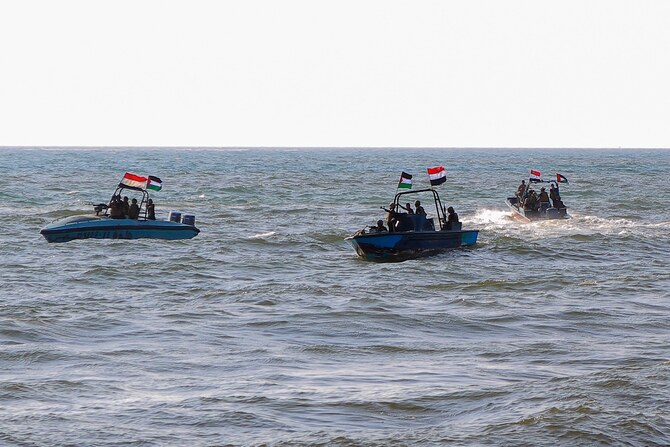
It was claimed by Yemen’s Iran-backed Houthi rebels, who have waged a campaign against international shipping that they say is in support of Gaza during the Israel-Hamas war.
The Philippines is a major supplier of mariners to the global shipping industry.
Manila said Thursday the Sounion was the ninth ship with Filipino crew members that has been attacked by the Houthis.
One Filipino remains missing from a Red Sea attack on the MV Tutor in June, while 17 Filipino crew of the Galaxy Leader have remained in Huothi captivity since the ship was seized last November.

Philippines urges its mariners to ‘avoid’ Red Sea amid Houthi attacks
https://arab.news/rfung
Philippines urges its mariners to ‘avoid’ Red Sea amid Houthi attacks
- The foreign ministry said Filipino seafarers should “exercise prudent choice” and their “right-to-refuse sailing” due to the risks
- The Philippines is a major supplier of mariners to the global shipping industry
Cuba says a 5th person died after people on a Florida-flagged speedboat opened fire on soldiers
- Authorities in Cuba said that on Feb. 26 Cuban soldiers confronted a speedboat carrying 10 people as the vessel approached the island and opened fire on the troops
- The shooting threatened to increase tensions between US President Donald Trump and Cuban authorities
HAVANA: Cuba said a fifth person has died as a consequence of a fatal shootout last month involving a Florida-flagged speedboat that allegedly opened fire on soldiers in waters off the island nation’s north coast.
The island’s interior ministry said late Thursday in a statement that Roberto Álvarez Ávila died on March 4 as a result of his injuries. It added that the remaining injured detainees “continue to receive specialized medical care according to their health status.”
Authorities in Cuba said that on Feb. 26 Cuban soldiers confronted a speedboat carrying 10 people as the vessel approached the island and opened fire on the troops. They said the passengers were armed Cubans living in the US who were trying to infiltrate the island and “unleash terrorism”. Cuba said its soldiers killed four people and wounded six others.
“The statements made by the detainees themselves, together with a series of investigative procedures, reinforce the evidence against them,” the Cuban interior ministry said in its statement, adding that “new elements are being obtained that establish the involvement of other individuals based in the US”
Earlier this week, Cuba said it had filed terrorism charges against six suspects that were on the speedboat. The government unveiled items said to have been found on the boat, including a dozen high-powered weapons, more than 12,800 pieces of ammunition and 11 pistols.
Cuban authorities have provided few details about the shooting, but said the boat was roughly 1.6 kilometers (1 mile) northeast of Cayo Falcones, off the country’s north coast. They also provided the boat’s registration number, but The Associated Press was unable to readily verify the details because boat registrations are not public in the state of Florida.
The shooting threatened to increase tensions between US President Donald Trump and Cuban authorities. The island’s economy was until recently largely kept economically afloat by Venezuela’s oil, which is now in doubt after a US military operation deposed then-Venezuelan President Nicolás Maduro.


