

Marcos signs law expanding Shariah jurisdiction in Philippines

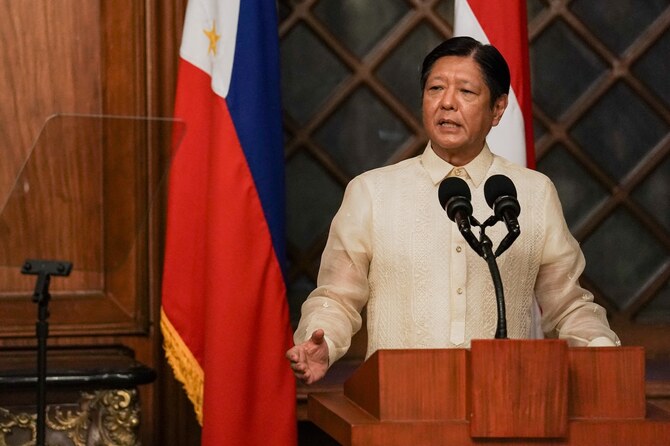
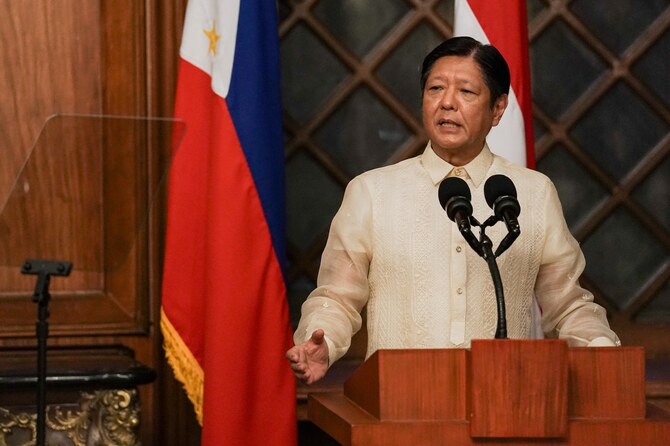
Philippine President Ferdinand Marcos Jr speaks during a press conference at the Malacanang Palace in Manila on Aug. 15, 2024. (AFP)
Short Url
Updated 16 August 2024
Follow

Marcos signs law expanding Shariah jurisdiction in Philippines

  • New Shariah judicial districts created beyond the country’s Muslim-majority south
  • Muslim officials say the president’s decision is a ‘victory for efforts on inclusivity’

Manila: Philippine President Ferdinand Marcos Jr. has signed a law expanding Shariah jurisdiction and creating new Islamic courts in the Catholic-majority country.

Shariah, or Islamic law, is partially implemented in the Philippines, applicable only to the Muslim community — about 10 percent of the 120 million of the country’s predominantly Catholic population.

Established under the 1977 Code of Muslim Personal Laws, the Islamic law courts are under the administrative supervision of the Supreme Court and until now had jurisdiction over the Bangsamoro Autonomous Region as well as other parts of the southern Mindanao island, which have significant Muslim populations.

The new law creates three additional Shariah judicial districts — beyond the country’s south — and an additional 12 courts.

“The new law also increases the number of (Shariah) circuit courts from 51 to 63. The 12 new (Shariah) circuit courts will serve the newly created (Shariah) Judicial Districts,” the Office of the President said in a statement on Thursday.

The Shariah judicial system used to have five districts, all in Mindanao. The new ones expand the reach of Islamic law to the most populous Luzon island — including Metro Manila — and the islands of Mindoro, Marinduque, Rombolon and Palawan island, where Muslims are in the minority.

The president’s decision was welcomed in the Bangsamoro Autonomous Region in Muslim Mindanao.

“The addition of new Shariah District Courts and Circuit Courts will enhance the access to justice of Muslims in the Philippines,” Mohd. Asnin Pendatun, BARMM cabinet secretary and the Bangsamoro government’s spokesperson, told Arab News, adding that the decision adds to the ongoing efforts for Filipino Muslims to have a “genuine place in the Bagong Pilipinas (New Philippines) vision of the national government.”

Lawmakers in the Bangsomoro region said in a statement it was a “victory for efforts on inclusivity and a powerful acknowledgment of the unique needs” of the Muslim community.

“This is a victory for efforts on inclusivity and a powerful acknowledgment of the unique needs of the Muslim community,” MPs Amir Mawallil, Rasol Mitmug Jr. and Laisa Alamia said in a statement.

“This represents a significant advancement in the administration of justice for our Muslim brothers and sisters in the Philippines. It acknowledges the importance of the (Shariah) judicial system and brings it closer to the communities it serves, ensuring that justice according to Islamic law is more accessible to all,” Amir Mawallil, member of the Bangsamoro Parliament, said in a joint statement with lawmakers Rasol Mitmug Jr. and Laisa Alamia.

“We thank President Marcos Jr. for deeply understanding the situation of our Muslim brothers and sisters and signing into law this significant measure.”

Shariah courts in the Philippines have application over personal status law, including marriage, as well as financial laws and halal certification.

The expansion of their reach aligns with the Supreme Court’s Strategic Plan for Judicial Innovations 2022-2027, which includes a goal to “strengthen the Shariah justice system.”


US military boards sanctioned oil tanker in Indian Ocean

Updated 3 sec ago
Follow

US military boards sanctioned oil tanker in Indian Ocean

  • Tanker tracking website says Aquila II departed the Venezuelan coast after US forces captured then-President Nicolás Maduro
  • Pentagon says it 'hunted' the vessel all the way from the Caribbean to the Indian Ocean
WASHINGTON: US military forces boarded a sanctioned oil tanker in the Indian Ocean after tracking the ship from the Caribbean Sea, the Pentagon said Monday.
The Pentagon’s statement on social media did not say whether the ship was connected to Venezuela, which faces US sanctions on its oil and relies on a shadow fleet of falsely flagged tankers to smuggle crude into global supply chains.
However, the Aquila II was one of at least 16 tankers that departed the Venezuelan coast last month after US forces captured then-President Nicolás Maduro, said Samir Madani, co-founder of TankerTrackers.com. He said his organization used satellite imagery and surface-level photos to document the ship’s movements.
According to data transmitted from the ship on Monday, it is not currently laden with a cargo of crude oil.
The Aquila II is a Panamanian-flagged tanker under US sanctions related to the shipment of illicit Russian oil. Owned by a company with a listed address in Hong Kong, ship tracking data shows it has spent much of the last year with its radio transponder turned off, a practice known as “running dark” commonly employed by smugglers to hide their location.
US Southern Command, which oversees Latin America, said in an email that it had nothing to add to the Pentagon’s post on X. The post said the military “conducted a right-of-visit, maritime interdiction” on the ship.
“The Aquila II was operating in defiance of President Trump’s established quarantine of sanctioned vessels in the Caribbean,” the Pentagon said. “It ran, and we followed.”
The US did not say it had seized the ship, which the US has done previously with at least seven other sanctioned oil tankers linked to Venezuela.
A Navy official, who spoke on condition of anonymity to discuss military operations, would not say what forces were used in the operation but confirmed the destroyers USS Pinckney and USS John Finn as well as the mobile base ship USS Miguel Keith were operating in the Indian Ocean.
In videos the Pentagon posted to social media, uniformed forces can be seen boarding a Navy helicopter that takes off from a ship that matches the profile of the Miguel Keith. Video and photos of the tanker shot from inside a helicopter also show a Navy destroyer sailing alongside the ship.
Since the US ouster of Maduro in a surprise nighttime raid on Jan. 3, the Trump administration has set out to control the production, refining and global distribution of Venezuela’s petroleum products. Officials in President Donald Trump’s Republican administration have made it clear they see seizing the tankers as a way to generate cash as they seek to rebuild Venezuela’s battered oil industry and restore its economy.
Trump also has been trying to restrict the flow of oil to Cuba, which faces strict economic sanctions by the US and relies heavily on oil shipments from allies like Mexico, Russia and Venezuela.
Since the Venezuela operation, Trump has said no more Venezuelan oil will go to Cuba and that the Cuban government is ready to fall. Trump also recently signed an executive order that would impose a tariff on any goods from countries that sell or provide oil to Cuba, primarily pressuring Mexico because it has acted as an oil lifeline for Cuba.