

Philippines holds victory parade for double gold medalist Carlos Yulo

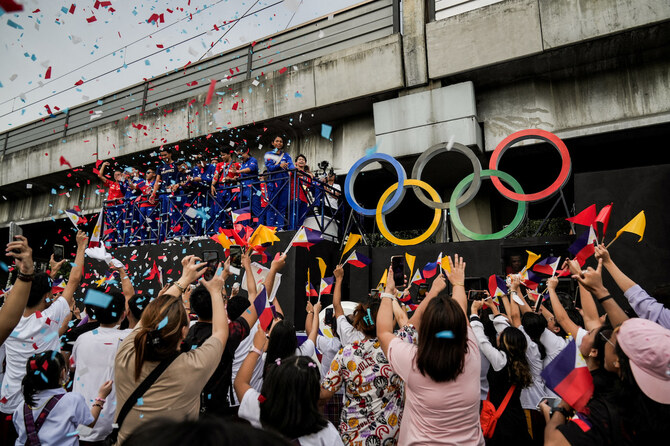
Filipino gymnast Carlos Yulo joins a welcoming parade for Filipino athletes who competed at the Paris 2024 Olympics, in Manila, Philippines, on Aug. 14, 2024. (Reuters)
Short Url
Updated 14 August 2024
Follow

Philippines holds victory parade for double gold medalist Carlos Yulo

  • Philippines was the best-performing Southeast Asian country at Paris Olympics
  • President Marcos promised to develop country’s sports after meeting Filipino Olympians

MANILA: Thousands of euphoric Filipinos jammed the streets of Manila on Wednesday in a grand homecoming parade for the country’s Olympians led by Paris Olympics double gold winner Carlos Yulo. 

Yulo’s victories in the men’s floor exercise and vault events earlier this month were the largest victory ever by an athlete from the Philippines since the country joined the Games a century ago. Two Filipino boxers, Nesthy Petecio and Aira Villegas, won bronze medals in women’s boxing in Paris. 

Adoring fans were shrieking and waving little flags on Wednesday to greet Yulo and the Philippines’ Olympics contingent as they rode on a float adorned with the five Olympic rings as a backdrop, cruising through major Manila streets. 

“I’m here to welcome Carlos and our other athletes. They deserve a warm welcome,” Manila resident Berns Tolentino told Arab News. 

“Congratulations, Carlos … What’s important is you made us Filipinos proud.” 

Ligaya Sardiya, another Manila resident, said she was very happy to see the Filipino athletes who performed at the Olympics. 

“It is very important for me to be here, to see them, because I am a Filipino, so I want to see all those athletes who made us proud as a nation,” she told Arab News. 

With his medals hanging proudly on his neck, a beaming Yulo flashed victory signs, took selfies and signed T-shirts that were later thrown back to the street crowd. The parade ended with Yulo and his fellow Olympians addressing thousands of people gathered at the Rizal Memorial Coliseum. 

“This is overwhelming … We will do better in the next competition, and rest assured that we will get more medals. I thank all the people who support us,” Yulo said. 

The 24-year-old is the first Filipino and Southeast Asian to win two golds at a single Olympics, making the Philippines the best-performing country in the region for this year’s Games, followed by Indonesia. 

Across the archipelago nation, other government offices, leading Philippine companies and local brands have showered Yulo with various pledges of gifts. 

These include a fully furnished three-bedroom condominium in one of Manila’s posh neighborhoods, free ramen for a lifetime and also free consultations from a gastroenterologist after he turns 45. 

On Tuesday, President Ferdinand Marcos Jr. gave the 22 Filipino athletes presidential citations and 1 million pesos ($17,500) each, while Yulo was awarded the Presidential Medal of Merit and given 20 million pesos. 

“Your performance was the result of … (your) sacrifice of yourself, your coaches, trainers, nutritionists, and especially your families … You made the Philippines famous all over the world,” Marcos said. 

Marcos acknowledged how the Philippines currently had “no formal structure” to help its athletes, a longstanding concern in the country’s sports development. 

“That’s what we are going to establish now,” Marcos said. “I want to be part of the development of sports in the Philippines. We have been left behind.”


Bangladesh shuts universities, turns off air conditioners as global fuel crunch hits

Updated 8 sec ago
Follow

Bangladesh shuts universities, turns off air conditioners as global fuel crunch hits

  • Bangladesh relies on oil and gas imports for 95 percent of its energy needs
  • Gas stations ration fuel, government offices ordered to halve electricity use

DHAKA: Bangladesh has closed educational institutions and slashed the use of air conditioning and lighting at government offices in a worsening energy crisis linked to the US-Israeli war with Iran and the closure of vital oil and gas routes from the Middle East.

A country of 170 million people, which relies on imports for 95 percent of its energy needs, Bangladesh has for years been vulnerable to disruptions in global energy markets.

Oil and natural gas prices have been soaring since the beginning of the US-Israeli attack on Iran last week, which triggered Iranian retaliatory strikes on American-linked assets across the Gulf region and the closure of the Strait of Hormuz.

Bangladeshi authorities almost immediately started implementing austerity measures, including fuel rationing at gas stations, ordering educational institutions to begin their Eid Al-Fitr holidays ahead of schedule, and government offices to minimize power consumption.

“The prime minister has already started using half of the lights at his office. He does not turn on air conditioning unless it’s urgent. This austerity is being practiced at all offices across the country,” Saleh Shibly, press secretary to Prime Minister Tarique Rahman, told Arab News on Tuesday.

“The move has been undertaken as a preventive measure in case the global energy situation deteriorates further due to the ongoing war in the Middle East.”

The measures might offer some immediate relief if they can be enforced nationwide, as during summertime — from March to June — the use of air conditioning consumes more than 2,000 megawatts of electricity.

“The government needs to build consensus so that people realize that each and every one can contribute to this energy conservation,” said Prof. Abdul Hasib Chowdhury from the Bangladesh University of Engineering and Technology.

But energy conservation could help only immediately, he said, as the Iran war brought to the spotlight the fact that Bangladesh has no strategic energy reserves — an issue that the prime minister and government, who only took office last month, will have to address during their term.

“Bangladesh needs to build a strategic reserve of energy — primary fuel for the power plants, and also for the industry. Between three and six months of energy reserves have to be here,” Chowdhury said. “This will take years of planning and work to build these reserves. Nevertheless, Bangladesh should do that.”

Oil prices have surged by about 50 percent since the US and Israel launched joint strikes on Iran on Feb. 28, with Brent crude, the international benchmark, topping $119 a barrel on Sunday.

For Bangladesh, every $10 increase in global fuel prices raises the monthly import bill by roughly $80 million, according to BRAC EPL, one of the country’s leading stockbrokers.

While the effect will not be felt immediately, especially as the government announced on Tuesday it had no plans to increase the prices of fuel or electricity, Bangladeshis are likely to experience a crisis in the longer term.

“It’s more like a looming crisis because any shortfall in supply takes a little bit of time to show. So, the agriculture will be affected, but it will be realized only after a few months,” Chowdhury said.

“It will affect transportation and, because of that, the primary food supply, which would add to inflation ... It is not a crisis as such at this moment, but it will be.”