

Philippines seeks UAE organization’s help to clean world’s most polluting river

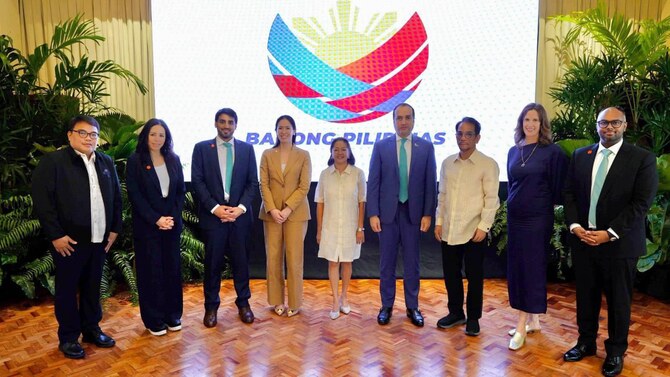
First Lady Liza Marcos welcomes the delegation from Abu Dhabi-based Clean Rivers on Aug. 7, 2024. (Liza Marcos)
Short Url
Updated 13 August 2024
Follow

Philippines seeks UAE organization’s help to clean world’s most polluting river

  • Pasig River emits about 63,000 metric tons of plastic waste annually, study shows
  • President Ferdinand Marcos Jr. is on a campaign to clean, revive the vital waterway

MANILA: Philippine officials are hoping for closer cooperation with an Abu Dhabi-based organization to clear the Pasig waterway — the world’s most polluting river — following a delegation visit from the UAE to Manila last week. 

The Pasig River, which runs through the heart of the Philippine capital, was ranked as the most polluting river out of over 1,600 others around the world in a 2021 study published in the Science Advances journal. 

The Philippines is also the largest contributor of plastic waste that ends up in the world’s oceans, emitting more than 356,000 metric tons annually — around 63,000 of which came from the Pasig River. 

Clean Rivers, a UAE-based nonprofit working on tackling plastic pollution, was in Manila last week to meet officials working on the Pasig River Urban Development project, which was established in 2023 to clear and revive the vital waterway. 

“I think we need more assistance, more help in cleaning the river, because it’s embarrassing,” Michael Gisod, director of the Metropolitan Manila Development Authority, told Arab News. 

“Statistically speaking, we are one of the contributors to the plastic in the open waters … We will be minimizing the trash that goes to the Pacific Ocean, Indian Ocean and it will affect greatly the marine ecosystem … because apparently, our marine resources like the fish are found to have traces of microplastic and we have to address that.” 

Gisod is hopeful of partnering with Clean Rivers to achieve PRUD’s goal, adding that the organization can provide support for Philippine authorities across different aspects. 

“They can provide sewerage treatment plans. They can provide funding for dredging activities. They can provide water technology equipment, they can provide solid waste management activities, maybe soft or hard infrastructure. There’s a lot they can do to help us,” he said. 

The Clean Rivers delegation also met with First Lady Liza Marcos during their trip, as officials gave them a tour of the Pasig River to get an overview of its issues and challenges. 

The visit is a “big boost” to President Ferdinand Marcos Jr.’s ongoing campaign to clean and revive the Pasig River, said Kathryn Yu-Pimentel, special envoy to the UAE for trade and investment. 

“We need to get as many organizations as possible on board to help us in the Pasig River Urban Development. I am hopeful that UAE-based Clean Rivers will help us in this endeavor,” Yu-Pimentel said in a statement. 

She said Clean Rivers has been “instrumental” in initiating and supporting global river rehabilitation projects, as the Philippines also looks to other success stories as inspiration, including the rehabilitation of France’s Seine River and Thailand’s Chao Phraya River. 

“These success stories and the global initiatives led by Clean Rivers are an inspiration to the Marcos administration,” she said. “It gives us hope that even the most polluted rivers can be revived. We have been longing to see the Pasig River thriving once more.”


FGM reports add to scrutiny of Somali community in Minnesota

UN data shows that nearly 98 percent of Somalia’s female population aged between 15 and 49 have undergone FGM. (Getty Images)
Updated 6 sec ago
Follow

FGM reports add to scrutiny of Somali community in Minnesota

CHICAGO: The US state of Minnesota has reportedly seen a rise in instances of female genital mutilation, or FGM, especially among the growing Somali community.

More than 260,000 Somalis live in the US, with nearly 100,000 of them settled in Minnesota. About 50,000 Somalis live in Minnesota’s 5th Congressional District, represented by Somali American Rep. Ilhan Omar.

UN data shows that nearly 98 percent of Somalia’s female population aged between 15 and 49 have undergone the procedure.

The controversy over FGM in Minnesota has only added to the dark cloud of alleged fraud that is hanging over the state’s Somali community. US President Donald Trump made this subject a major part of his State of the Union speech on Tuesday, calling the fraudsters “Somali pirates.”

State and federal investigators have said Somalis in Minnesota have been implicated in the theft of billions of dollars in state and federal funds intended to support childcare, food programs for families and seniors, and healthcare and mental health programs. Officials contend that this has resulted in the loss of up to $9 billion in funding over many years. In his State of the Union speech, however, Trump said the fraud has cost American taxpayers as much as $19 billion.

Muslim leaders are speaking out against the practice of FGM. Imam Kifah Mustapha of the Orland Prayer Center, one of the largest mosques in Illinois, said FGM is not representative of Muslim religious practices and is not required by Islam.

“There is nothing in Islam that says it should be done as an obligation. There’s no such thing,” Mustapha told Arab News.

“It is not something that Islam urges parents or families to do for their children at all. It is not practiced at all in most Muslim countries. It is not something Islam urges people to do or obligates people to do. We know that most Muslim countries now even prohibit it, they don’t allow it anymore.”

Congress first banned FGM on girls under the age of 18 in 1996. However, a 2018 federal court ruling struck down that law as unconstitutional. President Trump toughened the law and signed the Stop FGM Act into law in 2021, imposing a penalty of up to 10 years’ imprisonment for anyone convicted.

Forty-one US states, including Minnesota, have enacted their own laws banning FGM. The nine states that have failed to adopt bans are Alabama, Alaska, Connecticut, Hawaii, Maine, Mississippi, Montana, Nebraska and New Mexico, all states with small Muslim populations.

Minnesota was one of the first states to pass an FGM law in 1994. State Rep. Mary Franson has been fighting ever since to strengthen its enforcement. She recently told the media that cultural secrecy makes FGM “exceptionally difficult to detect” in tight-knit communities.

Somali-born activist Ayaan Hirsi Ali, an author who survived FGM and has spoken out against it, has publicly described the lasting physical and psychological damage that she experienced. Hirsi Ali has called for a strong legal response.

Hirsi Ali was on Sunday quoted as saying: “Female genital mutilation is violence against the most vulnerable — children. It causes infection, incontinence, unbearable pain during childbirth and deep physical and emotional scars that never heal. Religious or cultural practices that deliberately and cruelly harm children must be confronted. No tradition can ever justify torture.”

In 2018, the UN Population Fund released a report showing that nearly 70 million girls will undergo FGM between 2015 and 2030.