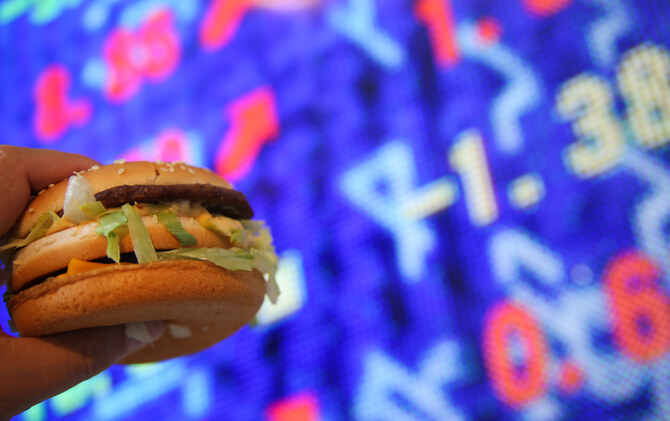

CAIRO: A Big Mac burger costs less on average in Arab countries compared to the US, indicating currency undervaluation in the region.
The latest Big Mac Index reveals that currencies in Saudi Arabia, Egypt, Bahrain, UAE, Lebanon, Jordan, Qatar, Oman, and Kuwait are undervalued when compared to the US dollar, indicating disparities in purchasing power parity across these nations.
The cheapest Big Mac was in Egypt, priced at 120 Egyptian pounds ($2.47), reflecting a 56.6 percent undervaluation of the Egyptian pound against the US dollar.
Conversely, the most expensive Big Mac was in Lebanon, costing 460,000 Lebanese pounds ($5.13), indicating a 9.7 percent undervaluation of the Lebanese pound.

Invented by The Economist in 1986, the index offers a lighthearted measure of currency valuation by applying the economic theory of PPP. This theory suggests that exchange rates should adjust so that a basket of goods and services, including a Big Mac burger, costs the same across different countries when measured in a common currency.
Most other Arab currencies, including the Kuwaiti dinar, Bahraini dinar, and Omani rial, also showed notable undervaluation in July, highlighting ongoing regional economic imbalances.
Here’s how each country fares in currency valuation and purchasing power:
Saudi Arabia
The Big Mac Index for July reveals that the Saudi riyal is 11 percent undervalued against the US dollar, with a Big Mac costing SR19 ($5.06) compared to $5.69 in the US.
The implied exchange rate of SR3.34 per dollar contrasts with the actual market rate of SR3.75, underscoring the currency’s undervaluation. However, after adjusting for gross domestic product per capita, the analysis shows that a Big Mac is 11 percent cheaper in Saudi Arabia, while it should be 12.6 percent cheaper. This suggests the riyal is actually 1.8 percent overvalued when considering local purchasing power.
This represents a slight shift from July 2023, when the riyal was 9.2 percent undervalued based on the Big Mac Index.
At that time, a Big Mac in Saudi Arabia also cost SR19, compared to $5.58 in the US, resulting in an implied exchange rate of 3.41. Adjusting for GDP per capita, the 2023 analysis indicated that a Big Mac was 9.2 percent cheaper in Saudi Arabia, but it should have been 11 percent cheaper, suggesting the riyal was 2 percent overvalued.
This year’s Big Mac Index highlights significant undervaluation across several Arab currencies, continuing a trend observed in the previous year and underscoring ongoing disparities in purchasing power within the region.
UAE
In the UAE, a Big Mac cost 18 dirhams in July, implying an exchange rate of 3.16 UAE dirhams per US dollar. However, the actual exchange rate was 3.67 dirhams per dollar, indicating that the dirham was 13.9 percent undervalued.
When adjusted for GDP per capita, the dirham was still undervalued by 8.4 percent, as a Big Mac cost 11 percent less in the UAE compared to the US.
This represents a slight increase from July 2023, when the dirham was 12.2 percent undervalued with an implied exchange rate of 3.23 dirhams per dollar. At that time, the GDP-adjusted analysis showed the dirham was 7.7 percent undervalued, with the Big Mac priced 12.2 percent less in the UAE.
Bahrain
In Bahrain, a Big Mac was priced at 1.70 dinars in July, implying an exchange rate of 0.30 dinars per US dollar. The actual exchange rate was 0.38 dinars per dollar, indicating a 20.8 percent undervaluation of the Bahraini dinar.
When adjusted for GDP per capita, the dinar remained undervalued by 9 percent, with the Big Mac costing 20.8 percent less than in the US.
This marks a slight increase in undervaluation from July 2023, when the dinar was 19.2 percent undervalued with an implied exchange rate of 0.30 dinars per dollar. At that time, the GDP-adjusted undervaluation was 8.4 percent, with the Big Mac priced 19.2 percent less than in the US.
Kuwait
In Kuwait, a Big Mac was priced at 1.40 dinars in July, implying an exchange rate of 0.25 dinars per US dollar. The actual exchange rate was 0.31 dinars per dollar, suggesting the Kuwaiti dinar was 19.5 percent undervalued.
When adjusted for GDP per capita, the dinar was 9.1 percent undervalued, with the Big Mac costing 19.5 percent less than in the US.
In comparison, July 2023 data indicated the dinar was 18.3 percent undervalued, with an implied exchange rate of 0.25 dinars per dollar. The GDP-adjusted analysis at that time showed the dinar was 10.4 percent undervalued, with the Big Mac priced 18.3 percent less in Kuwait.
Oman
Oman displayed the highest level of undervaluation in July, with a Big Mac priced at 1.53 rials, implying an exchange rate of 0.27 rials per US dollar. The actual exchange rate was 0.39 rials per dollar, indicating a 30.2 percent undervaluation of the Omani rial.
When adjusted for GDP per capita, the rial was 18.6 percent undervalued, with the Big Mac costing 30.2 percent less in Oman compared to the US.
This represents a slight improvement from July 2023, when the rial was 33.9 percent undervalued, with an implied exchange rate of 0.25 rials per dollar. The GDP-adjusted analysis from that year showed the rial was 25.1 percent undervalued, with the Big Mac priced 33.9 percent less in Oman.
Egypt
In Egypt, a Big Mac was priced at 120 Egyptian pounds in July, implying an exchange rate of 21.09 pounds per US dollar. The actual exchange rate was 48.60 pounds per dollar, indicating a 56.6 percent undervaluation of the Egyptian pound.
When adjusted for GDP per capita, the pound was 44.7 percent undervalued, with the Big Mac costing 56.6 percent less in Egypt compared to the US.
This marks a deterioration from July 2023, when the pound was 53.1 percent undervalued, with an implied exchange rate of 14.52 pounds per dollar. At that time, the GDP-adjusted analysis showed the pound was 41.1 percent undervalued, with the Big Mac priced 53.1 percent less in Egypt.
Qatar
In July, the Qatari riyal displayed notable undervaluation, with a Big Mac priced at 14 riyals, implying an exchange rate of 2.46 riyals per US dollar. The actual rate was 3.64 riyals per dollar, indicating a 32.4 percent undervaluation of the riyal.
After adjusting for GDP per capita, the riyal was 38.4 percent undervalued, with the Big Mac costing 32.4 percent less in Qatar compared to the US.
This reflects a slight increase from July 2023, when the riyal was 31.1 percent undervalued, with an implied exchange rate of 2.51 riyals per dollar. The GDP-adjusted analysis from that year suggested the riyal was 38 percent undervalued, with the Big Mac priced 31.1 percent less in Qatar.
Jordan
In Jordan, the Big Mac was priced at 2.50 dinars in July, implying an exchange rate of 0.44 dinars per US dollar compared to the actual rate of 0.71 dinars. This indicates the Jordanian dinar was 38 percent undervalued.
After adjusting for GDP, the dinar was 21.8 percent undervalued, with the Big Mac costing 38 percent less in Jordan than in the US.
This marks a slight increase in undervaluation from July 2023, when the dinar was 36.8 percent undervalued, with an implied exchange rate of 0.45 dinars per dollar. The GDP-adjusted analysis at that time showed the dinar was 21.2 percent undervalued, with the Big Mac priced 36.8 percent less in Jordan.
Lebanon
In July, a Big Mac in Lebanon was priced at 460,000 Lebanese pounds, implying an exchange rate of 80,843.59 pounds per US dollar compared to the actual rate of 89,550.00 pounds. This indicates the Lebanese pound was 9.7 percent undervalued.
In July 2023, the Big Mac cost 430,000 Lebanese pounds, with an implied exchange rate of 77,060.93 pounds per dollar. The actual rate at that time was 85,500 pounds, suggesting the pound was 9.9 percent undervalued.
These figures highlight a persistent undervaluation of the Lebanese pound and other Arab currencies, with consistent disparities between implied and actual exchange rates. Despite slight year-over-year variations, the trend of undervaluation remains stable, reflecting ongoing challenges in currency valuation in the region.