

Pakistan’s deputy PM speaks with Iran, Türkiye after UN rights vote on Tehran

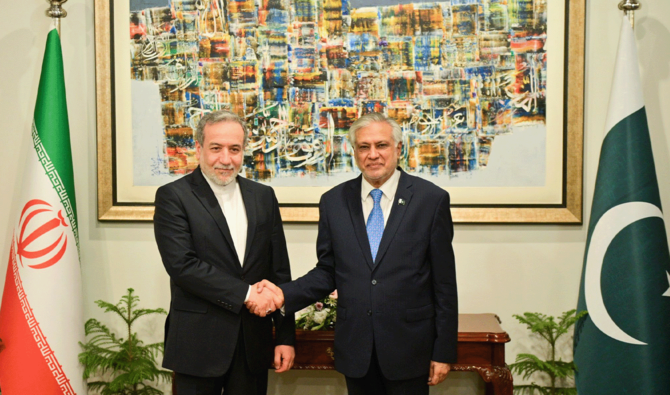
Pakistan’s Foreign Minister, Ishaq Dar (right), shakes hands with Iranian counterpart, Seyed Abbas Araghchi in Islamabad, Pakistan, on May 5, 2025. (@ForeignOfficePk/X/File)
Short Url
Updated 24 January 2026
Follow

Pakistan’s deputy PM speaks with Iran, Türkiye after UN rights vote on Tehran

  • Pakistan voted against UN rights council resolution seeking to expand scrutiny of Iran
  • Dar discusses regional issues with Türkiye’s Hakan Fidan after World Economic Forum

ISLAMABAD: Pakistan’s Deputy Prime Minister Ishaq Dar held separate phone calls on Saturday with the foreign ministers of Iran and Türkiye, highlighting Islamabad’s growing diplomatic engagement on regional crises after backing Tehran at the United Nations Human Rights Council and amid wider discussions on Middle East stability.

Dar, who also serves as Pakistan’s foreign minister, spoke with Iran’s Seyed Abbas Araghchi after Islamabad voted against a resolution at the UN rights council in Geneva that sought to expand international scrutiny of Iran following a crackdown on anti-government protests that began last month and continued for several days.

“Foreign Minister Araghchi thanked DPM / FM for his strong support and Pakistan’s position at the United Nations Human Rights Council in Geneva,” the foreign office said in a statement after the phone call.

While the resolution was adopted, Iran rejected it as “politicized” and described the council’s action as interference in its internal affairs.

Dar later spoke by phone with Türkiye’s Foreign Minister Hakan Fidan, with the two leaders reviewing developments following the World Economic Forum in Davos and agreeing to remain in close contact on key regional and international matters, the foreign office said.

Pakistan and Türkiye have increasingly coordinated diplomatic positions on regional issues, including Middle East tensions, as Islamabad positions itself as an active interlocutor in multilateral forums addressing conflict and humanitarian crises.

Iran’s foreign minister also conveyed appreciation to Pakistan’s prime minister, government and people for what he described as Islamabad’s principled stance, the statement added.


Pakistan Air Force conducts ‘Exercise Golden Eagle’ to test combat readiness, agility

Updated 10 February 2026
Follow

Pakistan Air Force conducts ‘Exercise Golden Eagle’ to test combat readiness, agility

  • The exercise follows an intense, four-day Pakistan-India military conflict in May 2025
  • It focused on AI-enabled operations integrating disruptive technologies, military says

ISLAMABAD: The Pakistan Air Force (PAF) has conducted “Exercise Golden Eagle” that successfully validated its combat readiness and operational agility through synchronized employment of the PAF’s complete combat potential, the Pakistani military said on Tuesday.

It comes months after Pakistan’s four-day military conflict with India in May, with Islamabad claiming victory in the standoff after the PAF claimed to have shot down at least six Indian fighter aircraft, including the French-made Rafale. New Delhi acknowledged some losses but did not specify a number.

The exercise was conducted on a Two-Force construct, focusing on AI-enabled, net-centric operations while integrating indigenous niche, disruptive and smart technologies in line with evolving regional security dynamics, according to the Inter-Services Public Relations (ISPR), the Pakistani military’s media wing.

Operating within a robust Integrated Air Defense System, friendly forces shaped the battlespace through seamless fusion of kinetic operations with cyber, space and electro-magnetic spectrum operations.

“The kinetic phase featured First-Shoot, First-Kill swing-role combat aircraft equipped with long-range BVR air-to-air missiles, extended-range stand-off weapons and precision strike capabilities, supported by Airborne Early Warning & Control platforms and Air-to-Air Refuelers,” the ISPR said in a statement.

“A key highlight of the exercise was Manned–Unmanned Teaming, with deep-reach killer drones and loitering munitions operating in a highly contested, congested and degraded environment, validating PAF’s capability to conduct high-tempo operations in modern warfare.”

In recent months, many countries have stepped up defense engagement with Pakistan, while delegations from multiple nations have proposed learning from the PAF’s multi-domain air warfare capabilities that officials say were successfully employed during the May conflict.

“The successful conduct of Exercise Golden Eagle reaffirms Pakistan Air Force’s unwavering commitment to maintaining a high state of operational preparedness, leveraging indigenous innovation and effectively countering emerging and future security challenges,” the ISPR added.