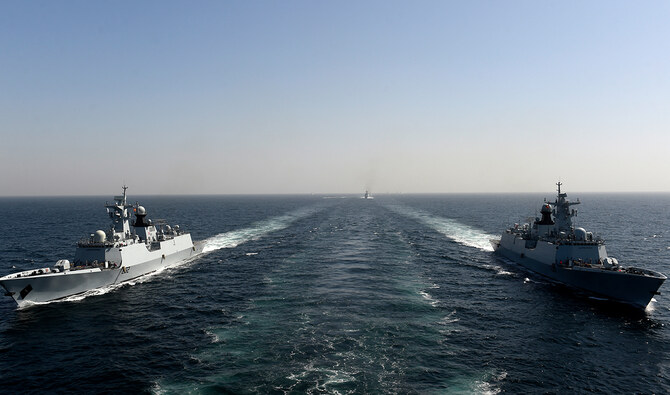
ISLAMABAD: Pakistan Navy on Tuesday held a command and staff conference that reviewed situation in the North Arabian Sea and the Gulf of Aden as well as deliberated upon measures for the safety of trade vessels passing through them, the navy’s media wing said.
The command and staff conference is the apex decision-making body of Pakistan Navy, in which chief of the naval staff along with all principal staff officers and field commanders undertake review of Pakistan Navy’s policies and plans.
Naval Chief Admiral Naveed Ashraf presided over the conference at the Naval Headquarters in Islamabad that reviewed matters relating to geo-strategic milieu, national security, operational preparedness, and training of troops, according to the navy’s director-general public relations (DGPR).
“The forum reviewed maritime situation in North Arabian Sea and Gulf of Aden and deliberated on measures for safety and security of national sea trade passing through the region,” the DGPR said in a statement.
The development comes weeks after Yemen’s Houthi group said they had targeted three ships in the Arabian Sea and Gulf of Aden using missiles and drones.
Houthi militants in Yemen have launched drone and missile attacks on ships in the Red Sea, Bab Al-Mandab Strait and Gulf of Aden since November. They say they are acting in solidarity with Palestinians over the war in Gaza.
The command and staff conference of Pakistan Navy was also briefed by officials on important ongoing and future developmental projects, according to the statement. The naval chief expressed confidence over combat readiness and significant contribution of the navy in maritime domain.
“Chief of the Naval Staff emphasized on strengthening maritime security and maintaining combat readiness so as to effectively respond to any aggression against Pakistan,” it read.
“He urged on acquisition of niche and novel capabilities while exploiting indigenous sources in order to cope with modern day challenges in maritime domain.”
Last week, Pakistan Navy warship PNS Yarmook conducted bilateral exercises with navies of allied countries as part of a Regional Maritime Security Patrol (RMSP) deployment in Bahrain aimed at enhancing naval coordination and the capability of joint operations in the region.
In July, Pakistan Navy also assumed command of a multinational task force responsible for ensuring maritime security in the southeastern waters of the Middle East, operating in the Arabian Sea, Gulf of Oman and Gulf of Aden.


Pakistan Navy reviews situation in North Arabian Sea and Gulf of Aden, safety of trade vessels
https://arab.news/4m3t4
Pakistan Navy reviews situation in North Arabian Sea and Gulf of Aden, safety of trade vessels

- The development comes weeks after Yemen’s Houthi group said they had targeted three ships in the Arabian Sea and the Gulf of Aden
- In July, Pakistan Navy assumed command of a multinational task force responsible for ensuring maritime security in regional waters

Pakistan says inflation to remain within 5-6 percent range in January
- Current account projected to remain in deficit, says Finance Division in monthly economic outlook
- Pakistan suffered a financial crisis in 2023, marked by inflation of 38 percent, depleted forex reserves
KARACHI: Inflation is expected to remain within the 5-6 percent range in January, Pakistan’s Finance Division said in its monthly economic outlook report on Tuesday, saying that the country’s economy is well positioned to sustain growth momentum in FY2026.
Consumer Price Index (CPI) inflation was recorded at 5.6 percent year-on-year (YoY) basis in December 2025 as compared to 6.1 percent in November 2025 and 4.1 percent in December 2024.
“Inflation is expected to remain within the range of 5.0-6.0 percent in January,” the Finance Division said.
“On the external front, the current account is projected to remain in a deficit; however, robust remittance inflows and steady performance in IT and services exports are likely to cushion external pressures.”
The report said that the “positive trajectory” of the economy reflects the impact of the government’s prudent policies, ongoing structural reforms and easing of monetary conditions due to subsiding inflationary pressures.
Earlier, Pakistan’s finance ministry adviser Khurram Schehzad said S&P Global Market Intelligence’s latest macroeconomic forecast for Pakistan broadly aligns with projections issued by the State Bank of Pakistan, signaling easing inflation, manageable external balances and a gradual recovery in economic growth.
The assessment came amid stabilizing macroeconomic indicators after Pakistan went through a prolonged financial crisis marked by record inflation of 38 percent, depleted foreign exchange reserves and repeated balance-of-payments pressures, culminating in emergency support from the International Monetary Fund.
Tighter monetary policy, fiscal consolidation and external financing have since helped stabilize prices and ease pressure on the external account, prompting more measured assessments from international credit rating agencies.
“S&P’s projections broadly align with SBP’s outlook, with slight differences on growth and the current account but a shared assessment of easing inflation and gradual economic improvement,” Schehzad said in a statement.
According to S&P, inflation is expected to average 5.1 percent in 2026 and edge up slightly to 5.6 percent in 2027, staying within the SBP’s projected range of 5 percent to 7 percent over the next two years.
On the external front, S&P forecast a current account deficit of 0.5 percent of gross domestic product in 2026, broadly in line with the central bank’s expectation that the deficit will remain between 0 percent and 1 percent of GDP in the fiscal year.
Economic growth is projected to strengthen gradually, with S&P forecasting real GDP growth of 3.5 percent in fiscal year 2026, rising to 4.4 percent the following year. The SBP has projected growth of 3.75 percent to 4.75 percent for FY26.
Both S&P and SBP projections echo the government’s assessment that macroeconomic conditions are stabilizing, as Pakistan seeks to attract foreign investment and push toward export-led growth.


