

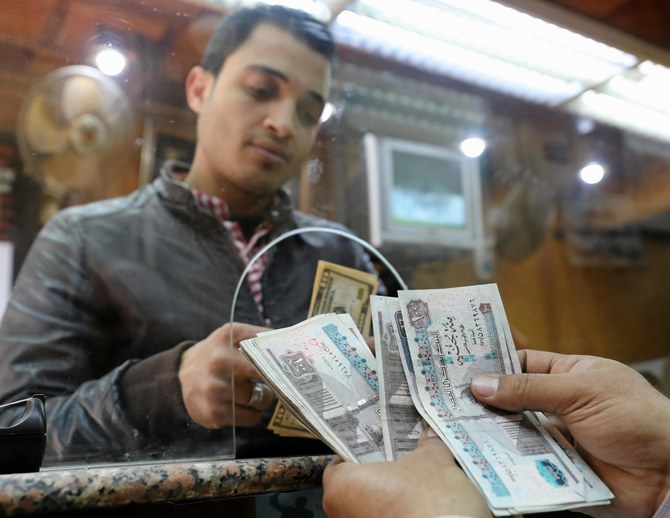
Egypt’s currency edges higher against greenback

According to the IMF, recent efforts by Egyptian authorities to restore macroeconomic stability are showing signs of progress. Reuters/File
Short Url
Updated 07 August 2024
Follow

Egypt’s currency edges higher against greenback

  • Egyptian pound approached critical threshold of 50 per US dollar

RIYADH: The Egyptian pound is approaching a critical threshold of 50 per US dollar, as indicated by recent figures from the Central Bank, which currently value the pound at 49.16 per dollar.

This development follows recent increases in subway fares and fuel prices. Throughout June and July, the pound fluctuated between 47 and 48 to the dollar, after a dramatic depreciation in March when it had lost roughly 60 percent of its value, dropping to about 30 pounds per dollar.

Economist Mahmoud Khairy, in an interview with Arab News, highlighted that this surge in the pound’s value has both positive and negative consequences.

On the negative side, Khairy said that continued increases could lead to another wave of imported inflation, adversely affecting domestic demand and business output. The lack of stability in the foreign exchange market could also create uncertainty for firms and consumers, impeding their ability to make informed decisions.

Khairy added that a rising pound might signal to the market and the International Monetary Fund that Egypt’s foreign exchange market is fully free-floating, with no imposed ceilings or intervention from the Central Bank of Egypt. This could lead to a successful IMF review and encourage foreign portfolio investments.

These developments come in the wake of the IMF’s approval of approximately $820 million in funding for Egypt, following the completion of the third review of the country’s extended arrangement.

The IMF had earlier approved an expanded $8 billion support program for Egypt, which had been hit hard by the Gaza crisis. The crisis had negatively affected tourism and caused a significant decline in Suez Canal revenue due to disruptions in Red Sea shipping.

According to the IMF, recent efforts by Egyptian authorities to restore macroeconomic stability are showing signs of progress, though inflation remains high.

The IMF said that inflation is coming down but remains elevated, and emphasized that a flexible exchange rate is a key component of Egypt’s economic reform program.

An IMF official mentioned in a video press conference that Egypt would undergo a fourth review from mid-September to December 2024, with the possibility of receiving an additional $1.3 billion if successful. Inflation is projected to fall below 15 percent by the end of June.

Egyptians have been struggling with high inflation rates, although a recent decrease in food prices has led to an annual consumer price inflation rate of 27.1 percent in June 2024, a slight decrease from 27.4 percent the previous month.

The Central Agency for Public Mobilization and Statistics reported that the general consumer price index for June 2024 stood at 225.6 points, following a significant interest rate hike by the central bank in early March and a shift to an inflation-targeting regime that allows market forces to determine the exchange rate.

Cairo’s subway fares officially increased last week, now ranging from 2 to 5 Egyptian pounds. These price hikes are part of broader measures deemed necessary to fulfill the IMF’s conditions for further financial assistance, following Egypt’s agreement to expand its bailout package to $8 billion earlier this spring.


As world fractures, experts weigh in on the politics of AI at WGS

Updated 26 sec ago
Follow

As world fractures, experts weigh in on the politics of AI at WGS

  • e& group CEO Hatem Dowidar said there was increasing pressure to choose between the Chinese and US ecosystems

DUBAI: Across three days of rigorous debate at the World Government Summit in Dubai, experts from some of the world’s largest tech and telecommunication companies debated what the future political landscape of artificial intelligence development would be.

Speaking at the summit on Thursday, e& group CEO Hatem Dowidar said there was increasing pressure to choose between the Chinese and US ecosystems, which could have impacts on the sovereign capabilities of countries, like Gulf Cooperation Council member states, which thus far have stayed in the middle.

“I think the fracture and the pressure today is if you use this technology, you cannot use the other. You must separate them completely and this is something that never happened before,” Dowidar said.

He warned that whilst people around the world currently have access to both the leading large language models in the US and China, ChatGPT and Deepseek, this would not always be the case, and middle powers would need to develop their own capability to maintain their sovereignty.

“Europe is trying to find its own way as well, because Europe — having been caught now in the middle — they don’t have platforms, they don’t have the data center capability,” he said.

“So now, Europe is focusing a lot on building sovereign capability, sovereign data centers to run AI applications within Europe.”

Dowidar said the GCC had been ahead of the curve in this regard, having worked out early on that sovereign capability would be necessary in the new multipolar world and subsequently investing heavily in local infrastructure and capability.

“We were lucky here in the region that already — I would say a couple of years ago —we have kind of ironed out how this works,” he said.

“I think that everyone will try to see how they can either utilize the global platforms in a sovereign manner, or they end up trying to push to develop their own platforms.” 

This sentiment was echoed by Chamath Palihapitiya, the founder and managing partner of Social Capital, who said that China’s dedication to open-source models — whose code is released under a license granting users rights to view, study, modify, and redistribute it freely — could make Chinese AI more popular in the long run for nations looking to keep some level of sovereignty.

“I do think that there are a handful of American open-source models that are quite good. I think Nvidia’s models are excellent. But in fairness, the Chinese open-source models are just superb,” he told the summit on Wednesday.

“It’s going to be important for every country to make their own decisions about their own sovereignty, and in that realm, I think the open-source models provide the clearest path, because it just gives you total transparency to what’s happening underneath the hood.”

This was reiterated by Joseph Tsai, the chairman and co-founder of Alibaba Group, who said Chinese open-source systems would be favored by middle powers — but warned they had yet to find a way to be economically self-sufficient. 

“Because countries care about the sovereignty aspect and care about their data privacy, you can take an open-source model and deploy it on your own infrastructure … giving you ownership and control” he said.

“But it remains to be seen how economically all the model companies are going to make it sort of sustainable with an open-source approach … This is the biggest challenge for the Chinese firms.”