

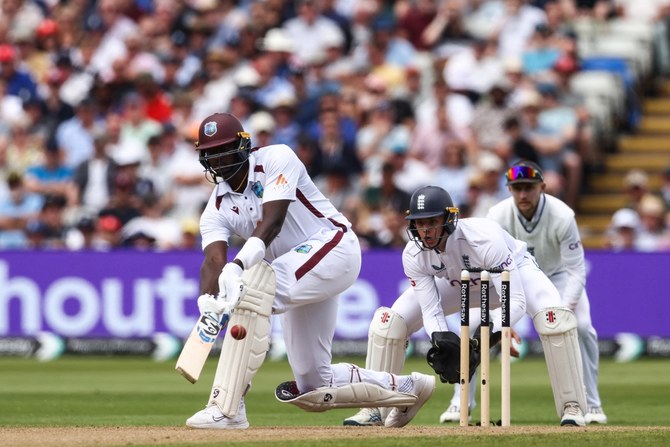

Devotees of Test-match cricket live in troubled times. Despite July having a thrilling match between Ireland and Zimbabwe in Belfast and a three-match series between England and the West Indies, the matches raised serious questions about the sustainability of the format. These questions are not new but are being observed in sharper relief.
It is the norm to allot five days for men’s Test matches. The one in Belfast lasted until a third of the way into the fourth day. The first one in England was concluded in slightly over two days, the second one at the end of the fourth day, and the third one by teatime on the third day.
A Test match is costly to put on and relies on not just broadcasting and sponsorship revenues but also on income from ticket sales, hospitality and in-ground sales of drinks and food. Tests which finish on day two or three mean less exposure for advertisers and sponsors, lower in-ground sales and, depending on when the match finishes, refunding of ticket income to buyers.
The reasons why the matches did not go the full distance reflect several judgmental but reasonably arguable factors. In the case of England and the West Indies, it is obvious that the latter team were inexperienced both in Test cricket and English conditions, shorn of their best players who chose to play franchise cricket. They were also under-prepared, some players arriving late from the Caribbean because of flights delayed by Hurricane Beryl.
These factors coalesced to produce a tepid performance in the first Test. Much improvement came in the second, marked by several outstanding batting achievements in the first innings that dissipated in the second.
Fighting spirit was evident in the third match, to the point where England were on the rack, only to be let off by a failure to review a decision against masterful batter, Joe Root, now seventh in the all-time list of Test match run scorers. England turned the screw and claimed victory on the third afternoon in merciless fashion. Requiring 84 to win, the target was reached in a mere 7.2 overs.
If the England team were keen to return home early, the spectators were probably not, having been deprived of a full day’s play. No doubt, the players would argue that they provided the spectators with entertainment.
In Belfast, rich entertainment was provided in a match which ebbed and flowed in the true spirit of Test cricket. Both teams suffered batting collapses at critical times, Zimbabwe’s lower order proving to be especially inept.
By contrast, Ireland’s top order collapsed in the fourth and final innings. Chasing 158 for victory, they were reduced to 21 for five. The following morning, Ireland’s batters took advantage of more favorable batting conditions to achieve a memorable victory, their second in a row out of nine played.
All 12 International Cricket Council full members have a remit to play Test cricket. It is something to which new and potential full members aspire and it remains at the pinnacle of cricket for many players and spectators alike.
However, the bonds are weakening. The World Cricketers Association conducts regular surveys amongst a sample of players. A recent survey reveals that, in the past five years, there has been a sharp increase in the proportion, especially amongst young players, who consider the T20 World Cup to be the most important ICC event.
In 2019, 85 percent of respondents ranked the 50-over World Cup as the most important ICC event, compared to 15 percent who chose the T20 World Cup. In 2024, the importance given to the ODI World Cup had fallen to 50 percent, compared with 35 percent who chose the T20 World Cup. The balance of 15 percent voted for the World Test Championship.
A sharp fall in the importance given to Test cricket also surfaced. Five years ago, 82 percent of survey respondents viewed the format as the most important one, whilst 11 percent chose T20. This year, only 48 percent of players chose Test cricket compared to 30 percent who chose T20.
A note of caution should be introduced. The surveys exclude players from India, Pakistan and Afghanistan, for whom unions do not exist. Nevertheless, the results do seem to be a fair reflection of the trends in professional cricket that are intuitively felt and have been observed in the recent England versus West Indies series.
This was not an isolated instance. Cricket South Africa sent a much-weakened side to New Zealand in January as their top players were involved in the African nation’s T20 franchise competition.
More hand-wringing can be expected if England’s series against Sri Lanka in September is one-sided. Not that England should be complacent. Their own performances in recent Test series away from home against India and Australia were marked by heavy defeats.
The relative strengths and weaknesses of Test-playing countries have always ebbed and flowed. Match durations have always varied accordingly, along with pitch and weather conditions.
Since 2000, 42 percent of Tests have gone into the fifth day and 39 percent into the fourth day. Perhaps the furor over the recent early finishes is overblown, more an outcome of the way that Test cricket is played, especially by England.
A more balanced approach would be to look at the reasons for what seems to be a growing financial and playing disparity between Test-playing countries. Apart from losing players to the lucrative T20 franchises, there is the escalating cost to national boards of hosting and preparing players for Test matches. Under the existing ICC financial model, host boards keep all revenues earned from a series.
The CEO of the England and Wales Cricket Board has said that the richer boards have a responsibility to help the poorer ones remain competitive. An example of this will be when Zimbabwe travel to England in 2025 for a one-off Test, when the ECB will pay a “touring fee.” It remains to be seen if the boards of India and Australia follow suit.
In a sport in which collective actions are not high-profile, devotees are hoping for an outbreak of collective responsibility.


